August 18, 2026: Top International, National, Regional and Thunder Bay News to Know
THUNDER BAY — A worsening Middle East confrontation, a critical Canada-U.S. tariff deadline and Northwestern Ontario’s continuing wildfire emergency are leading the news agenda for Tuesday, Aug. 18, 2026.
For Thunder Bay and Northwestern Ontario, these stories are not distant headlines. Energy prices affect transportation and resource industries, U.S. trade policy can quickly reach manufacturers and exporters on both sides of the border, and the wildfire situation continues to affect First Nations, remote communities, aviation and emergency services across the Northwest.
Here is what NetNewsLedger NewsHawks should be watching today.
The NewsHawk Morning Brief — Tuesday, Aug. 18
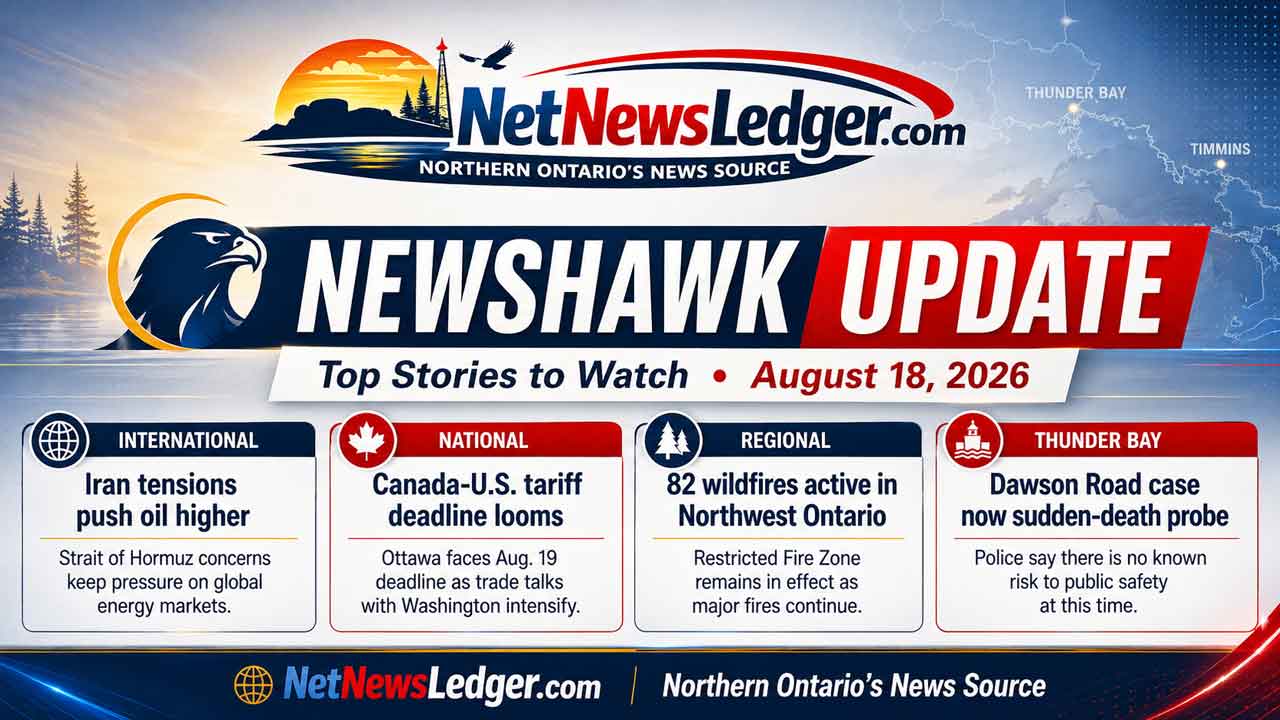
INTERNATIONAL — Iran conflict pushes oil higher as hopes for an agreement fade
The most consequential international story for Northwestern Ontario this morning is the continuing conflict involving the United States, Israel and Iran.
Oil prices climbed for a third consecutive session Tuesday, with Brent crude trading around US$91 a barrel and West Texas Intermediate around US$85 as hopes faded for a quick agreement to end the confrontation. Iran has said the Strait of Hormuz will remain closed until Washington meets conditions associated with an interim agreement, while a senior Iranian official has said Tehran is shifting toward a more offensive military posture.
The Strait of Hormuz is one of the world’s most important oil transportation routes. Continued restrictions or further military escalation could keep pressure on global crude and refined fuel markets.
Why it matters in Northwestern Ontario: The immediate issue to watch is energy cost pressure. Northern communities depend heavily on trucking, aviation and long-distance transportation. Forestry, mining, construction and exploration operations are also fuel-intensive. If elevated global crude prices persist, they could eventually translate into higher transportation and operating costs across the region.
That does not mean a specific increase at Thunder Bay gas stations can be predicted from Tuesday’s oil move alone. Retail fuel prices depend on several additional factors, including refining margins, currency movements, taxes and regional supply.
INTERNATIONAL — Ukraine war raises NATO concerns after drone incident
Russia’s war against Ukraine also remains a significant international security story.
Russia recently launched another wave of strikes against Ukraine, including an attack on a major steel operation in Kryvyi Rih. Ukraine, meanwhile, launched a large drone attack on the Moscow region.
Of particular importance to NATO countries, including Canada, a Spanish F-18 operating as part of a NATO air-policing mission shot down a drone after it entered Romanian airspace. NATO said the drone appeared to be Russian.
Russia also warned Britain Tuesday of unspecified consequences over British-supplied drones being used by Ukraine against targets inside Russia. Britain says it remains committed to providing Ukraine with equipment needed for its defence.
For Canada, the wider concern is the possibility of the war increasingly touching NATO territory. Any sustained escalation also has implications for defence spending, commodity markets, fertilizer, grain and international shipping.
INTERNATIONAL — Gaza diplomacy produces another possible opening
There is also a new diplomatic development surrounding Gaza, although details remain limited.
A Board of Peace official said U.S. President Donald Trump’s envoy Jared Kushner and Israeli Prime Minister Benjamin Netanyahu reached agreement Monday on a proposed “path forward” for Gaza following talks. Reuters reported that few details of that framework were immediately made public.
That makes this a watch story rather than a confirmed breakthrough.
For NewsHawks, the key question is whether the discussions produce measurable changes on the ground, including humanitarian access, security arrangements and movement toward a durable political settlement.
NATIONAL — Canada faces Wednesday deadline for new 50 per cent U.S. tariffs
For Canadians, the biggest immediate story is likely the countdown to Wednesday, Aug. 19.
U.S. President Donald Trump has threatened tariffs of up to 50 per cent on nearly $20 billion worth of Canadian goods. Products identified by Reuters include wine, furniture, dairy products, cement, clothing, fishing rods and hockey equipment.
Unlike many earlier trade measures, the new duties are expected to reach some Canadian products that would otherwise receive preferential treatment under the Canada-U.S.-Mexico trade agreement.
Prime Minister Mark Carney said Monday that negotiations with Washington were intense and delicate and that he expected to speak with Trump before the deadline. Canadian and American officials have been holding repeated discussions.
Why Thunder Bay should care: Northwestern Ontario sits directly on the Canada-U.S. economic corridor.
Thunder Bay businesses depend on cross-border customers and suppliers, while forestry products, manufactured goods, machinery, food and other commodities move through regional highway, rail and Great Lakes transportation networks.
Even where a Northwestern Ontario product is not directly covered by the new tariff list, prolonged trade uncertainty can influence investment decisions, supply chains and business confidence.
NATIONAL — Auto tariffs emerge as a key part of Canada-U.S. negotiations
There may still be room for movement in the trade talks.
Canadian and U.S. negotiators have been discussing a possible reduction in American tariffs on Canadian-built vehicles from the current 25 per cent level to 15 per cent, subject to rules governing how North American content is calculated.
The disagreement is important. Washington has favoured deductions based on U.S. content, while Canada has pushed for recognition of broader North American content, including parts from Canada and Mexico.
This matters well beyond southern Ontario’s auto plants. The auto dispute is part of a much larger argument over whether North America will continue operating as a highly integrated manufacturing and trading region.
For Northwestern Ontario, the outcome could eventually affect freight movements, industrial investment and the economic relationship with neighbouring Minnesota and the wider U.S. Midwest.
NATIONAL — Canada’s pipeline ambitions collide with questions about future oil production
Canada is also debating how much new energy transportation capacity it needs.
Reuters reports that at least six pipeline expansions or proposals could collectively increase Canadian oil export capacity by about 45 per cent, or 2.25 million barrels per day, by 2035. The challenge is that producers have not committed to increasing oil sands production at the pace needed to fill all that capacity.
The debate is increasingly connected to Ottawa’s goal of strengthening Canada’s economy against international trade and geopolitical shocks.
For Northern Ontario, the broader issue is familiar: major resource development depends on transportation infrastructure, predictable regulation, Indigenous consultation and investment certainty.
Those same questions apply to critical minerals, electricity transmission and all-season transportation infrastructure needed to develop northern resources.
REGIONAL — 82 wildfires remain active across Northwestern Ontario
The wildfire emergency remains Northwestern Ontario’s dominant regional story.
Ontario’s Aviation, Forest Fire and Emergency Services reported 82 active wildland fires in the Northwest Region as of Monday evening. Seven were not under control, three were being held, 11 were under control and 61 were being observed. No new fires had been confirmed in the region by the evening of Aug. 17.
The huge Rinker Lake Complex continues to demand substantial resources. The complex includes Thunder Bay 36, Dryden 34 and Dryden 35.
Thunder Bay 36 alone was listed at more than 301,000 hectares and remained not under control in the province’s Aug. 17 update. Hundreds of personnel and multiple helicopters have been committed to the Rinker Lake operation.
The Atikokan area also remains an important focus, including Fort Frances 13, Fort Frances 14 and Fort Frances 15.
A Restricted Fire Zone remains in place in the Northwest Region, reflecting the continuing fire load and the need to prevent additional human-caused fires.
REGIONAL — Wildfire recovery will last longer than the flames
Lower fire behaviour following rainfall is encouraging, but the regional emergency cannot be measured solely by the number of flames visible on a particular day.
Wildfires have affected remote First Nations, transportation access, aviation, emergency services and host communities. Thunder Bay has been among the communities preparing to support people displaced by fires, and the city says wildfires remain active while some communities continue under evacuation orders or alerts.
The longer-term questions include when evacuees can safely return, what condition communities and infrastructure will be in when they do, and how governments will approach rebuilding and wildfire resilience.
For Indigenous communities in the Far North, those questions also involve reliable emergency transportation, housing, power, communications and the ability to respond to increasingly severe wildfire seasons without repeated large-scale displacement.
LOCAL — Dawson Road assault investigation becomes sudden-death investigation
Thunder Bay Police Service has updated an investigation involving a woman found injured on Dawson Road.
Police say officers responded to the 1000 block of Dawson Road during the afternoon of Saturday, Aug. 15. A woman was found and transported to hospital with injuries.
The Major Crime Unit became involved, and police announced Tuesday that the matter is now being investigated as a sudden death.
Investigators say they do not believe there is a risk to public safety at this time.
Police have not released the woman’s identity or additional information about the circumstances of the death. No charges have been announced.
This is an evolving investigation, and NetNewsLedger will update the story as confirmed information becomes available.
LOCAL — Pleasant August weather, but keep watching wildfire conditions
Thunder Bay begins Tuesday with relatively comfortable summer weather.
The forecast calls for a mix of sun and cloud with a high around 24 C, followed by a cooler overnight low near 9 C. Wednesday is expected to reach about 22 C.
The pleasant weather in the city should not be taken as an indication that the Northwest wildfire emergency is over. Fire conditions vary greatly across the region, and restrictions remain in effect.
What NewsHawks should watch through Tuesday
The Canada-U.S. trade negotiations are the story most likely to produce a major Canadian breaking-news development over the next 24 hours. The tariff deadline is Wednesday, Aug. 19, and either an agreement, an extension or the implementation of new tariffs would have immediate national consequences.
Internationally, watch the Strait of Hormuz. Any significant change in shipping access or further escalation between Iran and the United States could move energy markets quickly.
Across Northwestern Ontario, watch for new information on evacuation orders, community returns, the Restricted Fire Zone and the status of Thunder Bay 36 and other major fires.
In Thunder Bay, the Dawson Road sudden-death investigation is the key developing local police story Tuesday morning.
For NNL NewsHawks, the connecting theme on Aug. 18 is uncertainty: uncertain trade access, uncertain energy markets and a wildfire emergency that has improved in some areas but remains far from finished.