THUNDER BAY — Rainfall across parts of Northwestern Ontario helped reduce fire behaviour Tuesday, Aug. 4, allowing crews to make progress on several major wildfires. However, 113 wildland fires remained active across the Northwest Region as of 7:40 p.m. CDT, including 17 fires that were not under control.
Two new fires were confirmed during the day, while evacuation orders, alerts, aviation restrictions and a region-wide Restricted Fire Zone remained in effect.
Two New Wildfires Confirmed
Fort Frances 59 was discovered west of Quetico Provincial Park, between Vie Lake and Wisa Lake. The fire was declared out at 0.2 hectares.
Thunder Bay 74 is burning near the north side of Weikwabinonaw Lake, about six kilometres east of Titmarsh Road. The 0.1-hectare fire is being held.
A fire classified as being held is not expected to spread beyond existing or predetermined control boundaries under current and forecast conditions, given the suppression resources assigned.
Of the 113 active fires in the Northwest Region, 17 were not under control, nine were being held, three were under control and 84 were being observed.
Rinker Lake Complex
Firefighters reported lower fire behaviour across the Rinker Lake Complex after overnight precipitation.
The complex includes Thunder Bay 36, Dryden 34 and Dryden 35.
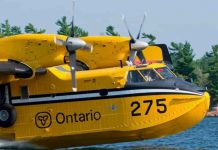
Fifteen firefighting crews from Ontario and Alberta are assigned to the complex, along with two 20-person crews from Mexico. Heavy-equipment operators, pilots, support personnel from Ontario and Quebec, and an incident management team are also assisting.
Crews are patrolling for hotspots, extinguishing remaining heat, consolidating hose lines and installing or maintaining protection equipment around buildings and other values at risk.
Helipads are also being constructed to improve access and support the movement of personnel and equipment into more remote sections of the fire area.
Heavy-equipment operators continue to build fireguards along portions of the Thunder Bay 36 and Dryden 35 perimeters.
Thunder Bay 36 is estimated at 306,335 hectares and remains not under control.
Dryden 34 is estimated at 46,277 hectares and remains not under control.
Dryden 35 is estimated at 31,510 hectares and remains not under control.
<H3>Atikokan Fire Cluster</H3>
Between 14 and 30 millimetres of rain fell across the Atikokan fire areas overnight.
Aviation, Forest Fire and Emergency Services expects the rainfall to help maintain lower fire behaviour over the next several days.
Infrared scanning continues along fire perimeters, providing ground crews with locations where heat remains below the surface or in burning material.
Incoming crews are joining suppression operations as other firefighters complete their two-week assignments.
Fort Frances 13 is estimated at 25,279 hectares and remains not under control.
Fort Frances 14 is estimated at 51,768 hectares and remains not under control.
Fort Frances 15 is estimated at 42,273 hectares and remains not under control.
<H3>Dryden 36 Near Moosehide Lakes</H3>
Dryden 36, near Upper and Lower Moosehide lakes, is being held at 1,710 hectares.
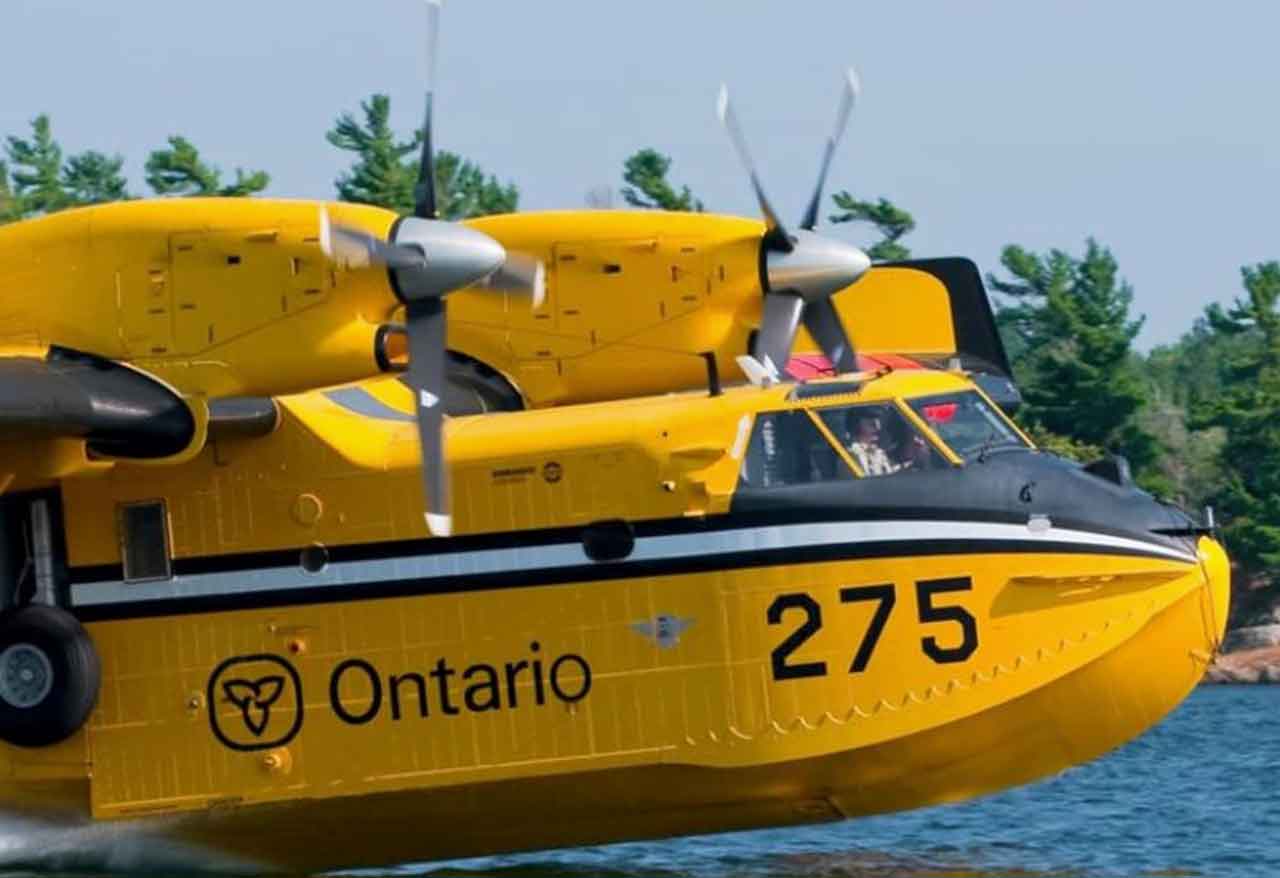
Ontario FireRangers, Type 2 crews and firefighters from Mexico continue ground suppression operations with support from helicopters carrying water buckets.
Low fire behaviour has been observed in recent days under more favourable weather conditions.
Highway 599 Fire Cluster
The Alberta incident management team overseeing the Highway 599 cluster has begun transferring operations back to the Sioux Lookout Fire Management Headquarters.
There are 118 personnel assigned to the incident, supported by five helicopters.
Firefighters are using pumps, hoses and hand tools to extinguish remaining heat across Sioux Lookout 84, Sioux Lookout 86 and Sioux Lookout 89.
Helicopter bucketing was not required Tuesday because of recent rainfall. No recent fire growth has been observed within the cluster.
Only minimal hotspots were reported on Sioux Lookout 84 and Sioux Lookout 86. Both fires have been reclassified as being held.
Sioux Lookout 84 is estimated at 4,796.6 hectares and is being held.
Sioux Lookout 86 is estimated at 5,644 hectares and is being held.
Sioux Lookout 89 is estimated at 7,190.1 hectares and remains not under control.
The province said this would be the final scheduled update for the Highway 599 cluster following the improved fire status.
Evacuation Orders and Alerts Remain in Effect
Evacuation orders remain connected to Dryden 36; Thunder Bay 36, 54 and 56; Dryden 34 and 35; and Fort Frances 14.
An expanded evacuation alert remains in place for Fort Frances 14.
An evacuation alert also remains connected to Fort Frances 15 and Fort Frances 38.
Residents in affected communities should continue following instructions from their First Nation leadership, municipality, emergency management officials and provincial authorities. Conditions and evacuation information may change as fire behaviour, weather and access routes are reassessed.
Aviation Restrictions Near Active Fires
Notices to Airmen remain in effect around Thunder Bay 36 and Fort Frances 14, northeast of Byers Lake.
These notices are in addition to the standard restrictions around active wildfires under Section 601.15 of the Canadian Aviation Regulations.
Airspace within five nautical miles of an active forest fire and up to 3,000 feet above ground level is restricted to aircraft involved in fire suppression.
Unauthorized aircraft, including drones, can force water bombers and helicopters to leave an area, delaying suppression operations and placing crews at risk.
Pilots are advised to check NAV Canada’s Collaborative Flight Planning Services for current wildfire-related notices before flying.
Restricted Fire Zone Continues
A Restricted Fire Zone remains in effect across the Northwest Region and a small portion of the Northeast Region.
The restriction took effect July 15 because of high to extreme fire hazard, increased wildfire activity, the number of active fires and the need to reduce preventable human-caused fires.
Open fires are prohibited within the Restricted Fire Zone unless specifically authorized. Residents, campers and visitors should check provincial rules before using any outdoor flame-producing equipment.
Recent rainfall may reduce fire behaviour in some locations, but it does not automatically end the Restricted Fire Zone or eliminate the risk of new fires.
Regional Implications
The reduction in fire behaviour is positive for crews working on the Rinker Lake, Atikokan and Highway 599 fires. However, the size and remote locations of several fires mean suppression and monitoring operations will continue.
Wildfire activity can affect northern aviation, forestry operations, mining exploration, tourism, highway travel and access to remote First Nations.
Smoke conditions may also change quickly depending on wind direction. Residents with respiratory or cardiovascular conditions, older adults, pregnant people and young children may be more affected when wildfire smoke moves into populated areas.
How to Report a Wildfire
To report a wildland fire north of the French and Mattawa rivers, call 310-FIRE, or 310-3473.
Wildfires south of the French or Mattawa rivers should be reported by calling 911.
The provincial fire situation, fire danger ratings, restrictions and evacuation information are available through Ontario’s online forest fire information services.