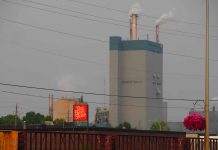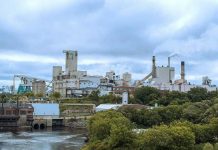
THUNDER BAY – NEWS – Kap Paper will start an “orderly idling” of its Kapuskasing mill, citing a lack of near-term support to keep the integrated forestry supply chain running. NOMA urges Ottawa and Queen’s Park to act together now as global demand for newsprint and catalogue grades keeps shrinking.
Conservative MPP and Minister Kevin Holland states, “Our government cannot indefinitely provide this assistance without the active support and engagement of the federal government.”
The decision: “A heartbreaking day” for Kap and the North
Today Kap Paper says it will begin an orderly idling of its Kapuskasing facility after months—and years—of talks that failed to produce immediate relief.
“This is a heartbreaking day for our people and the community,” CEO Terry Skiffington said, adding that while longer-term federal support may be possible, timing “doesn’t appear to be aligning for an immediate solution.”
At the Province’s urging, the company sought a Strategic Response Fund solution from Ottawa but says it does not have the resources to continue operating until that support materializes. The mill will wind down in phases to protect workers and the environment, and employees are expected to access federal income supports. The company pledged continued engagement with unions, municipal leaders, and Indigenous partners during the transition.
Ontario has provided $50 million in loans over the past two years, which Kap Paper credits with keeping 2,500 workers employed across the supply chain.
NOMA: “Act together, now”
The Northwestern Ontario Municipal Association (NOMA) called on the Prime Minister and Premier to deliver emergency, coordinated support to keep the mill operating. NOMA warns the idling will ripple well beyond Kapuskasing into Hearst and other northern communities whose local mills depend on Kap Paper to process and receive wood residue—a linchpin in the region’s integrated system.
“Thousands of workers, families, and businesses depend on Kap Paper,” said NOMA President Rick Dumas, urging both governments to move “without delay.”
Province to workers: supports activated; Ottawa urged to match
Ontario’s Minister of Natural Resources Mike Harris and Associate Minister of Forestry and Forest Products Kevin Holland say the province has repeatedly “stepped up,” but cannot indefinitely shoulder operating support without federal participation. Provincial programs mobilized include:
-
POWER Centres (wrap-around support in closure communities)
-
Better Jobs Ontario (tuition, retraining, living supports)
-
Skills Development Fund (northern training investments)
-
Employment Standards & Income Supports (ESA termination/severance guidance; Ontario Works)
-
Employment Ontario (local delivery via Collège Boréal)
Ontario also points to sectoral investments (Forest Sector Investment and Innovation Program, Forest Biomass Program, Forest Access Roads funding, mass timber research and training, and Northern Energy Advantage electricity relief) and reiterates calls for immediate federal action.
Why this matters to Thunder Bay and Northwestern Ontario
Thunder Bay is a regional hub for trucking, maintenance, training, and engineering and has a long history in the forest sector. Business in the city service and support mills from the James Bay lowlands through Highway 11/17.
While the closure of a mill in Kapuskasing might seem distant, it is also perhaps yet another sign of changing technology and its impact on some traditional industries.
The integrated model means:
-
Residue flow risk: If Kap doesn’t take chips, bark, and sawdust from sawmills (e.g., in Hearst), those mills face higher disposal costs or curtailed runs, jeopardizing logging contractors and transport firms that operate across Northwestern Ontario.
-
Employment shock: The 2,500 jobs Kap Paper cites include forest harvest, hauling, trades, and services—roles that Thunder Bay-area families also depend on during seasonal swings.
-
Training and redeployment: With POWER Centres and Better Jobs Ontario activated, Confederation College, local unions, and Employment Ontario partners in Thunder Bay can quickly pivot workers into in-demand trades (mechanical, electrical, heavy equipment) or mass timber opportunities seeded by provincial funding.
-
Housing & infrastructure knock-on: Ottawa’s national housing ambitions rely on a stable forest-products chain. Disruptions in newsprint and specialty grades can cascade into availability and pricing for packaging, tissue inputs, and engineered wood, affecting remote and northern builds.
The market headwinds behind the idling
Newsprint: demand keeps shrinking
Independent industry trackers project another steep drop in North American newsprint demand in 2025—about 15–20%—as newspaper use declines and export outlets fail to fully absorb capacity.
Printing & writing / catalogue grades: structural decline
AF&PA data show printing & writing capacity fell 6.9% in 2024—the sharpest annual drop since 2021’s pandemic shock—while overall U.S. paper and paperboard capacity contracted 2.0% even as production in packaging improved. The shift underscores publishers’ and retailers’ long-term migration away from catalogues and inserts and into digital.
Europe & global trade: flat to down
The UNECE market review expects 2024 demand for pulp, paper, and paperboard to be flat-to-lower amid high rates and inflation. Meanwhile, the FAO reports global trade in wood and paper products fell 12% in 2023 from 2022’s highs, confirming a broad demand reset after the pandemic spike.
Capacity rationalization in real time
Announcements across the sector—mill closures, idlings, and conversions—continue as producers chase healthier markets like containerboard and tissue. Recent examples include International Paper’s facility closures and job cuts and Domtar’s Grenada mill idling.
Canada’s macro picture
The forest sector’s GDP contribution fell 22% in 2023 vs. 2022 (nominal), a reminder of how volatile revenues have become for mills exposed to printing/newsprint.
Bottom line: Even efficient Northern mills face secular demand decline in newsprint and catalogue grades, higher input volatility, and tight capital, making timely policy coordination decisive when market windows narrow.
Methodology note: Global market context is drawn from Fastmarkets (forecast –15% to –20% 2025 North American newsprint demand), AF&PA (capacity trends), UNECE (flat-to-lower demand in 2024), FAO (–12% global wood/paper trade in 2023), and recent industry closure reports—all consistent with long-running decline in newsprint and catalogue grades.
What an effective “save” would look like
If governments pursue a bridge solution that keeps Kap operating while longer-term capital is arranged, the package would likely need to:
-
Stabilize the residue loop (chip contracts, biomass outlets) to keep sawmills and loggers running.
-
De-risk short-term cash flow (working capital support that aligns with the Strategic Response Fund timeline).
-
Fund grade transition work (e.g., specialty, packaging, tissue parent rolls, or dissolving pulp), consistent with industry trends and skills in Northern Ontario.
-
Tie to training: scale POWER, BJO, and SDF dollars to re-skill electricians, millwrights, process techs for mass timber and packaging growth areas already backed by provincial investments.
-
Guarantee community supports (relocation help, mental-health services, and Indigenous partnership funding) if a prolonged idling proceeds.
What we’ll watch next (Thunder Bay lens)
-
Residue logistics: Are Hearst and area sawmills curtailing? Watch chip trucks and yard inventories—early indicators for contractors and truckers servicing Thunder Bay.
-
Training uptake: Enrollment spikes at Employment Ontario/Confederation College programs tied to SDF and BJO.
-
Conversion chatter: Any technical studies on repurposing Kap lines toward packaging or tissue—the only paper segments showing relative resilience.
-
Federal timing: Whether Strategic Response Fund or other Ottawa tools can align in weeks—not quarters to avert a full stop.