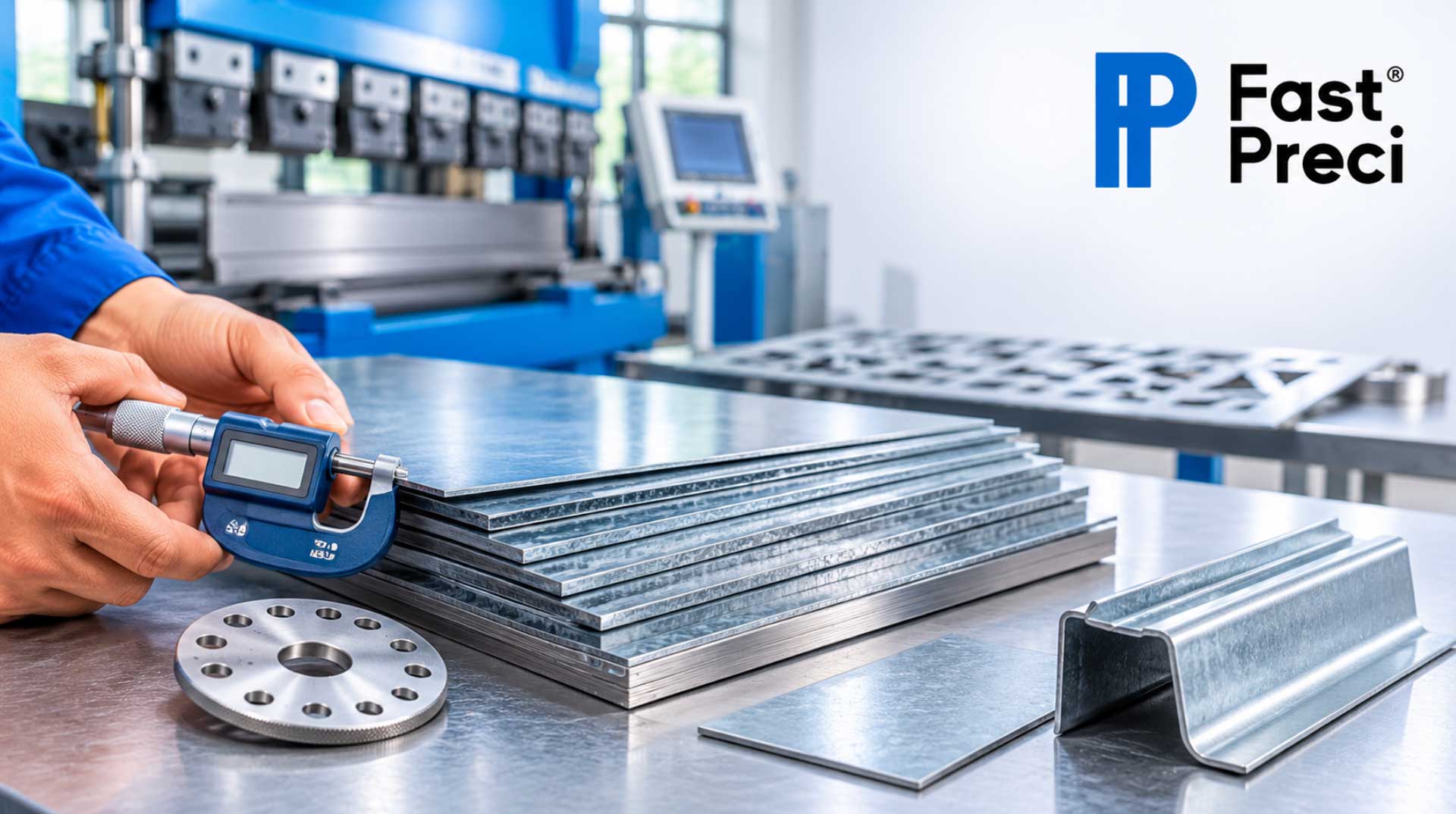
Pick the wrong gauge and you pay for it twice. If the sheet is too thin, the part flexes, dents or fails under load. If it is too thick, you overspend on material, machine time and shipping.
Gauge is the number that sets this balance. Yet many buyers treat it as a simple label and never check the real thickness behind it.
This guide explains what gauge means, how it changes strength and price, and how to choose the right one. Keep a sheet metal thickness reference open while you read, so you can match each number to a real measurement.
What a Gauge Number Really Means
Gauge is a standard way to describe sheet thickness with a single number. The system comes from older wire and sheet mills, where makers tied the number to the weight of a sheet per square foot.
The scale runs backward. A higher gauge number means a thinner sheet. A 10 gauge steel plate is far thicker than a 24 gauge steel sheet.
The scale is also not linear. Each step in gauge does not add the same amount of thickness. That is why you should always look up the real value instead of guessing.
Gauge Changes With Material
A gauge number does not give one thickness for every metal. Steel, stainless steel and aluminum each follow their own chart.
Sixteen gauge carbon steel measures about 0.0598 inches (1.52 mm). Sixteen gauge aluminum measures about 0.0508 inches (1.29 mm). Mixing up the charts leads to parts that do not fit, bend wrong or miss the load rating.
Why Many Engineers Now Use Millimeters
Most of the world specifies sheet thickness in millimeters, and several international standards bodies discourage gauge numbers. Millimeters leave no room for doubt.
When you send drawings to a shop, list the thickness in millimeters or inches. Add the gauge only as a note.
Common Steel Gauges at a Glance
| Gauge | Thickness (in) | Thickness (mm) | Approx. weight (lb/ft²) |
|---|---|---|---|
| 10 | 0.1345 | 3.42 | 5.5 |
| 11 | 0.1196 | 3.04 | 4.9 |
| 12 | 0.1046 | 2.66 | 4.3 |
| 14 | 0.0747 | 1.90 | 3.1 |
| 16 | 0.0598 | 1.52 | 2.4 |
| 18 | 0.0478 | 1.21 | 1.9 |
| 20 | 0.0359 | 0.91 | 1.5 |
| 22 | 0.0299 | 0.76 | 1.2 |
These values apply to standard carbon steel. Check the matching chart before you order stainless steel, galvanized steel or aluminum.
Heavy gauges such as 10 to 12 suit frames, brackets and equipment bases. Mid gauges such as 14 and 16 suit enclosures, housings and panels. Light gauges such as 20 and 22 suit covers, trim and ductwork.
How Gauge Affects Strength
Thickness drives strength more than almost any other design choice. A thicker sheet carries more load before it bends and resists dents better.
The gain is steep. For a flat panel, bending stiffness grows with the cube of the thickness. Double the thickness and the panel becomes about eight times stiffer. Bending strength grows with the square of the thickness, so the same doubling gives about four times the capacity.
Material grade matters as much as gauge. A thin sheet of a strong alloy can outperform a thicker sheet of soft metal. Compare yield strength and gauge together, not one alone.
Shape Can Replace Thickness
Design features add stiffness without adding weight. Flanges, hems, ribs and bends turn a flat sheet into a rigid shape.
A formed channel in a lighter gauge can often match the stiffness of a thicker flat plate. Ask whether a bend or a rib solves the problem before you move up a gauge.
Fatigue and Vibration
Thin sheet fatigues sooner when it vibrates. Fan housings, vehicle panels and machine covers all face this problem.
If a part shakes in service, choose a heavier gauge or add stiffeners. A small step in thickness often extends part life by a wide margin.
How Gauge Affects Cost
Metal is bought by weight, so thickness sets the starting price. A square foot of 10 gauge steel weighs more than twice as much as a square foot of 16 gauge steel. The material bill rises in step.
Processing costs rise too. Laser cutters run slower on thick sheet. Press brakes need more tonnage and larger tooling to bend it. Bend radii grow with thickness, and welds need more passes. Shops charge for every extra minute of machine time.
Shipping adds a third layer. Heavy sheet raises freight costs and makes handling harder for your team.
Thin sheet is not always cheaper in practice. Very light gauges warp during welding and may need extra stiffeners. Rework and scrap can erase the savings.
The cheapest part is the thinnest one that still meets every requirement. Finding that point is the goal.
Practical Rules for Choosing a Gauge
- Start with the load. Write down the force, span and support points before you pick a number.
- Check the material chart. Never reuse a steel gauge for aluminum or stainless steel.
- Use millimeters or inches on drawings, and list the gauge as a note.
- Add flanges or ribs before you add thickness.
- Match the gauge to the process. Tight bends and fine cuts work best on thinner sheet.
- Order a prototype in two gauges when the choice is close, and test both.
- Ask your fabricator which gauges they stock, since stock sizes ship faster and cost less.
Working With a Fabrication Partner
A good fabricator reviews your drawing before cutting any metal. They spot gauges that are too heavy, bends that are too tight and features that raise cost.
Send the material, thickness, quantity, finish and tolerance for every part. With that information, a partner offering custom sheet metal fabrication from FastPreci can suggest a gauge change that cuts cost without hurting strength.
An early conversation costs little. A wrong gauge found after production costs a lot.
Frequently Asked Questions
What is the most common sheet metal gauge?
Sixteen and fourteen gauge steel are among the most popular choices. They balance strength, weight and cost for enclosures, housings and panels.
Is a higher gauge number thicker or thinner?
A higher gauge number means a thinner sheet. A 22 gauge sheet is thinner than a 12 gauge sheet.
Is 14 gauge stronger than 16 gauge?
Yes, when the material is the same. Fourteen gauge steel measures about 0.0747 inches, while 16 gauge measures about 0.0598 inches. The thicker sheet resists bending better.
Does gauge affect the price of sheet metal parts?
Yes. Thicker sheet costs more to buy, takes longer to cut and bend, and weighs more to ship. Each of these raises the final part price.
Can I use the same gauge for steel and aluminum?
You can use the same gauge number, but the thickness will differ. Aluminum at 16 gauge is thinner than steel at 16 gauge. Always read the chart for your material.
How do I measure sheet metal gauge?
Use a gauge wheel, a caliper or a micrometer. Measure the bare metal and avoid coatings or burrs, then match the reading to the chart.
What tolerance applies to sheet thickness?
Sheet thickness varies slightly from the nominal value, and the allowed range depends on the standard and supplier. Ask your supplier for the tolerance when your design needs tight fits.
Conclusion
Gauge looks like a small detail, but it shapes strength, weight and price in every sheet metal part. Thickness decides how much load a part can carry, and it also decides how much you pay.
Read the right chart for your material, and use real measurements on your drawings. Add bends and ribs before you add thickness.
Select the thinnest gauge that meets your load and process needs. That choice keeps parts strong and budgets under control.