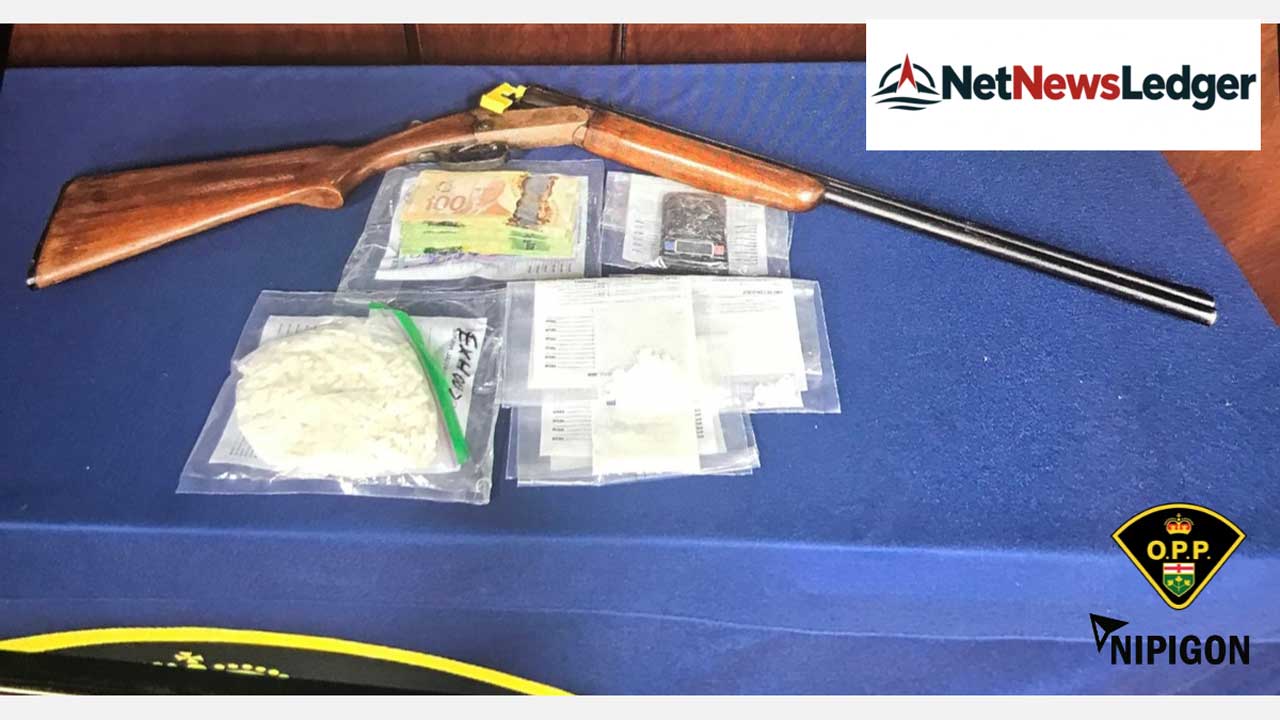
TERRACE BAY, ONT. — A 38-year-old Terrace Bay man is facing drug trafficking, firearm and other charges after police searched a local residence on November 19, the Ontario Provincial Police say.
The Nipigon OPP Community Street Crime Unit executed the search warrant with assistance from specialized OPP units, the Thunder Bay Police Service and the Anishinabek Police Service.
Police say they seized suspected cocaine and methamphetamine, a firearm, Canadian currency and items they describe as evidence of trafficking. The substances have not been identified in the information provided as confirmed through laboratory testing.
Aaron Jones, 38, of Terrace Bay, was arrested and charged with:
- Possession of property obtained by crime not exceeding $5,000
- Three counts of failing to comply with a condition of release
- Unauthorized possession of a firearm
- Careless storage of a firearm
- Possession of cocaine for the purpose of trafficking
- Possession of methamphetamine for the purpose of trafficking
Jones is scheduled to appear before the Ontario Court of Justice in Nipigon at a later date. The allegations have not been proven in court, and he is presumed innocent unless and until found guilty.
What the Charges Mean
Possession for the purpose of trafficking alleges that a person possessed a controlled substance intending to traffic it. It is distinct from an allegation of simple possession; the Crown must prove the elements of each offence. Cocaine and methamphetamine are Schedule I substances. Under the Controlled Drugs and Substances Act, each offence carries a maximum sentence of life imprisonment upon conviction.
Possession of property obtained by crime concerns property alleged to have been obtained through an offence, with the required knowledge of its criminal origin. For property valued at no more than $5,000, the Criminal Code provides a maximum of two years’ imprisonment when prosecuted by indictment, or a summary-conviction process.
Failure to comply with a release condition alleges that a person did not follow a condition of an undertaking or release order without a lawful excuse. Police did not specify the conditions involved. The relevant provisions generally carry a maximum of two years’ imprisonment when prosecuted by indictment, or a summary-conviction process.
Unauthorized possession of a firearm generally concerns possession without the required licence and, where applicable, registration. Under the relevant Criminal Code provision, the maximum is five years’ imprisonment when prosecuted by indictment; it may also proceed by summary conviction.
Careless storage of a firearm concerns storage without reasonable precautions for the safety of others. Under section 86 of the Criminal Code, the indictable maximum is two years for a first offence and five years for a subsequent offence; summary conviction is also possible.
The police release does not identify the exact statutory subsections for every charge or say how the Crown will proceed. The penalties above are general explanations, not a prediction of the outcome in this case.
Why Maximums Are Rare
A maximum penalty is the highest sentence the law permits for an offence. It is not an automatic sentence, and courts rarely impose the maximum.
If a person is convicted, a judge must determine a proportionate sentence based on the seriousness of the offence and the person’s degree of responsibility. Courts consider the facts proven in the case, relevant aggravating and mitigating factors, personal circumstances and sentences imposed in comparable cases.
When there are multiple convictions, sentences may be served at the same time or consecutively, depending on the circumstances and applicable law. The listed maximums should not simply be added together to predict a sentence.
The OPP asks anyone reporting an emergency to call 911. For non-emergency matters, the OPP can be reached at 1-888-310-1122.