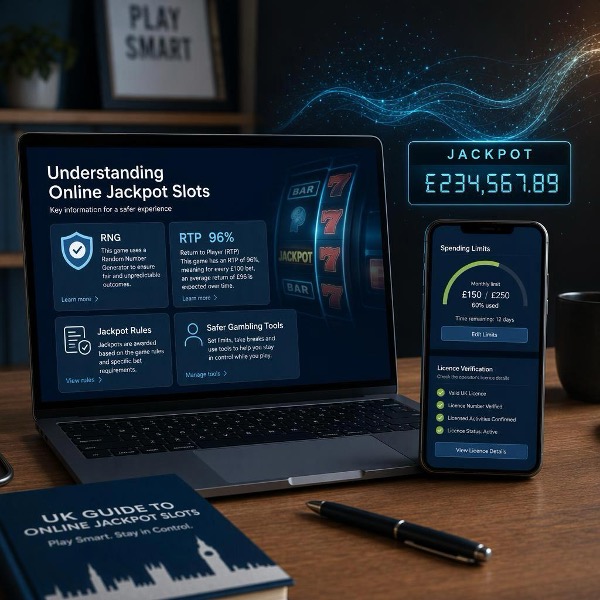
Online jackpot slots can look straightforward at first glance. You select a game, set the stake, press play and watch the reels spin. Behind that simple screen, though, sit several different systems: random-number generation, game maths, prize rules, software testing and, in the UK, regulatory requirements.
If you’re 18 or over and choosing to take part, it helps to know what the labels on a game actually mean. A large jackpot figure, for instance, tells you the current advertised prize amount. It does not tell you that a prize is due, how close it is to being awarded, or what will happen on your next spin.
This guide separates the useful facts from the usual misunderstandings, so you can read jackpot-slot information with a clearer head.
**18+ only.** Gambling should be treated as paid entertainment, not a way to solve money worries or generate income. Only use operators licensed to serve customers in Great Britain, and make use of deposit, time and spending controls where needed.
Why clear jackpot information matters
Digital entertainment products often contain a lot of information in a very small space. With online slots, the headline jackpot meter can naturally catch the eye, while the detail that explains eligibility, prize triggers, RTP and game rules may sit behind an information button.
That doesn’t mean the detail is unimportant. Quite the opposite.
A well-informed player should be able to find out:
- who operates the site and whether it is licensed;
- which software studio produced the game;
- how the game’s random outcomes are generated and checked;
- the published return-to-player figure;
- whether the advertised prize is fixed, local or linked across multiple games;
- the exact conditions for a jackpot prize;
- which safer-gambling tools are available.
The Gambling Commission licenses and regulates gambling businesses in Great Britain. Its role includes setting expectations around fairness, openness and the protection of customers. Seeing a licence is not a reason to assume a particular result, but it is an important starting point when checking whether a service is operating within the regulated UK framework.
The digital gaming stack, from the site to the spin
An online slot isn’t just a set of animated reels. It is a product made up of different layers, often supplied by different businesses.
The licensed operator
The operator is the business that provides the website or app where a customer has an account. It manages identity and age checks, payments, account settings, customer service and safer-gambling controls.
Before depositing, it is sensible to check the operator’s licence details and read the relevant account terms. A legitimate UK-facing operator should make key information accessible, including its licence status, rules for withdrawing funds and routes for raising a complaint.
The game software provider
The slot itself is frequently made by a specialist game studio rather than the operator. The provider develops the game’s visual design, paytable, bonus features, mathematical model and underlying random-number generator.
This matters because game-specific details, such as RTP and jackpot qualification rules, belong to that particular title. Two games on the same website can have very different prize structures and levels of variation.
Random-number generation and testing
A random number generator, usually shortened to RNG, is software that produces the outcome for each game round. In a slot, the spinning reels are the presentation. The game outcome has already been selected by the RNG according to the rules and probabilities built into that title.
In regulated remote gambling, technical standards and independent testing play a central role. Operators and suppliers are expected to ensure games work as described, outcomes are not misleadingly presented, and systems meet relevant requirements. You can read the Commission’s material on remote gambling and software technical standards for the regulatory context.
Information labels are there for a reason
The game’s information section may be called “Help”, “Paytable”, “Rules” or an “i” icon. It is worth opening before you play.
Look for:
- game RTP;
- stake range;
- paylines or ways-to-win format;
- bonus-round rules;
- jackpot trigger conditions;
- whether a special stake level is required for a particular feature;
- the prize’s reset value after it is awarded.
A jackpot banner alone is never the full rulebook.
What RNG, RTP, volatility and progressive jackpot really mean
These terms are often grouped together, but they describe different things. Mixing them up is where many misunderstandings begin.
RNG: each game round is independently selected
An RNG determines the result of a round based on the game’s programmed probabilities. It does not track a personal “run”, decide that someone has waited long enough, or compensate for earlier outcomes.
Put simply, a result does not become more likely because a jackpot has not appeared for a while. Nor does a previous win make a later result less likely. Each round is governed by the same underlying game rules.
No timing pattern, stake pattern or set of tips can guarantee a jackpot or change the RNG outcome.
RTP: a long-run theoretical measure
Return to player, or RTP, is usually shown as a percentage. It represents the theoretical proportion of stakes a game is designed to return over a very large number of rounds.
For example, an RTP of 96% is a long-term mathematical figure, not a forecast that a person staking £100 will receive £96 back. Actual short-term outcomes can differ considerably from that number, in either direction.
It is also worth checking the figure within the game itself, rather than assuming all versions of a title use the same setting. The displayed RTP should be treated as game information, not a personal promise.
Volatility: how outcomes may be spread
Volatility, sometimes described as variance, relates to the pattern and size of possible payouts across play. It is not a measure of fairness, and it does not say whether a jackpot is near.
Generally, a game described as higher volatility may have less frequent winning rounds alongside the possibility of larger individual payouts. A lower-volatility game may produce smaller payouts more often. Neither label changes the fact that outcomes remain random.
If a provider uses volatility labels, read them alongside the paytable and RTP, rather than treating any single metric as the whole story.
Progressive jackpots: a prize that changes over time
A progressive jackpot is a prize pool that rises as qualifying game rounds are played. A small defined part of relevant stakes may be added to the displayed prize fund, depending on the game’s rules.
When the qualifying trigger occurs and the jackpot is awarded, the prize normally resets to a stated base amount and begins building again. Progressive jackpots can be:
- Standalone, linked to one game;
- Local, shared among games within one operator or network;
- Networked, shared across a wider group of participating sites or games;
- Must-hit-by, designed to be awarded before a published upper figure is reached.
The important point is that the growing meter is a record of the prize pool, not a countdown. It does not reveal when the prize will be awarded.
Progressive prizes are a design feature, not a prediction
Progressive jackpots are built into a game’s product design. Their changing value gives players a visible piece of information, but the rules still determine exactly how that prize is funded and triggered.
Some games use a specific symbol combination to award the top prize. Others have a separate jackpot event or a randomly triggered feature. The help screen should explain this. If it does not feel clear, pause and check before continuing.
A few details are especially worth finding:
- Eligibility
- Contribution mechanics
- Trigger method
- Prize reset
- Displayed value
Clear user-experience messaging should help you understand those points without making claims that suggest an outcome is expected. “Must hit by” wording deserves particular care: it describes a prize ceiling in the rules, not a personal likelihood or a recommended moment to participate.
A practical checklist for UK customers
Before opening an online jackpot slot, take a moment to run through the basics.
- Be 18 or over. Gambling is for adults only, and licensed operators should verify age and identity.
- Check the licence. Use the operator’s licensing information and, where useful, the Gambling Commission’s public register.
- Read the game rules. Pay attention to the paytable, jackpot conditions, RTP and any feature-specific terms.
- Set limits before playing. Deposit limits, reality checks, time reminders and spending controls can help you keep activity within boundaries you have chosen.
- Use breaks when needed. A time-out can restrict access for a selected period. For a longer, wider restriction, GAMSTOP provides a free self-exclusion scheme for participating UK online gambling businesses.
- Keep gambling separate from essential spending. If it is no longer feeling manageable, stop and seek support rather than trying to change the outcome through further play.
- Know where to find help. The NHS lists information and support routes on its gambling support page.
The strongest habit is a simple one: decide your limits before you start, then stick to them. A game’s animations, jackpot meter and previous results should not set those boundaries for you.
Further reading on jackpot-slot information
If you want a supplementary, plain-English resource to help interpret jackpot-slot information, see Virgin Games, “Jackpot Machine Tips for Slots Players”. It should be read as educational background alongside the game’s own rules and UK safer-gambling controls, rather than as an endorsement or a route to play.
Whatever the game, the central facts remain the same: participation is 18+ only, outcomes are determined by the game’s RNG, RTP is a long-run theoretical figure, and no stake size, timing choice or approach can guarantee a jackpot or alter random results.