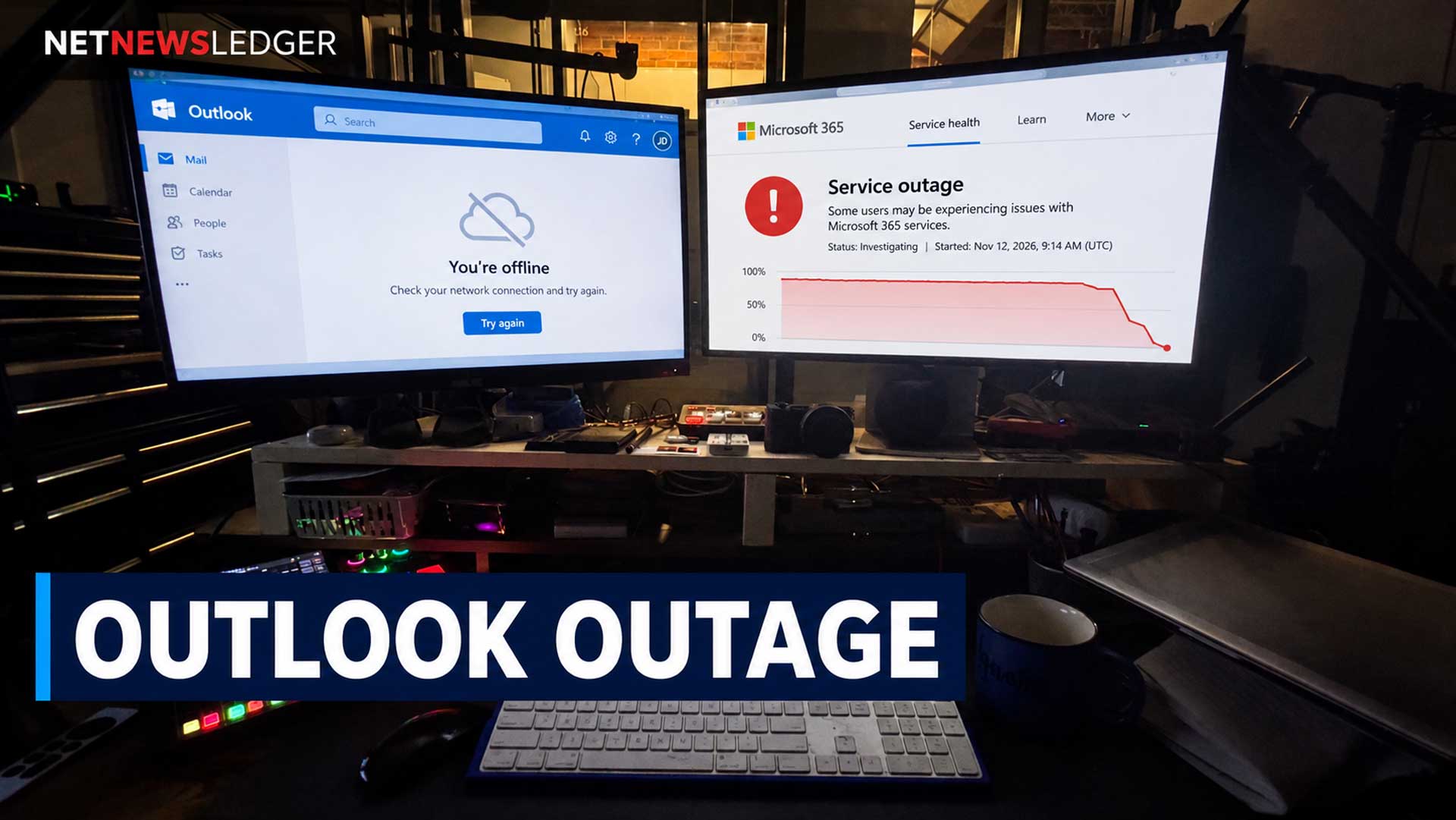
Microsoft reports limited recovery after server failures affected Outlook, Teams, SharePoint and Copilot, including users across Canada
THUNDER BAY – NEWS – A major Microsoft outage disrupted Outlook email and several Microsoft 365 services on Thursday, leaving users unable to open mailboxes, send messages or access workplace collaboration tools.
The disruption began in the Americas before Microsoft warned that customers in any region could be affected. Canada was included in the company’s initial impact area.
As of 8 p.m. Eastern time on Nov. 12, the incident remained active. Microsoft reported limited recovery in some regions, but had not provided an estimated time for full restoration.
Outlook reports surged Thursday afternoon
Reports of Outlook problems climbed sharply shortly after noon Eastern time. Nearly 130,000 user-submitted reports appeared on Downdetector around 1 p.m.
That figure represents individual reports submitted to the tracking service, not a verified count of affected customers. Microsoft has not disclosed how many people or organizations were affected.
Users reported being unable to load inboxes, send or receive email, or connect Outlook applications to their mailboxes. Microsoft said affected connection methods could include Outlook on the web, the Messaging Application Programming Interface, Exchange ActiveSync and services using its REST interface.
The company tracked the Exchange Online problem as incident EX1550543 and the broader Microsoft 365 disruption as MO1550821.
Outage spreads across Microsoft 365
Microsoft identified potential problems with:
- Exchange Online and Outlook
- Microsoft Teams
- SharePoint Online
- Microsoft 365 Copilot
- Microsoft Defender XDR
- Microsoft Planner
- Microsoft To Do
Some organizations also reported difficulties reaching OneDrive and Microsoft’s administration tools.
The outage affected more than workplace communication. Microsoft 365 connectors used by OpenAI and Anthropic were also disrupted. OpenAI investigated broken Microsoft connections, while Anthropic attributed problems with its Microsoft 365 connector to an upstream provider. More than 38,000 Microsoft 365 reports and approximately 4,500 Teams reports on Downdetector during the afternoon.
A separate Teams incident in North America occurred earlier Thursday. Microsoft said that problem had been restored, although the later Microsoft 365 outage again affected Teams connectivity for some customers.
Servers failed automated health checks
Microsoft initially said parts of its infrastructure were experiencing unusually high load. Its investigation later found that the pressure was not caused by a general increase in customer traffic.
Instead, a large number of servers had become unavailable, shifting their workload onto the remaining infrastructure.
The affected servers were failing automated health checks, which are designed to detect unhealthy equipment and remove it from service. Microsoft investigated whether a component involved in processing those checks was contributing to the failures.
The company paused deployments and configuration changes, redirected traffic and restarted affected servers. It also tested an alternative health-check method that initially allowed some servers to return to service.
By early evening, Microsoft said some restored servers were stable and users in certain regions were beginning to reconnect. A subsequent update, however, said servers could become unresponsive again after receiving traffic. Engineers were analyzing diagnostic information to identify what was triggering that behaviour.
Microsoft had not confirmed a final root cause or indicated that the outage resulted from a cyberattack.
Canadian organizations face wider operational risks
Microsoft 365 is widely used by Canadian businesses, governments, schools, health-care organizations and non-profit agencies. An outage affecting email, meetings, shared documents and security tools at the same time can interrupt far more than routine office correspondence.
The disruption is particularly significant for smaller and remote organizations that rely on Microsoft’s cloud services for most internal and external communication. In Northwestern Ontario, limited alternatives and geographically dispersed staff can make a prolonged Microsoft 365 failure more difficult to work around.
Delayed email also presents risks for time-sensitive messages, including password codes, appointment notices, invoices and emergency communications.
Email delivery provider SparkPost reported that Microsoft servers were returning temporary errors for messages addressed to Outlook.com, Hotmail, Live, MSN and Microsoft 365 recipients. It said affected messages were being queued and retried rather than discarded, although short-lived messages such as one-time security codes could expire before delivery. SparkPost’s incident notice advised senders not to resend delayed messages because doing so could create duplicates.
What users should do
People encountering Outlook errors should avoid repeatedly resending messages unless they receive a permanent non-delivery notice. Messages held by an email provider may arrive once Microsoft restores capacity.
Organizations should use an independent telephone, text-messaging or emergency-notification system for urgent communication. Administrators can follow incidents EX1550543 and MO1550821 through the Microsoft 365 admin centre or Microsoft’s public service-status page.
Users should also be cautious about messages or social-media posts claiming to offer an outage fix. Microsoft has not instructed customers to reset passwords, install software or change Outlook settings because of this incident.