A commercial building might look almost identical to the day it opened, yet behind the walls, above the ceilings and throughout its service areas, plenty can change. New tenants move in, contractors install additional cabling, internal layouts are rearranged and maintenance teams replace equipment. Most of these alterations seem insignificant on their own, but collectively, they can create a building that no longer reflects the fire safety documentation sitting in the manager’s office.
For property owners and strata managers, this disconnect can become particularly concerning when the annual compliance deadline approaches. Arranging AFSS fire safety inspections across Sydney is an important part of meeting NSW fire safety obligations, but the process becomes more complicated when the building’s actual condition differs from its approved Fire Safety Schedule. What appears to be a straightforward inspection can quickly reveal questions about undocumented modifications, missing fire protection measures and systems that no longer match their original specifications.
The challenge is that inspecting fire safety systems involves more than confirming that equipment is present or appears to function correctly. Fire safety measures must be assessed against the applicable performance requirements, and those requirements are closely connected to the building’s approved documentation. When the paperwork and the physical building tell different stories, identifying the reason for that discrepancy becomes an important part of managing fire safety compliance.
What Is a Fire Safety Schedule, and Why Does It Matter?
In New South Wales, a Fire Safety Schedule (FSS) is an official document identifying the essential and critical fire safety measures applicable to a building. It also specifies the minimum standard of performance that each measure must achieve. Depending on the property, these measures may include fire detection and alarm systems, fire doors, fire-resistant construction, emergency lighting, exit signs and other systems designed to protect occupants during a fire.
The schedule is generally issued by a council, registered certifier or other relevant authority as part of certain building approvals, changes of use or fire safety orders. It establishes the requirements against which the nominated fire safety measures are assessed and maintained throughout the building’s operational life.
For example, a schedule might specify that particular fire doors must comply with an identified Australian Standard or that a fire detection system must achieve a prescribed performance level. These requirements provide a reference point for determining whether the relevant systems remain capable of performing as intended.
However, a Fire Safety Schedule is not necessarily a complete record of every alteration that has occurred since the building was constructed. It documents the fire safety requirements applicable to the property, but it relies on appropriate approvals, construction practices, maintenance and record-keeping to remain consistent with the building’s actual condition.
This distinction becomes especially important in older Sydney buildings, where decades of renovations and changes in occupancy may have occurred under different owners, managers and contractors.
How Buildings Gradually Drift Away From Their Approved Documentation
A building rarely develops fire safety discrepancies because of one dramatic change. More commonly, the differences accumulate through ordinary maintenance, refurbishment and operational decisions.
Consider a multi-storey commercial property in Sydney that has operated for 25 years. During that time, several tenants have renovated their offices, new communications infrastructure has been installed, internal partitions have been relocated and mechanical services have undergone upgrades.
Each project may have been relatively small, but these works can interact with existing fire protection measures in unexpected ways.
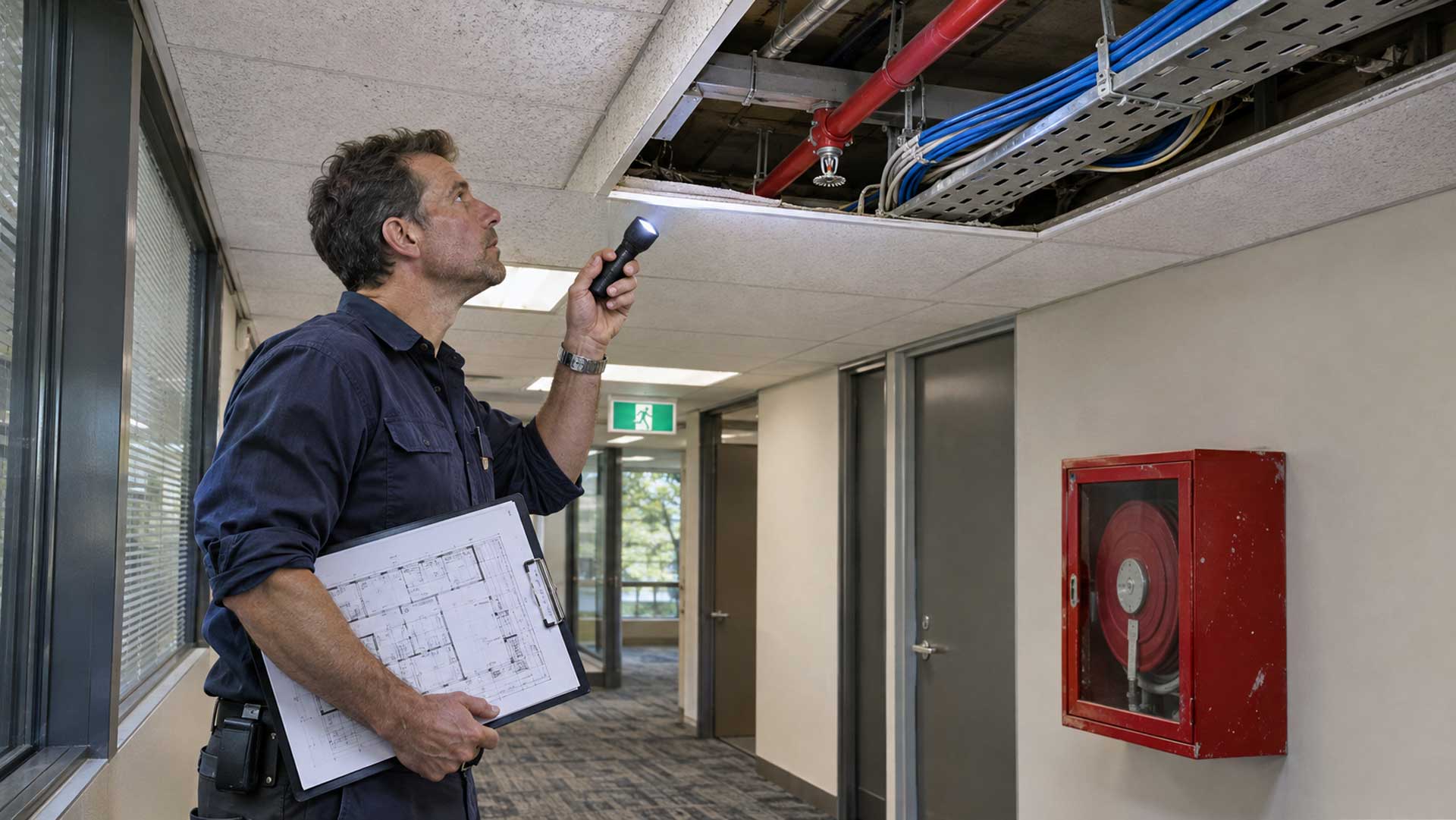
When electricians or data contractors run new cables between fire compartments, they may need to create penetrations through fire-resistant walls or floors. These openings must be appropriately protected to preserve the required fire resistance. If the penetrations are incorrectly sealed, or left untreated altogether, the original fire separation may be compromised.
Similarly, replacing a fire door during a refurbishment is not as simple as selecting another door of approximately the same size. Fire-rated doors form part of tested systems, and their performance depends on factors such as the door assembly, frame, hardware, installation and surrounding construction.
Even changes to the internal layout can introduce problems. A previously unobstructed exit route might be affected by new partitions, storage arrangements or changes to access control.
The issue is not that every renovation automatically creates a fire safety defect. Properly designed, approved and completed alterations can improve a building’s overall performance. Problems arise when changes affecting fire safety measures are not appropriately assessed, implemented or documented.
Over time, these discrepancies can make it increasingly difficult to establish whether the building continues to satisfy its applicable fire safety requirements.
When an Annual Fire Safety Inspection Reveals a Different Reality
An Annual Fire Safety Statement (AFSS) is an important compliance requirement for many commercial, residential strata and mixed-use buildings across Sydney.
Under NSW legislation, the building owner is responsible for arranging the required assessment of essential fire safety measures by an appropriately accredited practitioner. The annual statement confirms that those measures have been assessed as capable of performing to the applicable standards and that the building’s exit systems have been inspected as required.
The statement must then be provided to the relevant local council and Fire and Rescue NSW.
Although the process occurs annually, it should not be confused with a simple administrative renewal. The assessment must establish whether the relevant fire safety measures are capable of meeting their required performance standards.
This is where discrepancies between the Fire Safety Schedule and the building itself can become apparent.
An assessor might discover that a fire door identified in the documentation has been replaced with an unsuitable assembly. A service penetration may have been created through a fire-rated wall without appropriate fire-stopping. Alternatively, a fire safety measure listed on the schedule may be difficult to locate or assess because subsequent alterations have changed the surrounding construction.
Not every discrepancy means the building has immediately failed its assessment. Some differences require further investigation to determine whether the measure remains compliant, whether the documentation is incorrect or whether additional work is necessary.
However, unresolved discrepancies can prevent an accredited practitioner from confirming that a measure satisfies its required performance standard.
For building owners, this can be frustrating, particularly when previous annual statements have been issued without the same problem being identified. Yet a previous statement does not guarantee that the building remains compliant indefinitely.
Building conditions change, defects develop and alterations may affect systems that previously operated correctly.
The Hidden Problem With Incomplete Building Records
One of the biggest challenges facing established commercial properties is the quality of their historical documentation.
A building might have a Fire Safety Schedule, several years of maintenance records and copies of previous Annual Fire Safety Statements, but still be missing important information about modifications completed over the years.
Original construction drawings may be difficult to locate. Refurbishment records may have remained with previous property managers, while documentation for specialist fire protection work might never have been properly handed over.
This can leave current building managers trying to reconstruct the history of a property they had no involvement in developing.
For example, an inspection might identify fire-rated construction surrounding a service riser, but the available documentation may not clearly establish the required performance of a particular penetration system. Without suitable records, confirming the installation’s compliance can become considerably more difficult.
These situations often require more than routine maintenance. Depending on the issue, an accredited fire safety practitioner, fire protection specialist, registered certifier or appropriately qualified fire engineer may need to review the relevant documentation and physical conditions.
Importantly, missing paperwork does not automatically establish that a fire safety measure is defective. Equally, the absence of a defect in an old maintenance report does not prove that an installation meets its required standard.
The objective is to establish enough reliable evidence to understand the applicable requirements and determine whether the installed measures satisfy them.
The Difference Between a Documentation Error and a Compliance Defect
When an inconsistency is discovered, the first question should be straightforward: is the problem with the documentation, the physical building or both?
This distinction matters because the appropriate response can be very different.
An administrative error in a Fire Safety Schedule may involve an incorrect description, an omission or a document that has been lost. Under section 80A of the Environmental Planning and Assessment (Development Certification and Fire Safety) Regulation 2021, building owners can request the reissue of a schedule in certain circumstances, including where the council is satisfied that the schedule has been lost or contains errors requiring correction.
However, this process is not a general shortcut for approving changes to a building’s fire safety arrangements. The legislation places limits on reissuing schedules where discrepancies result from unauthorised building work or changes to plans and specifications.
If a fire safety measure has been physically altered or removed, correcting the paperwork alone may not resolve the issue. The circumstances may require further investigation, rectification, an applicable approval process or formal regulatory action.
This is why professional assessment is so important. A fire protection contractor may be able to identify a defective installation, but determining whether the Fire Safety Schedule itself requires formal amendment can involve separate regulatory and certification considerations.
Building owners should also understand that maintaining an existing building does not automatically mean upgrading every fire safety measure to the latest construction standard. NSW requirements generally recognise the applicable performance standards specified for existing measures, although upgrades may become necessary through relevant approvals, orders or other legal requirements.
The priority is establishing what the building is legally required to provide before deciding how any identified discrepancy should be addressed.
Why the 2026 Fire Safety Maintenance Changes Make Accurate Records Even More Important
From 13 February 2026, NSW introduced mandatory requirements for the routine servicing of relevant essential fire safety measures in Class 1b and Class 2 to 9 buildings under Australian Standard AS 1851-2012, where the standard addresses the maintenance activity and an applicable performance solution does not prescribe otherwise.
These requirements apply to both new and existing buildings and place greater emphasis on systematic inspection, testing, maintenance and record-keeping.
For building owners, this reinforces the importance of understanding exactly which essential fire safety measures apply to their property.
AS 1851-2012 establishes routine servicing requirements for various fire protection systems and equipment. It does not replace the Fire Safety Schedule or automatically require every existing system to be upgraded to current construction standards. Essential measures not covered by its procedures must still be maintained in accordance with their applicable legal requirements.
If a building’s records are incomplete or its physical systems differ from the documented requirements, arranging the appropriate maintenance program can become more difficult.
A contractor cannot confidently plan every relevant servicing activity without understanding the equipment, applicable standards and any special performance requirements. Similarly, building managers need reliable maintenance records to demonstrate that identified defects are being addressed.
The changes therefore provide another reason for Sydney property owners to review their fire safety documentation rather than treating it as something that only needs attention when the annual statement is due.
The Commercial Consequences of Letting Discrepancies Go Unresolved
Fire safety compliance issues can create substantial financial and operational difficulties when they are allowed to accumulate.
A relatively minor defect might be straightforward to rectify when first identified. However, when several problems remain unresolved across different tenancies or common areas, coordinating repairs can become considerably more complicated.
Access may need to be arranged with occupants. Ceiling spaces might require opening, specialist contractors may need to investigate concealed installations and some works may need to occur outside normal business hours.
In strata buildings, the process can be further complicated by questions about responsibility for works affecting common property, individual lots or shared building services.
For commercial landlords, unresolved fire safety issues can also become relevant during property transactions, due diligence investigations and discussions with insurers. The consequences depend on the particular circumstances and policy terms, but incomplete documentation and outstanding defects can introduce questions that are difficult to answer quickly.
There is also the possibility of regulatory enforcement where legal obligations have not been met. Councils and other relevant authorities have powers under NSW legislation to address fire safety concerns, with the circumstances determining what action may be appropriate.
Perhaps the most frustrating aspect for property owners is that many of these difficulties can be reduced through better communication and earlier investigation.
A discrepancy discovered during a planned building review is generally easier to manage than the same issue identified shortly before a compliance deadline, especially if specialist assessment or extensive rectification is required.
How Sydney Building Owners Can Close the Gap
The most practical starting point is to establish whether the building’s current documentation provides an accurate basis for assessing and maintaining its fire safety measures.
That means locating the latest applicable Fire Safety Schedule, reviewing previous Annual Fire Safety Statements and examining available maintenance reports. Where relevant, approved construction drawings, fire engineering documentation, refurbishment records and fire safety orders should also be considered.
The next step is understanding whether the building has undergone alterations that could affect its existing fire protection arrangements.
This does not necessarily require every property owner to commission an extensive investigation immediately. The appropriate scope depends on the building’s age, condition, complexity, documentation and any concerns already identified.
However, obvious inconsistencies should not simply be carried forward from one annual inspection to the next without investigation.
Engaging suitable professionals early can help distinguish routine maintenance defects from more complex issues involving fire-resistant construction, documentation, performance solutions or building approvals.
Where physical defects are confirmed, appropriate rectification should be arranged and documented. Where the Fire Safety Schedule itself appears incorrect, the owner should seek advice about the formal process required to address it.
It is also worth improving the way information is transferred between contractors and property managers. Fire safety documentation should remain accessible, and records of building alterations should be retained so future assessments are not dependent on someone’s memory of work completed years earlier.
Ultimately, the objective is not simply to get another annual statement signed. It is to create a reliable relationship between the building’s documented requirements, its actual fire protection measures and the maintenance activities needed to keep them effective.
A Building’s Fire Safety Records Should Reflect More Than Its History
Buildings are constantly evolving, particularly across Sydney’s established commercial centres, residential developments and mixed-use properties. Tenants change, equipment is modernised and spaces are adapted to meet new requirements.
The Fire Safety Schedule remains an essential reference throughout those changes, but its value depends on understanding how the documented fire safety requirements relate to the building that exists today.
A discrepancy between paperwork and physical conditions does not always indicate an immediate danger or a serious compliance failure. It does, however, deserve proper attention because unresolved differences can make it harder to demonstrate that essential fire safety measures are performing as required.
For Sydney building owners and managers, the lesson is to look beyond the annual compliance deadline. Accurate records, appropriate maintenance, professional fire safety inspections and timely investigation of defects all contribute to a clearer understanding of a property’s fire safety obligations.
After all, the most useful fire safety documentation is not simply a record of what a building was originally supposed to contain. It is documentation that can be reliably connected to the fire protection measures safeguarding the people who use that building today.