In Schreiber, Ont., “pisscutter” means excellent. The town’s cheeky slang has older roots, local pride and a life on hats
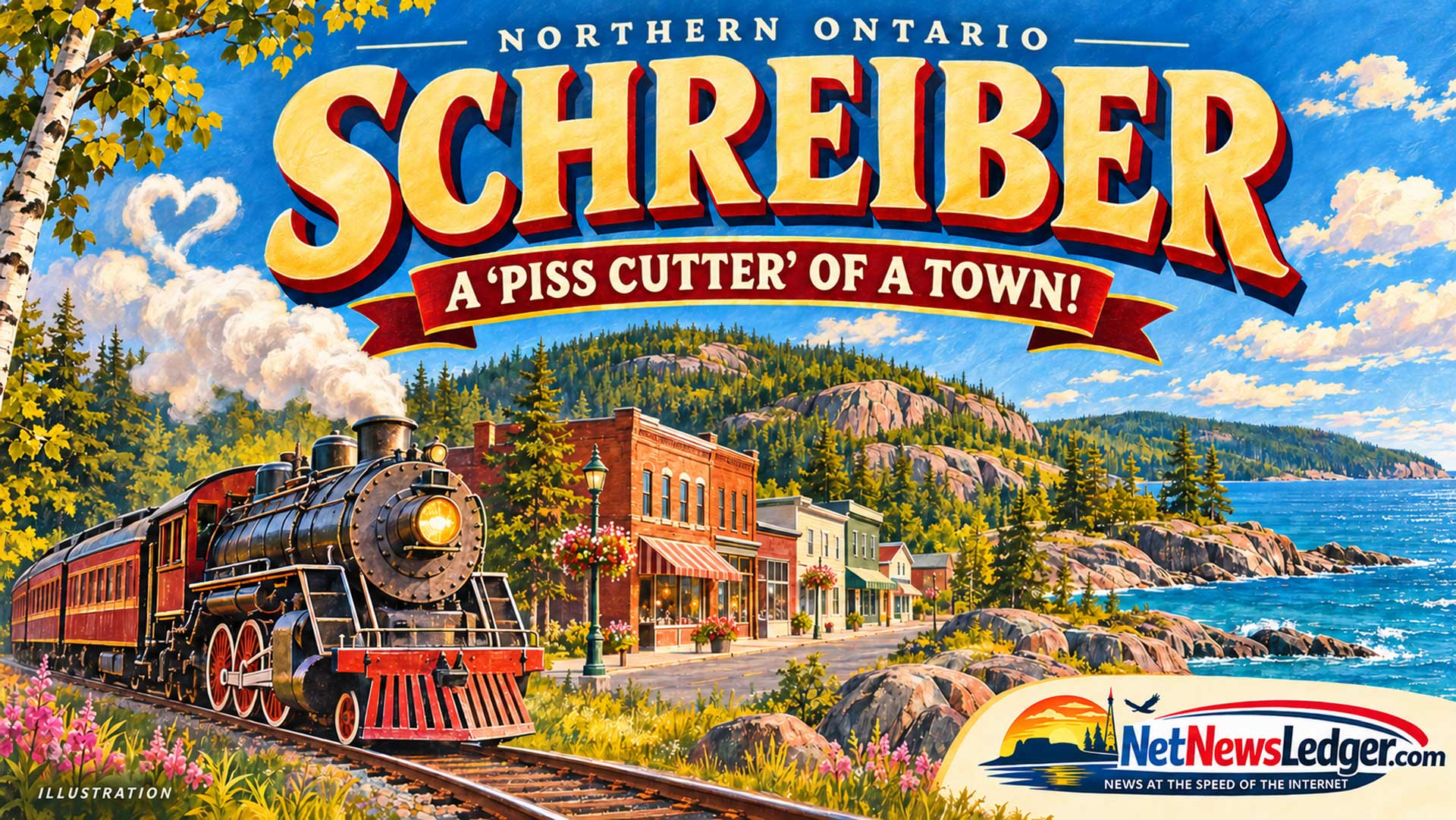
SCHREIBER, Ont. — LIVING – To people outside Schreiber, “pisscutter” may sound like an insult, a military nickname or simply a piece of crude humour.
In this small railway town on Lake Superior’s north shore, however, the word is a compliment.
Something described as “pisscutter” is excellent, impressive or especially enjoyable.
A local retailer gives the example: “I had a pisscutter time last night.” The word can describe an object, a person, an event or almost anything that earns strong approval.
It is informal and vulgar, but its meaning in Schreiber is firmly positive.
The expression has become associated closely enough with the town to appear on hats and other clothing. In 2019, Schreiber resident Domenic Patrick Joseph Figliomeni filed a Canadian trademark application for “Pisscutter,” covering clothing, hats, mugs and other products. The application was advertised in the federal Trademarks Journal in April 2024.
That commercial use offers clear evidence that the word has moved beyond private conversation. It now serves as a cheeky piece of Schreiber identity.
An older word with a local life
An online definition posted in 2010 claims the word was first uttered in Schreiber and describes it as a name for something so remarkable that it could perform the impossible feat of cutting a stream of urine.
It is a memorable explanation, but it should be treated as local folklore rather than established history. Urban Dictionary is written by its users and does not independently verify word origins.
Published language records show the term existed elsewhere long before the Schreiber claim appeared online.
The Routledge Dictionary of Modern American Slang and Unconventional English traces “piss cutter” to the United States in 1941. In that record, it describes a clever, resourceful and tough person.
A 1973 University of Victoria thesis surveying Canadian English slang also lists “piss-cutter” as a highly complimentary term for something well liked. Its source material dated that use to the navy by at least 1952.
The word has carried other meanings. In United States military slang, it has been used for a narrow folding garrison cap. Elsewhere, speakers have applied it to a small vehicle, an unimpressive animal or something insignificant. Those meanings can be neutral or insulting, depending on the speaker and setting.
Schreiber’s version belongs to the approving side of the word’s history. Calling a party, hockey game, car or day “pisscutter” means it was unusually good.
Why Schreiber claimed it
The available public record does not establish when the word arrived in Schreiber, who first used it there or whether residents inherited it through railway, military or other connections.
That gap matters. Schreiber developed as a Canadian Pacific Railway community and became home to generations of Italian families, many with roots in Siderno, Calabria. Railway workers and their families brought language from many regions into close contact, but no source reviewed for this article ties “pisscutter” directly to the railway or to the town’s Italian heritage.
Kevin Palmer, a former resident shares, “I landed in Schreiber in 1986, brand new on the CPR. It didn’t take long to find a few like-minded musicians on the job, and that led to some jamming. After hearing me play, one of the guys looked over and said, “You’re a pisscutter drummer.”
“Not knowing if that was good or bad, I asked right away what he meant”.
“You’re a pisscutter. Like, really good.”
“Ha! That was my introduction to Schreiber, Ontario. So the word was alive and well on the railway by 1986, and it’s been a compliment to me ever since”.
What can be shown is that residents kept using the positive meaning strongly enough for the word to become recognizable local shorthand.
A Schreiber retailer now markets several styles of “Pisscutter” hats and describes the expression as popular in the community. Online discussions about Northwestern Ontario slang also continue to connect the word with Schreiber, although some people elsewhere in the region use it differently.
That is often how local language works. A community does not have to invent a word to make it its own. Older expressions can survive in one place after fading elsewhere, or take on a sharper local meaning as families pass them down.
In Schreiber, “pisscutter” has become less about its literal wording than the reaction it delivers. It is rough, enthusiastic praise with a hometown accent.
The term’s full history remains unfinished. Interviews with longtime residents, retired railway workers and local families could help establish how far back the Schreiber use goes. Newspaper files, community scrapbooks and oral histories held by the Schreiber Public Library may also provide earlier examples.
Until that evidence is found, the safest conclusion is also the most interesting one: Schreiber probably did not invent “pisscutter,” but it gave the old slang a lasting home.