
Nearly every small and midsize business ran into a financial challenge last year, and more than half of the owners who did reached into their own pockets. In the Federal Reserve Banks’ 2026 Report on Employer Firms, drawn from the 2025 Small Business Credit Survey of 6,525 employer firms, 94% reported at least one financial challenge in the prior 12 months. After rising costs, the most common were paying operating expenses, a category the survey illustrates with payroll, rent, and inventory, at 54%, and uneven cash flow at 50%. Among the firms that hit a challenge, 54% used the owner’s personal funds and 36% took out debt.
Federico Nannini, Founder and Managing Partner of Miami-based Sterling Equity Partners, says that in established companies, the tight weeks behind those numbers are rarely a profit problem.
“The pattern I see most often is a company that made money last year and still has two or three weeks a quarter when payroll is tighter than it should be,” Federico said. “The owner knows something is off. They either don’t know which lever to pull, or they know and don’t have the hours. Either way, the cash is usually already in the business. It’s sitting in the contracts, the invoices, and the vendor terms.”
Why a Profitable Company Has Tight Weeks
The P&L records revenue when the work is done. Cash arrives when the customer decides to pay. In between, the company covers payroll, materials, rent, and insurance out of its own pocket. That gap is working capital, and most owners have never put a number on it.
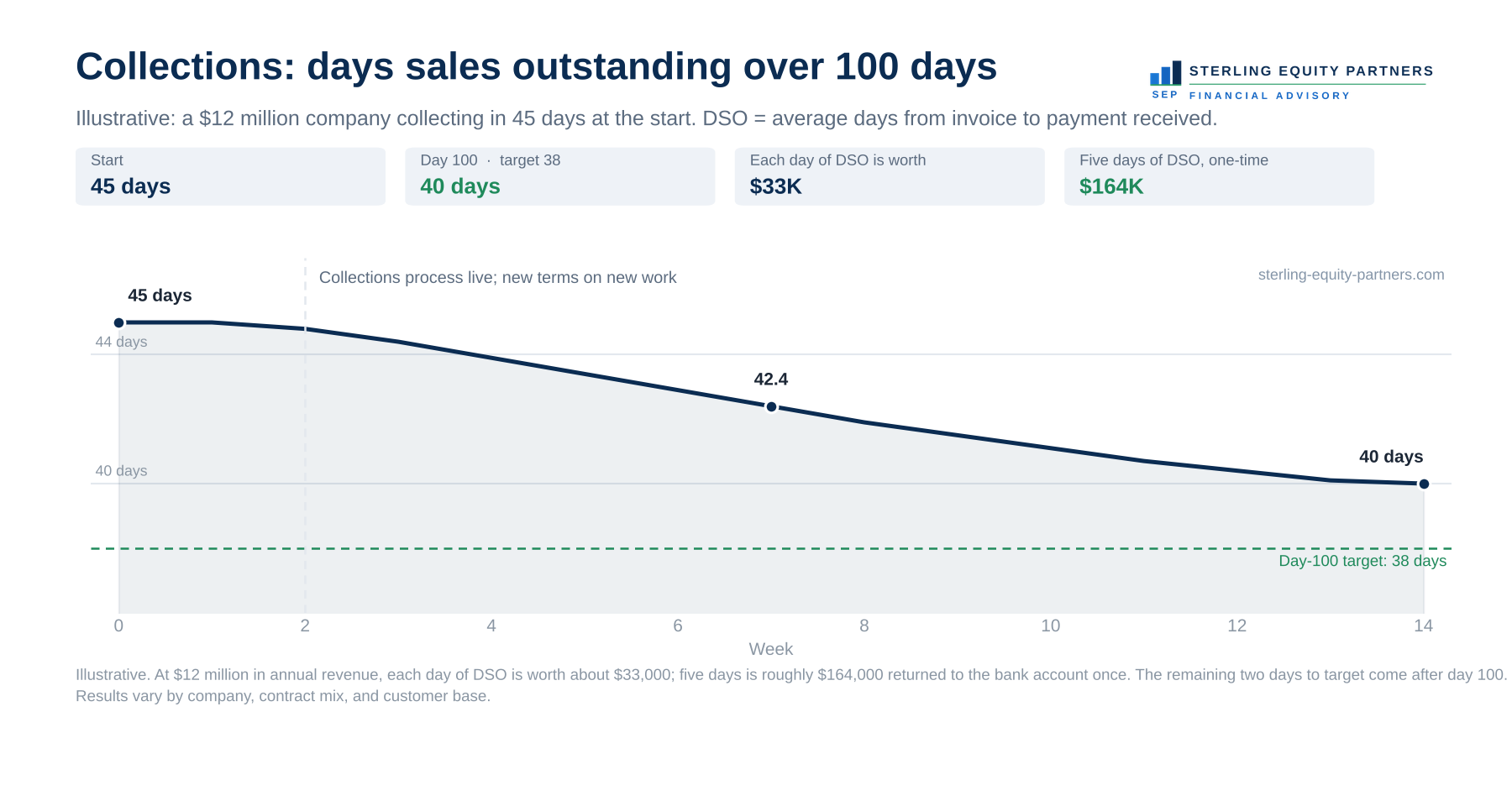
The number is bigger than it feels. A $12 million company that takes 45 days to collect has roughly $1.5 million of its own cash sitting in receivables on any given day. Every 10 days it takes off that collection cycle returns about $330,000 to the bank account, once, without a dollar of new revenue.
Late payment is the norm rather than the exception. Intuit QuickBooks’ 2026 Small Business Late Payments Report found that 59% of small businesses have invoices overdue by 30 days or more, up from 47% a year earlier, and that 39% of owners said a single late payment made it hard to cover payroll or bills in the past year. The report also found that 55% of businesses on net-30 terms had overdue invoices, compared with 26% of businesses that require immediate payment.
That last number is the whole argument. The collection problem is mostly decided on the day the contract is signed, not the day the invoice goes out.
Start With the Contract
The first place Federico looks is the paper that governs how and when the company gets paid. The changes are rarely dramatic, and none of them require being difficult with customers.
A deposit at signing. On a 90-day project, moving the first invoice from 30 days after completion to the day the contract is signed returns four months of float on that portion of the job.
Billing tied to milestones, not the calendar. Work finished on the 3rd should not be invoiced on the 31st. The invoice goes out when the milestone is hit.
Shorter terms for new customers. Net-15 for new accounts, with net-30 earned after a payment history. Many new customers don’t push back; they expect the vendor to set the terms.
Payment on file for recurring work. An ACH or card authorization for repeat and retainer customers takes the invoice out of their approval queue entirely.
A late charge that gets applied. A clause nobody enforces trains customers to ignore it. The point is not the fee, which stays within what the contract and state law allow. It is that the due date means something.
“You don’t have to be aggressive,” Federico said. “You have to stop being the bank.”
A Collections Process With Dates on It
The second lever is a written process keyed to days outstanding, with one person who owns it and one report every Friday. Federico’s version typically runs like this: the invoice goes out the day the work or milestone is complete. On day three, someone confirms the customer received it and that it is in their approval queue. On day 10, the person who did the work checks in, because the customer takes that call. On the due date, if the invoice is unpaid, the account escalates to the customer’s decision-maker. Ten days past due, the owner calls their counterpart. After that, the contract’s remedies apply, whether that is a hold on new work or a stop-work notice.
“The day-three call is the one everyone skips and the one that moves the number the most,” Federico said. “You find out the invoice went to the wrong inbox, or the PO number is missing, three weeks before you’d otherwise find out. Most late invoices aren’t refused. They’re stuck.”
What gets measured: days sales outstanding (DSO), which is the average number of days between sending an invoice and getting paid, against the terms in the contract; the share of invoices collected within terms; and the aging report by customer, every Friday.
Vendor Terms You’re Already Owed
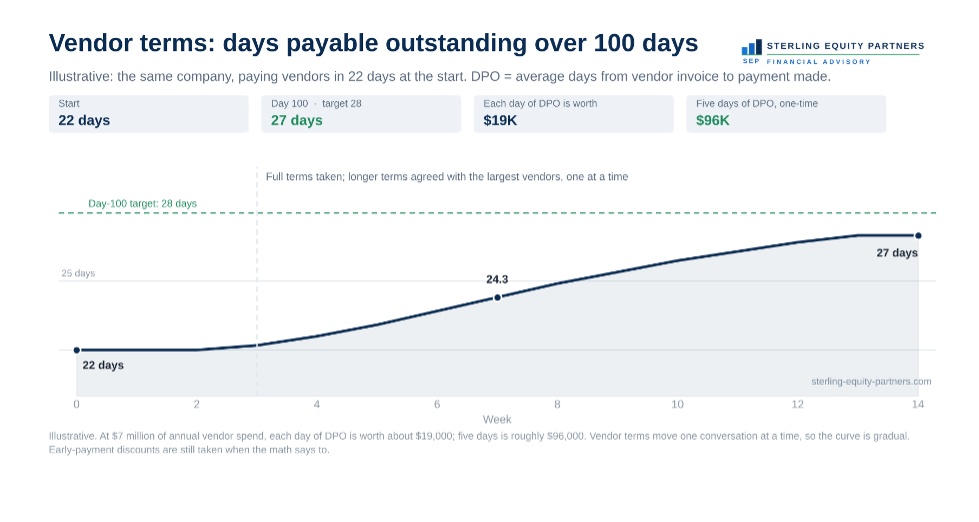
The third lever runs the other direction. Paying vendors early feels like discipline. It is an interest-free loan to the vendor, often funded by the company’s own line of credit. Federico’s standard moves: take the full terms on every invoice; have a direct conversation with the two or three largest vendors about 45-day terms, which many will grant to a customer who pays reliably; schedule payment runs to land after the week’s collections rather than before; and take early-payment discounts only when the math says to. A 2% discount for paying in 10 days instead of 30 works out to roughly 37% annualized, so that one is worth taking nearly every time.
The measure is days payable outstanding (DPO), the average number of days the company takes to pay its own vendors, against the terms actually available.
Cost Reduction That Reaches the Bank Account
Most owners can name five costs they would like to cut. The difference between a list and a result is execution. In Federico’s plans, every item gets an owner, a date, and the P&L line where the saving will appear, and it stays on the plan until the P&L shows the number three months in a row. The usual targets in a $5 million to $50 million company: insurance, re-marketed well ahead of renewal rather than after it; materials and the largest vendors, re-bid every year; software seats and subscriptions, where companies routinely pay for licenses nobody uses; merchant and processing fees; and overtime, which is often a scheduling problem dressed up as a labor cost.
“A cost plan isn’t done when the savings are identified,” Federico said. “It’s done when the bank balance is different.”
The Five Numbers the Owner Watches
Pulled together, the program gives the owner a short list that fits on one page every Friday: days sales outstanding against contract terms; the percentage of invoices collected within terms; days payable outstanding against available terms; weeks of payroll covered by cash in the bank; and savings delivered against the cost plan. Underneath them sits a 13-week cash forecast, updated every week against actual receipts and payments, so a tight week six shows up on a Friday in week one, when there is still time to pull the levers above.
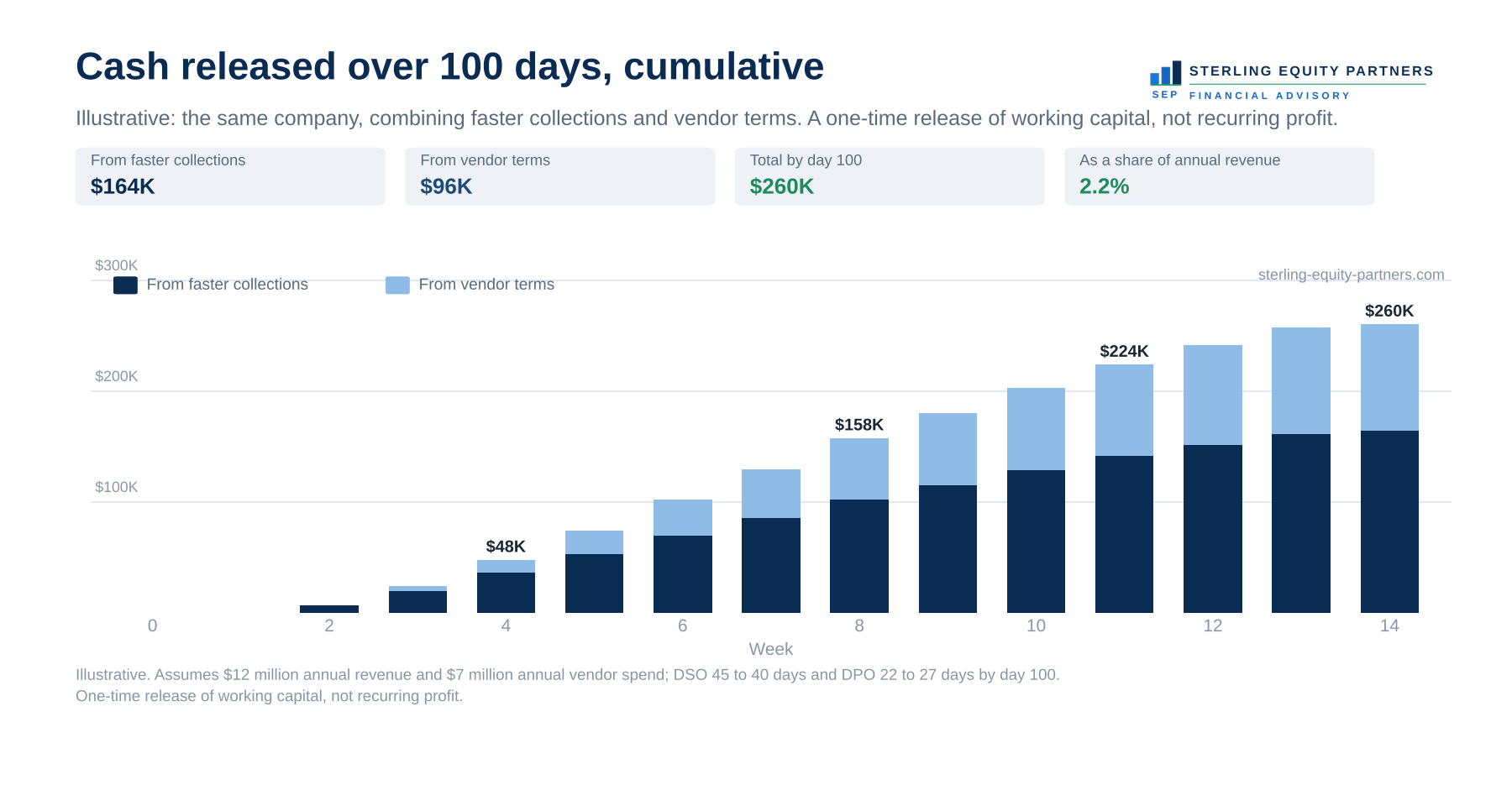
At an architecture firm with approximately $20 million in revenue, that combination, a structured collections program and vendor payments realigned to terms, released approximately $280,000 of working capital in about four months. The firm used the cash to pay off its revolving line of credit.
How the Work Runs
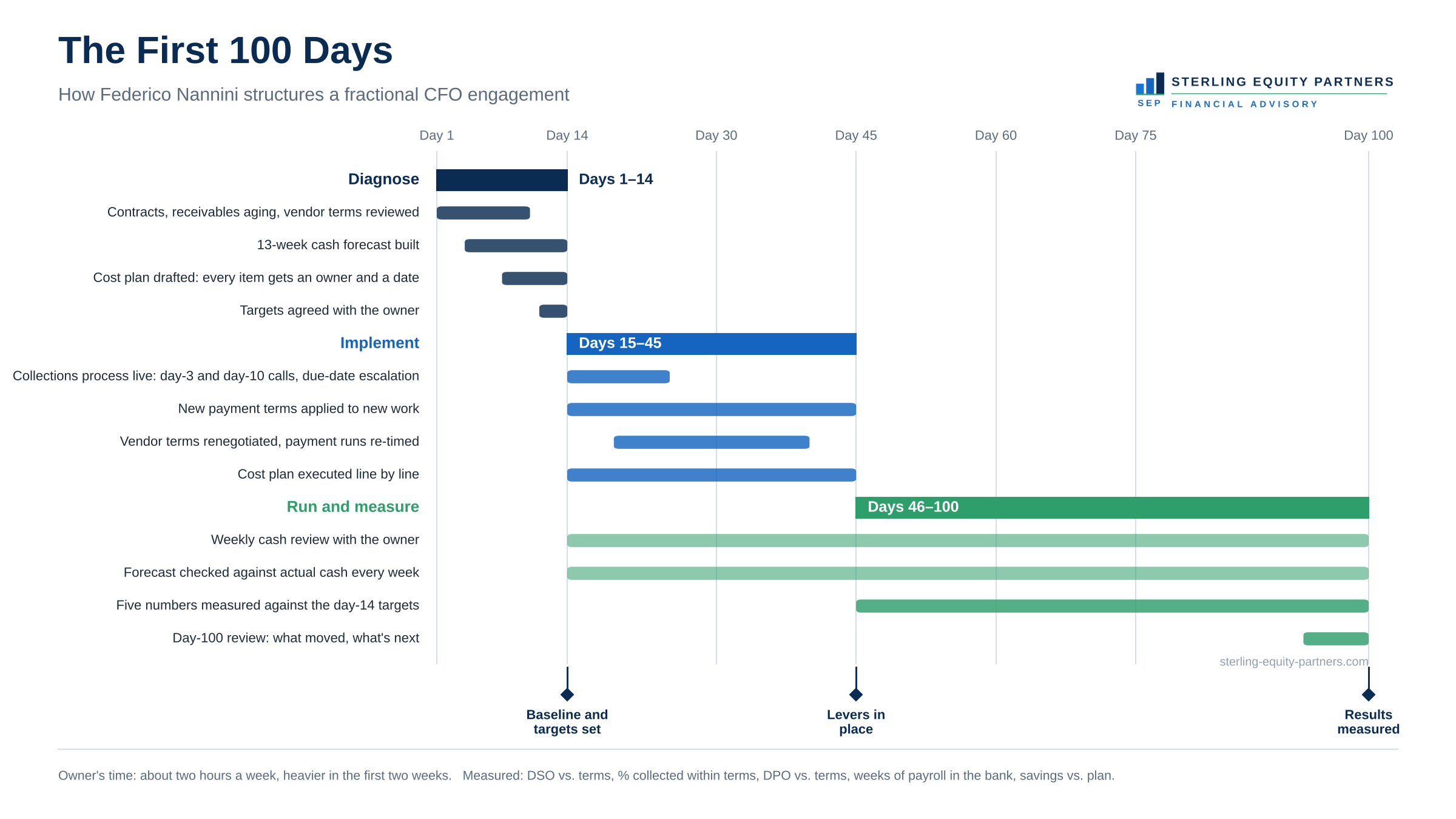
Federico structures the work as a 100-day engagement with the owner and whoever runs the books. The first two weeks go to the contracts, the aging report, the vendor terms, building the cash forecast, and drafting the cost plan with an owner and a date on every item. Days 15 through 45 put the collections process and the contract changes into effect on new work and start executing the cost plan. The balance of the 100 days is spent running the weekly rhythm, measuring the five numbers against the targets set at the start, and adjusting. The owner should plan on about two hours a week: a standing cash review, plus the time it takes to pull data, walk through how things get done today, and approve changes. The first two weeks run heavier than the rest.
“None of this is exotic,” Federico said. “It’s a set of decisions most owners would make in an afternoon if someone put the numbers in front of them. The work is putting the numbers in front of them and making sure the decisions get carried out.”
Owners who recognize those tight weeks in an otherwise healthy business, and want to see which of these levers apply to their company, can book a 30-minute call with Federico. The current receivables aging report is all it takes to start the conversation.
About Federico Nannini
Federico Nannini is the Founder and Managing Partner of Sterling Equity Partners, a Miami-based financial advisory firm that provides fractional CFO services to owner-operated and private equity-backed businesses, typically with $5 million to $50 million in revenue, with a focus on construction, auto dealerships, and professional services. He previously worked in transaction advisory at Berkeley Research Group, in private equity at Ark, and in the Office of the CFO and Turnaround and Restructuring practice at Impact Point Co. He holds a Master of Science in Finance from Georgetown University and a Bachelor of Science in Finance from Bentley University. Learn more at sterling-equity-partners.com.