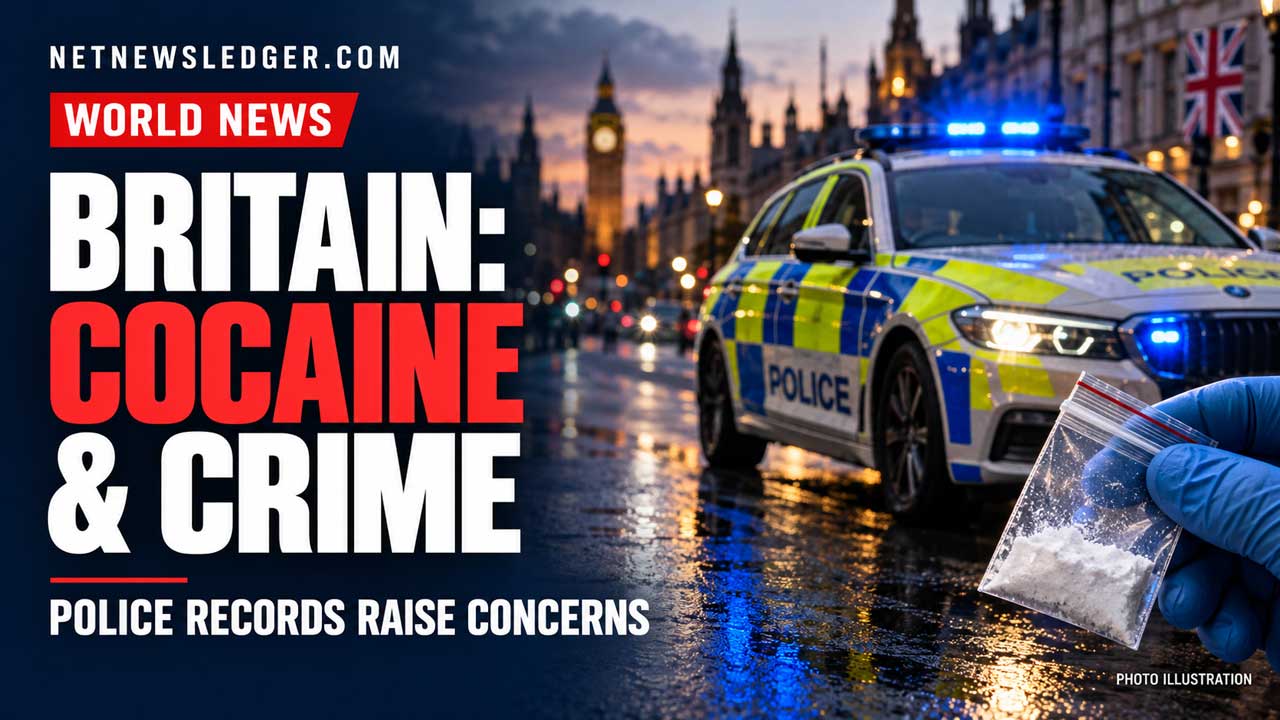
British crime records mentioning cocaine have risen since 2019, while new wastewater data show a recent decline in consumption at monitored English sites
An investigation highlights violence and road safety concerns, while newer government figures show a recent decline in estimated cocaine consumption
LONDON — British police are recording more offences that mention cocaine, raising concerns about drug trafficking, domestic abuse and road safety. The findings have renewed calls for prevention and treatment alongside enforcement.
A Guardian investigation published October 25 found at least 29,922 recorded crimes mentioning cocaine in 2025. The rate rose from 57.7 per 100,000 people in 2019 to 63.4 in 2025, an increase of about 10%.
Most were drug offences, but 18% involved violence and nearly 4% were sexual offences. Its keyword search covered 39 forces; records were incomplete, and London’s Metropolitan Police supplied none. Mentions do not establish causation.
Separate Home Office research, published October 14, found estimated cocaine consumption at 16 consistently monitored English wastewater sites was 17% higher in early 2026 than in the comparable 2021 sampling period. It was also 7% lower than in early 2025.
Those findings measure estimated consumption at the sampled locations. They do not count individual users or provide a full-year national total for 2026. They also do not support describing the latest consumption level as a record high.
An earlier Home Office analysis found a 26% increase between its 2021 and 2025 sampling periods. The newer report extends that comparison into 2026.
That earlier report also estimated England’s cocaine consumption at 123,000 kilograms between August 2024 and July 2025, with a retail market value of £9.8 billion. These are experimental estimates with substantial uncertainty: the published ranges extend roughly 39,400 kilograms and £3.2 billion above or below those central figures.
Domestic abuse remains a serious concern. The Guardian reported that nearly six in 10 drug tests carried out on people arrested on suspicion of domestic abuse between July 2025 and June 2026 were positive for cocaine. Those results describe the tested group, rather than all domestic abuse suspects.
Earlier police research also found a connection, while warning against treating drug use as the cause of abuse. A 2023 pilot across seven forces found 59% of those tested were positive for cocaine and/or opiates, rather than cocaine alone.
In that release, police and Women’s Aid said substance use can make existing abuse more severe or frequent. They emphasized that domestic abuse involves power and control, and that taking drugs does not automatically make someone an abuser.
Road safety figures add another concern. Data obtained from the Driver and Vehicle Licensing Agency by IAM RoadSmart show 30,707 drug-driving endorsements were added to licences in 2025, compared with 29,769 for the corresponding alcohol-driving offence.
The comparison covers specific offence categories and drugs generally, rather than cocaine alone. IAM RoadSmart has called for stronger enforcement and a national rehabilitation programme for convicted drug-drivers.
The National Crime Agency’s 2026 assessment says cocaine prices fell in 2025 while wholesale purity remained consistent. It identifies drug supply as a significant driver of violence associated with organized crime.
Paul Court, deputy drugs lead for the National Police Chiefs’ Council, told The Guardian that enforcement needs to be supported by prevention, reduced demand and access to treatment.
A May 2025 report by the Advisory Council on the Misuse of Drugs similarly called for coordinated prevention and stable, long-term funding. Its recommendations included closer work between schools, health services, local authorities and police, alongside better evaluation of which programmes reduce harm.