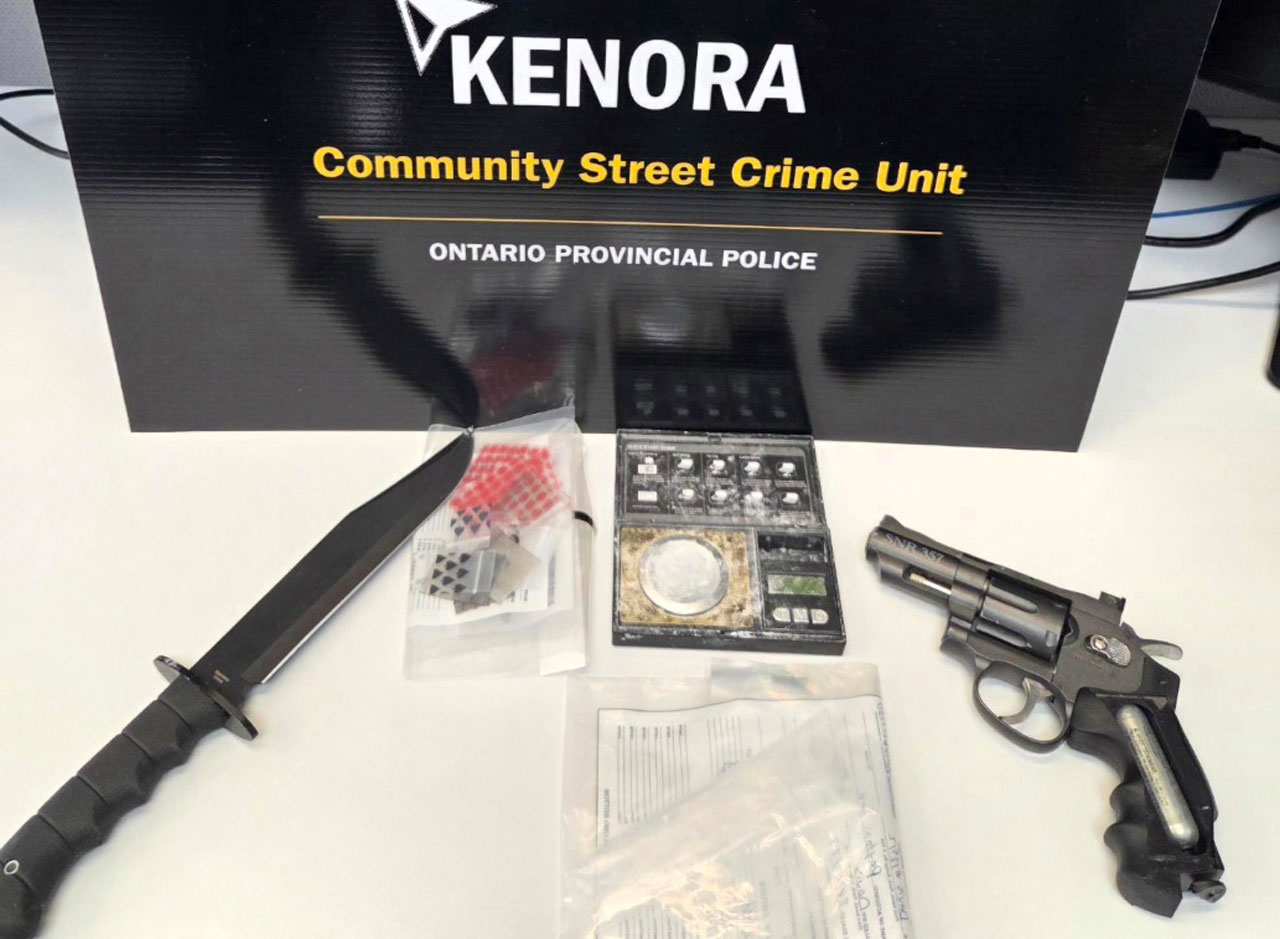
Kenora OPP Seize Suspected Crack Cocaine, Pellet Gun and Knife in Drug Trafficking Investigation
KENORA — REGIONAL CRIME NEWS — A 21-year-old Kenora resident is facing drug trafficking and weapons-related charges following an Ontario Provincial Police investigation that resulted in the seizure of suspected crack cocaine, a pellet gun, a large hunting knife and other items police allege are associated with drug trafficking.
Kenora OPP say Payton Roy, 21, was arrested Wednesday, Sept. 23, following an investigation involving officers from the Kenora detachment, Kenora Community Street Crime Unit and Kenora Organized Crime Enforcement Bureau.
Police Report Seizure of Suspected Crack Cocaine and Trafficking Materials
According to the OPP, investigators seized approximately 2.58 grams of suspected crack cocaine.
Police also reported seizing a pellet gun, a large hunting knife, multiple cellphones, packaging materials, a cutting agent and what investigators described as debt lists.
The substance is described as suspected crack cocaine because its identity remains an allegation unless confirmed through testing and established through the court process.
Roy has been charged with:
- possession of a Schedule I substance for the purpose of trafficking;
- carrying a concealed weapon; and
- failure to comply with an undertaking.
The accused was held in custody for a bail hearing scheduled before the Ontario Court of Justice on Thursday, Sept. 24.
Cocaine Trafficking Charge Explained
Possession of a controlled substance for the purpose of trafficking is prohibited by section 5(2) of the Controlled Drugs and Substances Act.
Cocaine is listed as a Schedule I substance under federal law.
A person convicted of possessing a Schedule I substance for the purpose of trafficking is guilty of an indictable offence and can face a maximum sentence of life imprisonment.
Life imprisonment is the statutory maximum and should not be interpreted as the likely sentence in an individual case.
Sentencing for cocaine trafficking varies considerably. Courts can consider the quantity involved, whether the trafficking was street-level or part of a larger operation, the offender’s role, criminal record, rehabilitation, guilty plea, pre-sentence custody and other aggravating or mitigating circumstances. Indigenous background and the principles established through Gladue must also be considered where applicable.
Custodial sentences are common in trafficking cases, but the length can range from relatively short periods of imprisonment to multi-year penitentiary sentences depending on the proven circumstances. The approximately 2.58 grams alleged in this investigation does not, on its own, establish what sentence could follow if there were a conviction.
What Carrying a Concealed Weapon Means
Under section 90 of the Criminal Code, it is an offence to carry a weapon, prohibited device or prohibited ammunition concealed without lawful authorization.
Police reported seizing both a pellet gun and a large hunting knife but did not specify in the release which item forms the basis of the concealed-weapon allegation.
The offence is hybrid.
If prosecuted by indictment, carrying a concealed weapon carries a maximum sentence of five years imprisonment. If the Crown proceeds summarily, the general maximum is two years less a day in jail, a fine of up to $5,000, or both, unless another penalty provision applies.
Actual sentences can range from non-custodial penalties to imprisonment depending on factors including the type of weapon, why it was carried, the circumstances in which it was concealed and the offender’s record.
Failure to Comply With an Undertaking
Roy is also charged with failing to comply with an undertaking.
An undertaking is a form of release containing conditions a person agrees to follow while a criminal matter is before the courts.
Under section 145(4) of the Criminal Code, a person commits an offence by failing, without lawful excuse, to comply with a condition of an undertaking or certain requirements to appear.
The offence carries a maximum of two years imprisonment if prosecuted by indictment. It can also be prosecuted summarily, where the general maximum is two years less a day, a $5,000 fine, or both.
Sentences for breaches can include probation, fines or custody depending on the seriousness of the breach, the condition involved and the individual’s previous compliance history.
Investigation Highlights Continuing Kenora Drug Enforcement
The involvement of the Community Street Crime Unit and Organized Crime Enforcement Bureau reflects the OPP’s continuing focus on drug trafficking investigations in Kenora and across Northwestern Ontario.
The items reported seized — including packaging materials, cellphones, a cutting agent and alleged debt lists — may form part of the Crown’s evidence, but their significance has not yet been tested in court.
No finding of guilt has been made.
Police Seek Information About Illegal Drug Activity
Anyone with information about suspected illegal drug activity can contact the Ontario Provincial Police at 1-888-310-1122.
Information can also be provided anonymously through Crime Stoppers at 1-800-222-TIPS (8477) or through Ontario Crime Stoppers online.
Residents should not confront people they suspect of trafficking drugs. Information such as dates, times, vehicle descriptions and observed activity can instead be provided directly to police.
Charges Remain Allegations
All of the charges against Roy remain allegations that must be proven in court.
Payton Roy is presumed innocent unless and until proven guilty beyond a reasonable doubt in a court of law.