Mining news: zinc tightens, gold stays strong and Ring of Fire road construction begins
THUNDER BAY — MINING — Mining markets enter September with a familiar theme taking on greater urgency: the world needs more metals, but producing and processing them is becoming increasingly difficult.
Copper remains central to electrification, artificial intelligence infrastructure and power-grid expansion.
Zinc markets are showing signs of acute supply tightness. Gold remains historically strong despite volatile interest-rate expectations, while governments continue treating rare earths, antimony and other critical minerals as matters of economic and national security.
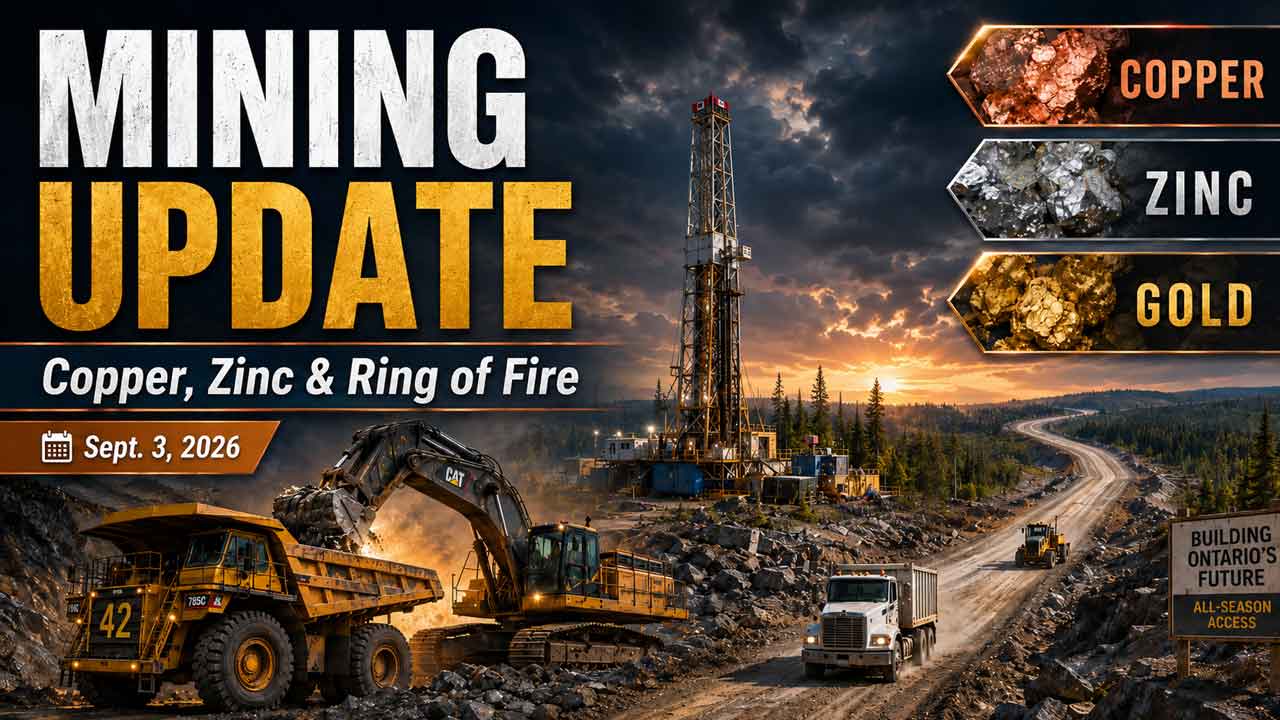
For Northwestern Ontario, the global trend is increasingly tangible. Construction is beginning on the Marten Falls Community Access Road, gold exploration remains active from Red Lake through Dryden, and governments are placing more emphasis on infrastructure capable of converting mineral deposits into operating mines.
September 3 Mining Watch: What NetNewsLedger Readers Need to Know
The most important mining stories for Northern Ontario readers are the growing Western zinc shortage, continued competition for copper and critical minerals, gold’s strength above US$4,400 an ounce, Canada’s newest copper-zinc mine moving toward commercial production, construction beginning on a major Ring of Fire road, and another active round of international drilling for gold, copper, silver and antimony.
INTERNATIONAL — Zinc Squeeze Exposes a Bigger Western Supply Problem
One of the most important commodity stories this week is not gold or copper.
It is zinc.
London Metal Exchange zinc reached a four-year high near US$3,990 a tonne as inventories tightened and mine production unexpectedly declined.
Global mined zinc production fell approximately 2.6 per cent during the first half of 2026, according to Reuters, despite expectations that supply would grow. Production disruptions have affected operations in Peru, Alaska, Australia and Sweden.
The bigger issue is processing.
Western smelters are being squeezed between tight concentrate supplies, high electricity costs and extremely low treatment charges. Chinese smelters, meanwhile, have increased output and imported more concentrate.
That creates a strategic problem familiar from other critical-mineral markets.
Having ore in the ground is not enough.
Countries also need the capacity to refine and process it.
INTERNATIONAL — Copper Remains at the Centre of the New Industrial Economy
Copper continues to command attention because almost every major industrial trend requires more electricity.
Data centres need power.
Electric vehicles need copper.
Transmission lines need copper.
Transformers, motors, renewable energy projects and conventional power generation all require substantial amounts of the metal.
Copper prices remain extremely elevated by historical standards as supply struggles to keep pace with projected demand.
Production problems at major mines are adding pressure.
Chile’s state-owned Codelco recently reported that its copper production fell 11 per cent during the first half of 2026, even as sharply higher copper prices helped its pre-tax profit climb to US$1.97 billion.
The company has dealt with operating problems at several mines, including El Teniente and Chuquicamata.
That illustrates a fundamental challenge facing the industry.
The world is demanding more copper at the same time that many existing mines are becoming older, deeper and more expensive to operate.
INTERNATIONAL — India Joins the Race for Overseas Copper Supply
India is also moving more aggressively to secure long-term mineral supplies.
Indian officials have resumed talks with Zambia over investments in copper and other critical minerals as the country’s industrial demand grows.
India’s state-backed overseas minerals organization is also examining opportunities in countries including Canada, Australia, Brazil, Indonesia and Malawi.
India is already one of the world’s largest importers of refined copper and could become increasingly dependent on imported concentrate during the next two decades.
The significance for Canadian mining is straightforward.
INTERNATIONAL — Washington Keeps Treating Minerals as National Security
The United States continues to reshape the relationship between government and mining.
Washington announced approximately US$3 billion in new critical-mineral and battery investment in August as part of a broader effort to secure supplies for defence, manufacturing and advanced technology.
The U.S. has also created a strategic mineral stockpile backed by billions of dollars and has increasingly taken equity positions in strategically important companies.
This is a significant departure from the idea that governments should simply permit projects and allow commodity markets to determine everything else.
Critical-mineral policy is increasingly industrial policy.
For Northwestern Ontario, that increases the strategic importance of deposits containing nickel, copper, chromite and other minerals — but it also raises expectations around project timelines, infrastructure and domestic processing.
INTERNATIONAL — Gold Rebounds Above US$4,400
Gold moved higher Thursday as the U.S. dollar and Treasury yields weakened.
Spot gold climbed approximately 1.2 per cent to US$4,437 an ounce, according to Reuters.
The metal remains sensitive to interest-rate expectations.
Higher rates can make gold less attractive because bullion does not pay interest, while geopolitical uncertainty and inflation concerns can increase investor demand for it.
For Northwestern Ontario, the larger picture remains favourable for exploration.
Gold prices at these levels can support financing for drilling and encourage companies to test targets that might receive less attention during weaker markets.
That benefits established and emerging camps including Red Lake, Pickle Lake, Geraldton and Dryden.
High gold prices, however, do not automatically make every discovery economic. Grade, geometry, metallurgy, infrastructure, capital costs and permitting still determine whether an exploration project can become a mine.
NATIONAL — Canada’s McIlvenna Bay Copper-Zinc Mine Moves Toward Commercial Production
One of Canada’s most significant new base-metal mines is moving into production.
The McIlvenna Bay mine in Saskatchewan’s Flin Flon Greenstone Belt produced its first copper concentrate in June and zinc and pyrite concentrates in July.
Commercial production is expected during the third quarter of 2026.
The Eldorado Gold project is expected over its operating life to average annual production of approximately:
- 41 million pounds of copper;
- 54 million pounds of zinc;
- 20,000 ounces of gold; and
- 444,000 ounces of silver.
The operation currently employs roughly 380 people, with employment expected to increase to approximately 450 at commercial production. Natural Resources Canada says about 34 per cent of the workforce is Indigenous.
McIlvenna Bay also illustrates the importance of electricity.
An 85-kilometre transmission line and substation were required to connect the project to Saskatchewan’s electrical grid.
NATIONAL — Processing Capacity Is Becoming as Important as Mining Capacity
McIlvenna Bay’s copper concentrate is expected to be smelted in Quebec.
That is important because Canada increasingly wants to retain more of the mining value chain domestically.
Recent zinc and copper market developments demonstrate why.
A country that produces concentrate but lacks refining capacity can still remain dependent on foreign processors.
That dependence becomes strategically significant when minerals are needed for electricity systems, vehicles, defence equipment and advanced manufacturing.
For Northern Ontario, future mining policy will therefore need to consider more than extraction.
Where material is processed could determine how many jobs and how much economic value remain in Canada.
NATIONAL — $2-Billion Sudbury Investment Highlights Ontario’s Nickel Opportunity
Glencore’s Onaping Depth project at Craig Mine near Sudbury reached another major milestone in late August.
The approximately $2-billion investment is designed to provide access to deeper nickel-bearing ore and extend production from the Sudbury Basin.
First production from the Onaping Depth zone is expected later in 2026.
The project reinforces the continued importance of Ontario’s century-old mining districts.
Technology allows companies to pursue ore at depths previous generations could not economically reach.
That has implications well beyond Sudbury.
Across Northwestern Ontario, improved geophysics, drilling, automation and geological modelling are allowing explorers to reassess old camps and test mineral systems at greater depths.
REGIONAL — Construction Begins on the Marten Falls Community Access Road
The Ring of Fire file has moved into a different phase.
Ontario and Marten Falls First Nation have marked the beginning of construction on the 184-kilometre Marten Falls Community Access Road, the longest section of the proposed Ring of Fire all-season road network.
Early work includes tree clearing, construction-camp preparation and development of aggregate sources.
The road is planned to include 35 bridges and culverts and is scheduled to open by November 2031.
Marten Falls First Nation and Bird Construction are working through Piinahzii Limited Partnership, a majority Indigenous-owned partnership involved in delivering the project.
The road serves two purposes that should both remain clear in coverage.
For Marten Falls First Nation, it would provide the community with year-round connection to Ontario’s provincial highway network, affecting travel, food costs, construction, health services and economic development.
For mining, it would form part of the infrastructure needed to access Ring of Fire mineral deposits.
REGIONAL — Ring of Fire Debate Now Turns to Execution and Ownership
After years dominated by announcements and environmental planning, the key Ring of Fire questions are becoming increasingly practical.
Who receives construction contracts?
How many First Nation workers are trained?
Who owns infrastructure?
How will mines receive electricity?
Where will minerals be processed?
Which projects are economically viable?
And how will environmental and Treaty concerns be addressed?
Ontario says its Ring of Fire strategy could eventually add $22 billion to the provincial economy and support 70,000 jobs, although those figures represent government projections rather than guaranteed outcomes.
There remains no single Indigenous position on Ring of Fire development.
Marten Falls and some other First Nations are directly participating in infrastructure initiatives, while other Indigenous leaders and communities have raised concerns over Treaty rights, environmental effects and the pace of development.
That distinction remains essential.
REGIONAL — Northwestern Ontario Gold Exploration Remains Well Positioned
Gold’s continued strength is helping maintain investor attention on Northwestern Ontario.
Recent deeper drilling by Dryden Gold at the Gold Rock Camp extended its Spyglass mineralized zone to approximately 330 metres vertical depth, while the nearby Buccaneer zone has been tested to roughly 370 metres.
A recently reported Spyglass hole returned 9.40 grams per tonne gold over 4.60 metres, including 78.40 g/t over 0.38 metres.
The Dryden results remain exploration-stage findings. Additional drilling will be required to determine continuity, geometry and eventual resource potential.
Elsewhere, Red Lake remains one of Canada’s most active gold districts, with producing mines, restart projects and grassroots exploration all drawing attention.
The region benefits from geology and established mining expertise, but higher gold prices make competition for skilled labour, drill crews and capital more intense as well.
DRILL RESULTS — Many Peaks Extends Ouarigue Gold Mineralization at Depth
Many Peaks Minerals reported a significant deep gold intersection from its Ouarigue prospect at the Ferké project in Côte d’Ivoire.
Hole FNDC135 returned:
36 metres grading 2.64 g/t gold from 600 metres, including 4.2 metres grading 5.39 g/t gold.
The hole represents a roughly 160-metre step-out and helps establish the interpreted northern extent of mineralization at that depth.
The current Ouarigue mineral resource is reported at approximately 26.7 million tonnes grading 1.54 g/t gold for 1.32 million ounces.
The latest drilling is intended to support an updated resource estimate.
For investors, the important issue is not simply depth but whether drilling can demonstrate sufficient continuity to justify expanding the resource model.
DRILL RESULTS — Sun Silver Finds Broad Silver-Antimony Mineralization in Nevada
Sun Silver reported another broad intersection from its Maverick project in Nevada.
Hole MV0004 returned approximately 89 metres grading 70 g/t silver equivalent from 126.5 metres, including 38.3 metres grading 100 g/t silver equivalent.
A narrower 0.8-metre interval returned 1,296 g/t silver equivalent.
The hole also encountered extensive antimony mineralization beginning above the current mineral-resource envelope.
Antimony is becoming increasingly important because of its applications in defence, alloys, batteries and flame-retardant products.
That means what might once have been viewed mainly as a silver exploration story now has a critical-minerals dimension.
DRILL RESULTS — AusQuest Reports Copper at Cangallo in Peru
AusQuest has reported what it describes as significant copper mineralization from drilling at its Cangallo project in Peru.
The company is exploring the project as part of a broader district-scale copper strategy.
Peru remains one of the world’s most important copper-producing countries, making exploration success there relevant to global supply forecasts.
The latest result also reinforces why copper exploration is attracting capital across multiple continents.
Demand growth is occurring at the same time major producers are experiencing grade decline, technical challenges and higher capital costs.
DRILL RESULTS — Santana Continues Infill Work at Rise and Shine
Santana Minerals continues infill drilling at the Rise and Shine, or RAS, gold deposit in New Zealand.
The program is designed to increase geological confidence in the higher-grade core and support mine-planning work.
RAS has previously returned thick, high-grade gold intersections and forms a central part of Santana’s Bendigo-Ophir project.
Infill drilling is different from early-stage exploration.
The principal objective is generally not finding an entirely new deposit, but determining whether mineralization already identified is sufficiently continuous and well understood to move material from lower-confidence resource categories toward higher-confidence classifications.
That information can directly influence engineering and mine design.
DRILL RESULTS — Gold Exploration Expands in Côte d’Ivoire
West Africa remains one of the world’s most active gold-exploration regions.
In addition to Many Peaks’ drilling, Famien Resources is expanding its land position and advancing exploration targets in Côte d’Ivoire.
Dalaroo Metals has also begun maiden drilling at its Bondoukou Gold Ridge project.
Côte d’Ivoire has attracted substantial exploration investment because it lies within the Birimian geological terrain that hosts major gold deposits across West Africa.
The increase in drilling demonstrates how elevated gold prices are encouraging companies to pursue both established deposits and earlier-stage geological targets.
DRILL RESULTS — Australian Gold Programs Continue Expanding
Australian companies also continue deploying substantial exploration capital.
Gorilla Gold Mines reports that the Sovereign Footwall mineralized trend has now been traced for more than a kilometre.
Marmota has expanded drilling at its Greenewood gold discovery to approximately 31,000 metres.
Javelin Minerals has begun drilling gold-copper targets at Coogee, while other explorers are carrying out resource conversion and extension programs.
The large number of active programs shows how strong metal prices can affect exploration quickly.
Money raised during favourable markets often translates into additional drill rigs, deeper holes and broader regional programs.
MERGERS AND STRATEGIC DEALS — Rare-Earth Recycling Gains Attention
Ionic Rare Earths and U.S. Strategic Metals have announced plans for a U.S.-based magnet-recycling joint venture.
The development highlights another component of critical-mineral security.
New mines are only part of the supply solution.
Recycling permanent magnets can recover rare-earth materials already circulating through vehicles, electronics and industrial equipment.
For Canada, recycling could eventually complement new mining and help reduce reliance on imported processed materials.
MERGERS AND ACQUISITIONS — Tungsten Joins the Strategic Mineral Hunt
Blaze Minerals is acquiring high-grade tungsten projects in Uganda.
Tungsten is another relatively small mineral market that has become much more strategically important because of defence and industrial applications.
Like antimony and rare earths, tungsten demonstrates how mining investment is moving beyond the traditional focus on gold, copper and iron ore.
Small commodity markets can become strategically significant when production is concentrated in a small number of countries.
What Northwestern Ontario Mining NewsHawks Should Watch
The Ring of Fire road network is now a construction and accountability story. Track contracts, employment, Indigenous ownership, environmental requirements, timelines and costs.
The McIlvenna Bay mine offers an important Canadian comparison. It shows the infrastructure, transmission and processing requirements needed to move a critical-mineral project from geological discovery to production.
The zinc squeeze deserves more attention. Copper dominates critical-mineral headlines, but shortages of zinc concentrate and Western processing capacity demonstrate that supply-chain vulnerabilities extend across the base-metals sector.
The gold price continues to support Northwestern Ontario exploration, particularly around Red Lake, Dryden, Pickle Lake and Geraldton.
And the bigger strategic question remains electricity.
More mines, mineral-processing facilities, data centres and advanced manufacturing all require large amounts of dependable power.
For Northwestern Ontario, future mineral development may ultimately be limited as much by transmission capacity as geology.
The province and federal government can accelerate permitting and build roads, but ore cannot be mined, crushed, processed and refined at scale without electricity.
That makes the next phase of Northern Ontario mining policy broader than mining itself.
It is about roads, power, processing, Indigenous ownership, technology and the ability to convert world-class geology into a functioning regional economy.