FBI launches Voices Not Forgotten, boosting rewards and mapping unsolved Indigenous cases in the U.S.
WASHINGTON — The FBI has launched a new initiative aimed at generating leads in unresolved homicides, kidnappings and missing-person cases involving Indigenous people in U.S. Indian country, combining larger rewards with an interactive map designed to make cases easier for the public to find.
Announced Aug. 18, 2026, by FBI Director Kash Patel, Voices Not Forgotten establishes rewards of up to US$25,000for publicly advertised cases that meet the initiative’s criteria and fall under FBI jurisdiction. The initiative is significant beyond the United States because Indigenous communities on both sides of the Canada-U.S. border continue to confront disproportionate levels of violence, missing-person cases and unresolved deaths.
New FBI Program Puts Unsolved Indigenous Cases on an Interactive Map
The FBI announced Voices Not Forgotten during its National Law Enforcement Partner Conference, which brought together more than 200 members of tribal law enforcement from across the United States.
The agency says the program is intended to increase public awareness and generate new investigative leads by making information about unresolved cases easier to locate.
The Voices Not Forgotten webpage includes a searchable, interactive map connecting users with FBI posters seeking information about violent crimes associated with tribal communities and reservations.
According to the FBI, the map identifies cases connected with federal Indian reservations across the United States. The agency has investigative responsibility for federal crimes on nearly 200 reservations and shares federal jurisdiction with the Bureau of Indian Affairs.
The initiative also establishes a new reward protocol. Publicly advertised homicide and kidnapping investigations, along with missing-person investigations where the person is suspected of having been killed, can carry a reward of up to US$25,000.
Some of those investigations are Missing or Murdered Indigenous Persons, or MMIP, cases.
Six Unsolved Cases Given Added Attention
The FBI is initially highlighting six cases as part of the initiative:
- Angel Beach
- Sa’wade Birdinground
- Maleeka “Mollie” Boone
- Logan Warrior Goings
- Mary Johnson (Davis)
- Emily Pike
The cases involve significant unresolved investigative work in Indian country, according to the FBI. The agency is asking people with information to contact investigators even when the information may appear minor.
Patel said the program is intended to use public awareness in much the same way the FBI has used its high-profile wanted-person campaigns.
“The public is one of our best resources,” Patel said in announcing the initiative.
Tips may be submitted anonymously through the FBI.
Why This Matters in Canada?
Although Voices Not Forgotten is an American initiative and does not extend FBI jurisdiction into Canada, its approach will be of interest to First Nations leaders, families, police services and Indigenous organizations in Northwestern Ontario.
The international boundary between Ontario, Minnesota and other Great Lakes states crosses a region where Indigenous peoples have longstanding family, cultural and community relationships. People also routinely travel across the border for employment, education, family, ceremonies and other reasons.
That means information relevant to a U.S. investigation does not necessarily remain on the U.S. side of the border.
The FBI specifically states that people outside the United States who have information concerning one of its cases may contact the nearest American embassy or consulate, an FBI field office or submit information through the agency’s tip system.
For Northwestern Ontario, the initiative also raises a broader policy question: Can better public access to case information and more prominent rewards produce useful new leads in long-unsolved Indigenous cases?
That will be worth watching as Voices Not Forgotten develops.
The interactive-map approach could also provide lessons for agencies seeking to make missing-person information easier for families and communities to locate without having to navigate multiple police databases and government websites.
Canada Continues to Face Disproportionate Violence Against Indigenous People
The U.S. initiative comes against a wider North American reality of disproportionate violence affecting Indigenous people.
Statistics Canada reported 225 Indigenous homicide victims in 2024, 29 more than in 2023. The Indigenous homicide rate was 10.84 victims per 100,000 population, about eight times the rate recorded among the non-Indigenous population.
The issue has been documented in Canada for decades.
An RCMP national review released in 2014 identified 1,181 police-recorded cases involving Indigenous women who were murdered between 1980 and 2012 or remained missing when the data was assembled. The RCMP cautioned that the figures represented the information available to police at the time and were not a complete measure of every missing or murdered Indigenous woman in Canada.
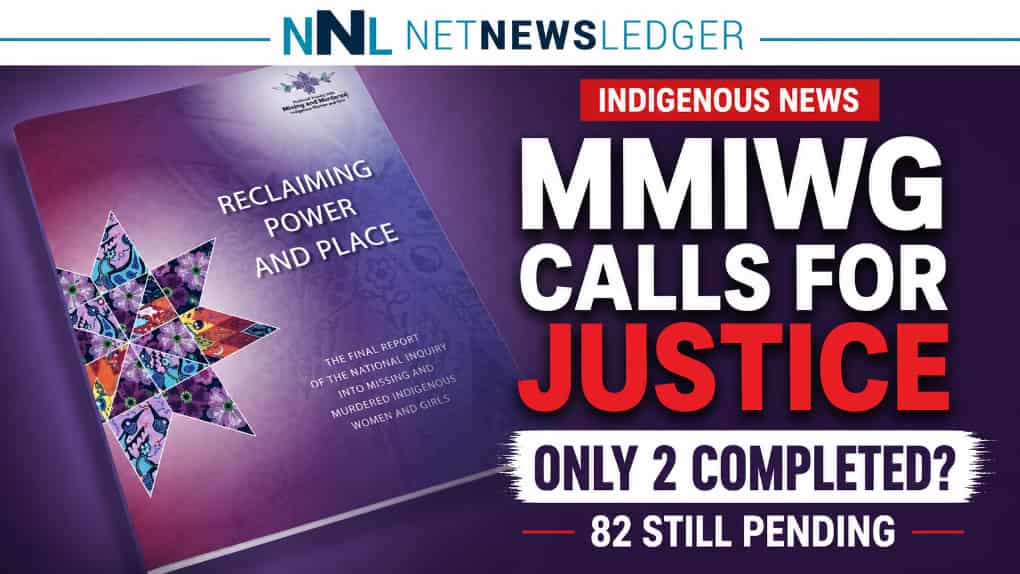
Canada’s National Inquiry into Missing and Murdered Indigenous Women and Girls delivered its final report, Reclaiming Power and Place, on June 3, 2019.
The inquiry issued 231 Calls for Justice directed at governments, institutions, service providers and Canadians, addressing policing and justice as well as the underlying social, economic and historical conditions contributing to violence against Indigenous women, girls and 2SLGBTQQIA+ people.
However few of the calls for justice have been completed and now the funding for any further efforts has sunsetted.
Initiative Builds on Earlier U.S. MMIP Work
Voices Not Forgotten did not emerge in isolation.
The FBI says it was shaped in part by recommendations from Indigenous communities and the U.S. Not Invisible Act Commission, which was established under legislation passed in 2020.
That commission brought together tribal leaders, law enforcement, federal agencies, service providers, family members and survivors. Its work included recommendations intended to improve intergovernmental co-ordination, law-enforcement practices and services for survivors and families. Its report was released in November 2023.
The FBI has also operated Operation Not Forgotten since 2023, deploying additional investigative, intelligence and victim-service resources to unresolved violent-crime investigations in Indian country.
Voices Not Forgotten adds a more public-facing component: greater visibility, location-based searching and substantially promoted financial rewards intended to encourage people with information to come forward.
How to Provide Information
Anyone with information concerning a case listed through Voices Not Forgotten can contact the FBI at 1-800-CALL-FBI (1-800-225-5324) or use the FBI’s online tip service. Tips may be made anonymously.
People outside the United States may also contact the nearest U.S. embassy or consulate.
The FBI says the initiative will continue to feature investigations in which federal, state, local and tribal authorities are seeking public assistance.
For families affected by missing and murdered Indigenous people, whether in the United States or Canada, the central test will be whether greater visibility translates into information investigators can use — and ultimately into answers.