Copernicus reports record-low first-half biomass burning emissions, but wildfire risks remain
THUNDER BAY — Climate News – Global emissions from biomass burning during the first half of 2026 were the lowest recorded for the period in the 24-year Copernicus Atmosphere Monitoring Service fire-emissions dataset.
The finding offers a positive global snapshot, but Copernicus warns the trend could change quickly. Fire activity increased sharply in North America and Eurasia in late June, including large wildfires in several Canadian provinces.
Reduced seasonal fires in Africa helped drive global decline
According to the Copernicus Atmosphere Monitoring Service, known as CAMS, total estimated carbon emissions from biomass burning between Jan. 1 and June 30 came in just below 400 megatonnes of carbon.
The largest contributors were Africa, at 154 megatonnes, and Asia, at 113 megatonnes. Both regions have long-standing dry-season agricultural fire patterns.
CAMS says reduced seasonal fires in tropical Africa were a major factor in the overall global decrease. Its Global Fire Assimilation System, or GFAS, places 2026 as the lowest first-half emissions year in the dataset, which dates back to 2003.
Canada sees late-June wildfire increase
During the second half of June, fire activity and emissions increased significantly in North America. CAMS says large wildfires developed in several Canadian provinces, many ignited by lightning.
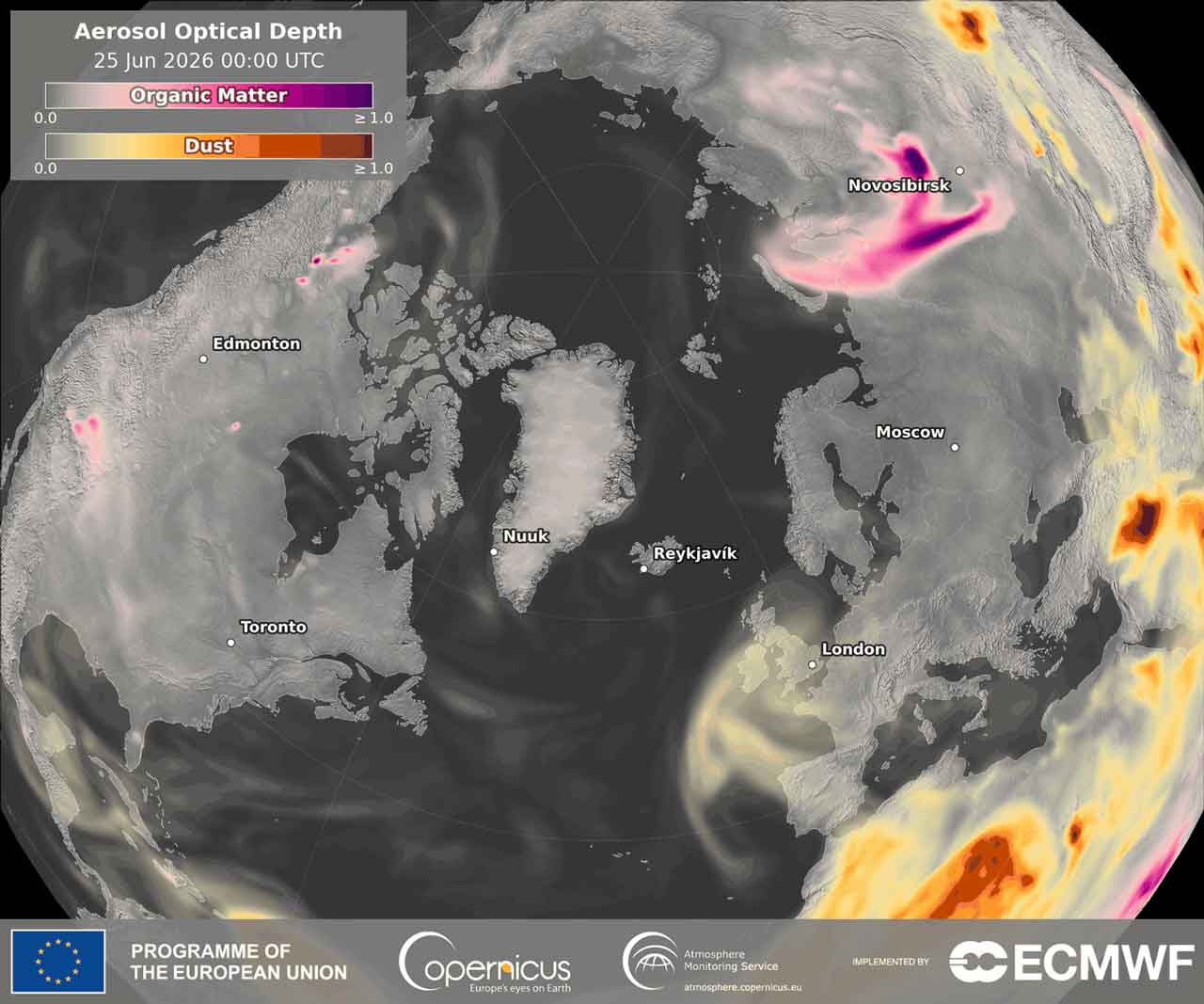
Smoke plumes containing particulate matter and gases such as carbon monoxide were observed in CAMS aerosol optical depth forecasts. The service has also tracked smoke transported toward the Canadian Arctic and across the North Atlantic.
The largest Canadian fires observed by CAMS were in the Northwest Territories and Manitoba. Despite the late-June increase, Canada’s overall carbon emissions from fires remain below average.
Why this matters for Thunder Bay and Northwestern Ontario
For Thunder Bay and Northwestern Ontario, wildfire emissions are a local public health and emergency-management issue.
Smoke from fires in Manitoba, Northern Ontario, the Prairies, the Northwest Territories and farther afield can affect local air quality, visibility and transportation. Heavy smoke can increase health risks for seniors, children, outdoor workers and people with asthma, chronic obstructive pulmonary disease, heart disease or other respiratory and cardiovascular conditions.
Wildfire smoke also affects remote First Nations, where poor visibility can disrupt flights, medical travel, supply movement and evacuation operations. Thunder Bay regularly serves as a transportation and emergency-response hub when northern communities are threatened by wildfire, smoke or unsafe conditions.
Europe and Southern Hemisphere also part of CAMS review
The CAMS review of the first half of 2026 also includes fire activity in northern and western Europe, where unusually dry and warm conditions contributed to wildfire concerns.
The review also examines an intense start to the year in the Southern Hemisphere.
Copernicus says wildfire emissions’ impacts on human health and the environment are a matter of global concern, with research continuing to show the wide-ranging consequences of smoke and airborne pollutants.
Scientist warns positive trend may not hold
Mark Parrington, senior scientist at the Copernicus Atmosphere Monitoring Service, said the record-low first-half emissions continue a broader downward trend linked to changes in savanna fires in tropical Africa and Asia.
“The record low total biomass burning emissions for the first half of 2026 continues the overall downward trend related to changes in savanna fires in tropical Africa and Asia,” Parrington said.
But he cautioned that the onset of large-scale wildfires across Eurasia and North America in the final weeks of June could increase global emissions during the rest of the summer.
Parrington also pointed to predicted El Niño conditions, which could increase global fire emissions later in the year. He cited previous El Niño years, including 2015 and 2019, when persistent biomass burning in Indonesia caused widespread regional haze and severely degraded air quality.
“While the first half of the year provides a positive snapshot, continued monitoring remains essential as wildfire smoke can still have significant air quality impacts and conditions can change quickly,” Parrington said.
How Copernicus monitors fire emissions
CAMS GFAS uses satellite observations from VIIRS and MODIS instruments to estimate fire radiative power. Those estimates are used to calculate emissions of carbon and other pollutants from wildfires and biomass burning.
The system then uses the European Centre for Medium-Range Weather Forecasts Integrated Forecasting System to help assess wildfire emissions, smoke transport and expected atmospheric impacts.
Copernicus is the Earth observation component of the European Union’s Space programme. It is coordinated by the European Commission and delivered with European member states and partner organizations.
The European Centre for Medium-Range Weather Forecasts, or ECMWF, is a research institute and 24/7 operational weather service that produces global numerical weather predictions and maintains one of the world’s largest meteorological data archives. ECMWF implements several Copernicus services, including climate change monitoring, atmospheric composition monitoring and contributions to flood and fire-danger information.
Regional climate context
A lower global emissions total does not mean lower local risk for Northwestern Ontario.
Wildfire danger depends on local conditions, including lightning, drought, wind, fuel moisture, forest type and human activity. Wet weather can temporarily reduce fire behaviour, while several dry, hot and windy days can rapidly increase risk.
For municipalities, First Nations, forestry operators, mining camps, tourism businesses and emergency planners, the key lesson is that fire conditions remain dynamic. Continued monitoring is essential, especially as smoke can travel thousands of kilometres and affect communities far from the fire line.