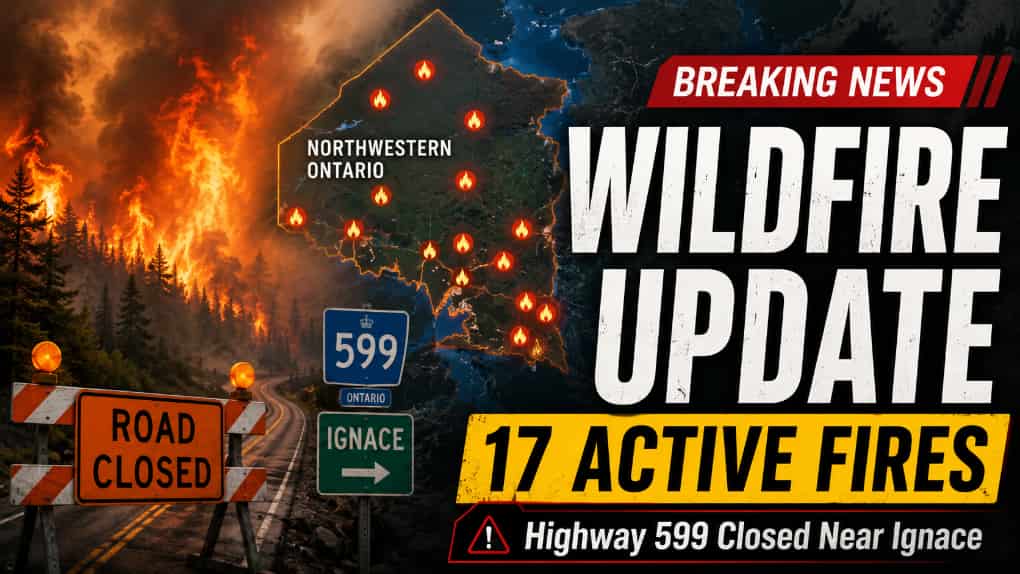
Northwest Region Reports 17 Active Wildland Fires as Long Weekend Begins
THUNDER BAY – Wildfire Update – Ontario fire officials are reporting 17 active wildland fires across the Northwest Region, including several not under control near Fort Frances, Ignace and Thunder Bay-area travel corridors.
The update matters locally as fire activity is affecting highways, Indigenous communities and rural areas across Northwestern Ontario at the start of the long weekend.
Twenty New Fires Confirmed Across the Northwest Region
Aviation, Forest Fire and Emergency Services reported 20 new wildland fires in the Northwest Region on Friday, May 15, with seven fires called out by the evening update issued at 9:50 p.m. CDT.
Of the 17 active fires, 14 are not under control, two are under control and one is being held.
The most serious fire activity is concentrated in the Fort Frances, Dryden and Thunder Bay districts, where crews are using aerial and ground suppression.
Fires of Note
Fort Frances 4 is burning south of Highway 11 near Factor Lake. The fire is listed at 10 hectares and is not under control. Fire crews continued aerial and ground suppression through the day.
Fort Frances 5 is near the southeast side of Little Turtle Lake near Mine Centre. The 20-hectare fire is not under control. The Ontario Provincial Police assisted with an evacuation of the community to allow safe aerial suppression operations.
Fort Frances 6 is near Highway 615 between Off Lake Road and Highway 71. The 30-hectare fire is not under control.
Fort Frances 7 is burning in Northwest Bay First Nation. The 20-hectare fire is not under control, with ground suppression efforts continuing.
Fort Frances 8 is west of Lac La Croix First Nation, on the west side of the Namakan River. The eight-hectare fire is not under control and received aerial suppression Friday evening.
Dryden 11 is north of Ignace on the east side of Sandbar Lake. The 168-hectare fire is not under control. Aerial and ground suppression efforts continued into the evening.
The OPP assisted with an evacuation in the area and issued a closure for Highway 599 between Ignace and Silver Dollar.
Thunder Bay District Fires
Several new fires were confirmed in the Thunder Bay District.
Thunder Bay 3 is near the intersection of Highway 11 and Highway 17. The 0.3-hectare fire is not under control.
Thunder Bay 4 is about 11 kilometres southwest of Upsala, south of Highway 17. The one-hectare fire is not under control.
Thunder Bay 5 is about two kilometres southwest of Armstrong. The 0.2-hectare fire is not under control.
Thunder Bay 6 is about two kilometres southeast of Wawang Lake, west of Graham Road. The 0.1-hectare fire is not under control.
Thunder Bay 7 is about four kilometres west of Kashabowie Lake, north of Highway 11. The 0.2-hectare fire is not under control.
Thunder Bay 8 is on the east side of Cushing Lake and Thunder Bay 9 is southwest of Cushing Lake. Both remain not under control.
Other Fires in the Region
In the Kenora area, Kenora 6, south of Muriel Lake near highways 596 and 641, was called out at 1.5 hectares. Kenora 7, west of Highway 673 and about 4.5 kilometres south of Highway 17, is 1.5 hectares and not under control.
In the Dryden area, several small fires were called out near Ignace, Wabigoon and Dryden. Dryden 10, about four kilometres northwest of Silver Dollar, is under control at 0.3 hectares.
Local Impact for Northwestern Ontario
The fire situation is significant for Northwestern Ontario because several fires are close to major road links, including highways 11, 17, 599, 615 and 71. These routes are important for regional travel, freight movement, emergency response and access to remote communities.
The Highway 599 closure between Ignace and Silver Dollar may affect residents, forestry operations, tourism traffic and people travelling to remote areas north of the Trans-Canada Highway. Fire activity near First Nations, including Northwest Bay First Nation and Lac La Croix First Nation, also highlights the added risk facing Indigenous communities, where road access, evacuation logistics and emergency response capacity can be more limited than in larger urban centres.
Conditions can change quickly with wind, dry grass and low spring moisture. Residents should monitor official fire updates before travelling, especially in rural, remote or camp areas.
Long Weekend Fire Safety Reminder
Ontario’s legislated fire season runs from April 1 to Oct. 31. Outdoor fire rules are in effect across the province.
Fire officials are reminding residents that spring is a high-risk period for grass fires. Dry grass can ignite easily and spread rapidly, especially during windy conditions.
Residents are encouraged to compost yard waste or use local landfill services rather than burn debris. Anyone who must burn is required to follow Ontario’s outdoor fire rules. Fires must be started no sooner than two hours before sunset and extinguished no later than two hours after sunrise. Water and tools must be available at the burn site.
Residents inside municipal boundaries should check with their local fire department for burn permits, restrictions or local fire bans before lighting any outdoor fire.
How to Report a Wildland Fire
To report a wildland fire north of the French and Mattawa rivers, call 310-FIRE, or 310-3473.
South of the French or Mattawa rivers, call 911.
The Ministry of Natural Resources posts current fire information through Ontario’s interactive fire map and its Ontario Forest Fires social media channels. Fire conditions are updated throughout the day and may change quickly.