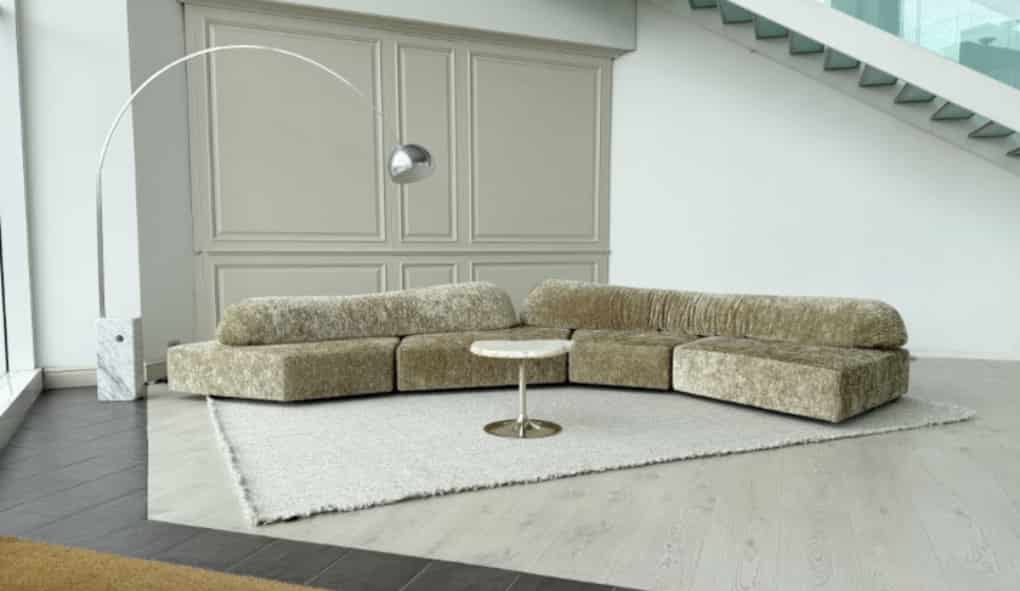
There’s a persistent myth in interior design that old and new furniture can’t coexist. Walk into any serious decorator’s home, and you’ll find the opposite is true: a Bauhaus sideboard sitting beside a contemporary sectional sofa, a Victorian mirror hanging above a minimal console. The mix isn’t accidental. It’s intentional, and increasingly, it’s the most credible marker of a well-designed space.
What separates a thoughtful combination from a cluttered one isn’t luck or instinct; it’s understanding why certain pieces work together regardless of their age. High-end furniture brands that specialize in statement furniture (Edra, Vismara, De Sede) have built entire collections around this tension: pieces deliberately designed to hold their own in any decade, next to anything.
Why Furniture Periods Are a Marketing Myth Worth Ignoring
The idea that furniture “belongs” to a specific era is partly a marketing invention and partly a comfort mechanism. Consumers like categories. But design has always been a conversation across time: Post-modernism was reacting to Modernism minimalism, Modernism was reacting to Victorian excess, and Victorian excess was a response to the austerity before it.
When you stop thinking about periods and start thinking about visual weight, proportion, and surface tension, the question of “old vs. new” dissolves. A heavy antique closet and a sculptural contemporary sofa can share a room because they both occupy space with authority. The problem isn’t age, it’s imbalance.
Mixed Interiors Always Begin With One Anchor Piece
Most successful mixed interiors are built around one dominant piece that sets the visual grammar for everything else. It doesn’t matter whether that anchor is an heirloom or a recent acquisition. What matters is that it’s strong enough to anchor the room.
A nineteenth-century French farmhouse table, for instance, can hold a room filled with contemporary chairs because the table’s mass and patina create a stable reference point. Conversely, a bold contemporary piece, such as a biomorphic sofa like the Moroso Pebble Rubble or an oversized floor lamp like the Cappellini Big Shadow, can bring coherence to a room of inherited furniture that might otherwise feel dusty and unresolved.
Interior designers often refer to this as “visual weight distribution“. In practice, it means that every room needs at least one object that earns its place unconditionally, and then builds outward from there.
The Underestimated Role of Materials and Lighting
Mixing periods successfully has less to do with stylistic matching and more to do with material continuity. Rooms that feel cohesive across decades tend to share a consistent material thread: wood tones that echo each other, metals that repeat (even if they don’t match), or textiles that carry a unifying tactile quality.
A mid-century teak cabinet can sit comfortably alongside a contemporary linen sofa and a gilded antique mirror if the room’s overall palette pulls those materials into dialogue.
Lighting is the other underestimated variable. A contemporary pendant fixture, such as the Henge Tape Light, can modernize an entire room of antique furniture without a single replacement. Conversely, an antique chandelier can lend historical gravitas to a room that would otherwise feel too new, too finished, and out of context.
Trust Your Eyes, Not Design Myths
The most common error when mixing old and new isn’t choosing the wrong pieces; it’s over-explaining the mix. Rooms that feel forced are usually the ones where someone has tried too hard to make the combination “make sense.” A folk art painting hung between two sleek candlesticks doesn’t need a justification. It either works or it doesn’t.
The same applies to collecting over time. Homes that accumulate pieces slowly, where a new sofa is added to a room that already has a grandfather’s reading chair, where a contemporary coffee table is introduced next to something brought back from a trip abroad, tend to feel more resolved than rooms that are designed all at once, regardless of how sophisticated the brief.
There’s no period of furniture history that is incompatible with any other, given enough skill and restraint. The real constraint isn’t time, it’s commitment to quality and a willingness to trust the eye over the rulebook. That’s a harder skill to teach than following a style guide. But it’s also the one that produces rooms worth living in.