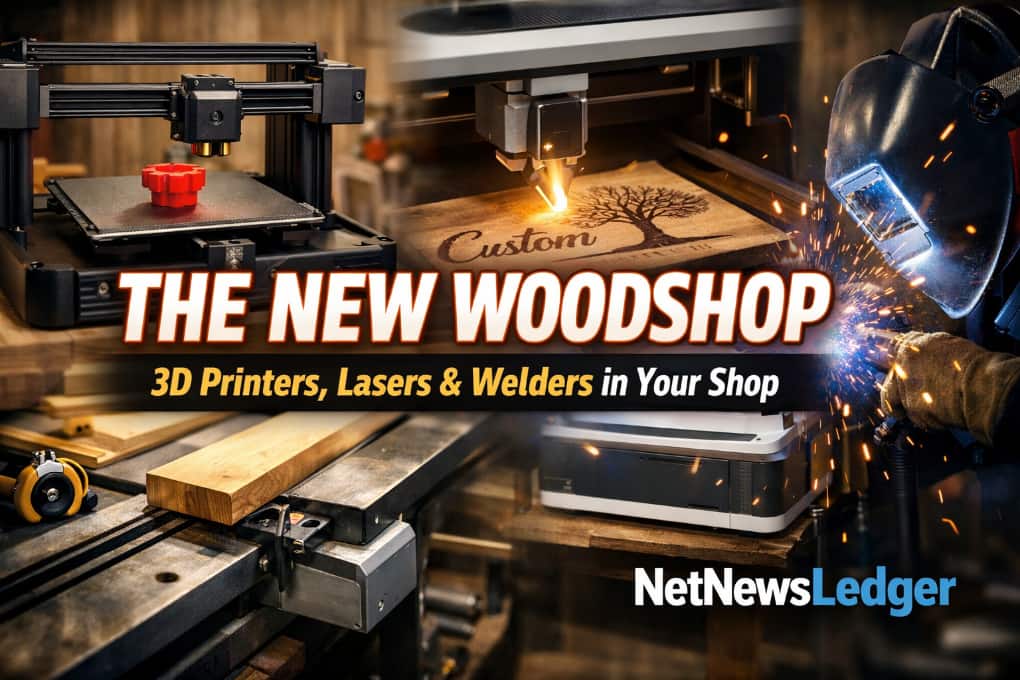
Thunder Bay – TECH – For generations, the woodshop was defined by cast iron, sharp edges and fine dust. That is still true. But the modern shop is evolving into something broader: a hybrid creative workspace where woodworkers use 3D printers for jigs and hardware, lasers for engraving and repeatable detail, and compact welders for bases, brackets and mixed-material furniture. That shift is happening because customers increasingly want customization, makers want faster prototyping, and newer desktop machines are smaller, easier to learn and more accessible than earlier generations of fabrication equipment.
Why woodworkers are adding more than wood tools
The biggest reason is simple: these machines solve problems that traditional woodworking tools do not solve as efficiently. A 3D printer can produce a custom knob, clamp pad, hose adapter, corner jig or router template overnight. A laser can engrave logos, cut thin materials, make signs, label drawers, or produce repeatable decorative parts with much tighter consistency than hand layout. A compact MIG or multi-process welder lets a woodworker build steel table bases, shop carts, brackets and repair parts without outsourcing the work. Instead of replacing woodworking, these tools extend it.
There is also a business reason behind the trend. Hybrid shops can move from one-off furniture into higher-margin products: engraved charcuterie boards, custom signs, personalized gifts, metal-and-wood shelving, branded corporate pieces, replacement parts for tools and fixtures, and short-run production of shop accessories. In a market where buyers want personal touches and fast turnaround, that flexibility matters. This is especially relevant in Thunder Bay and Northwestern Ontario, where makers often need tools that support repair, small-batch production and practical ingenuity rather than mass manufacturing.
The 3D printer: the fastest way to make your shop smarter
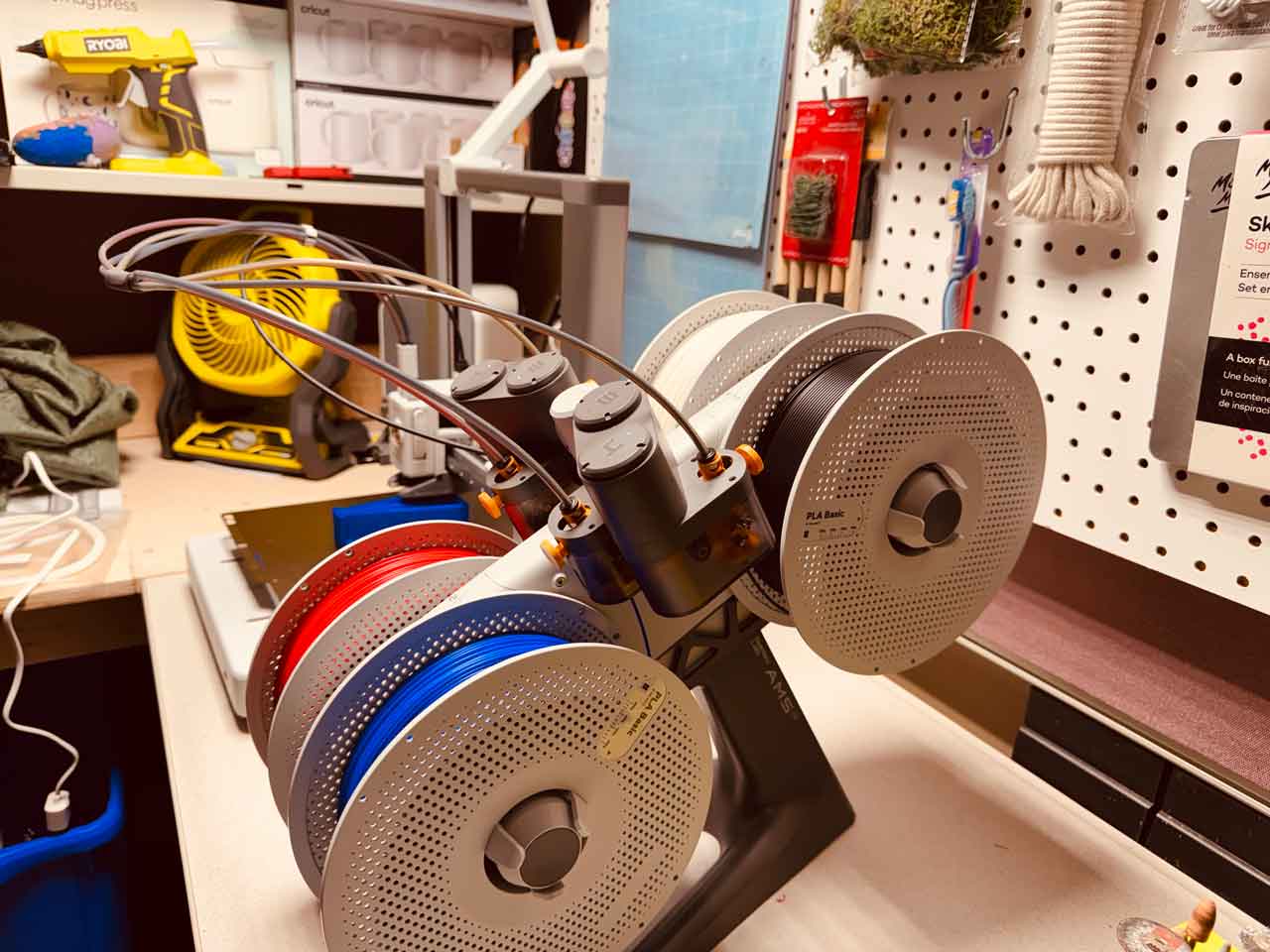
For most woodworkers, the most useful first digital tool may be a 3D printer. Not because it replaces wood, but because it improves workflow. A printer can make drill guides, dust-port adapters, push-stick holders, measuring aids, sanding blocks, hardware organizers and prototype parts that would be slow or annoying to fabricate by hand. The newer generation of machines is also far easier for beginners. Bambu Lab’s A1 Mini, for example, comes pre-assembled, pre-squared and pre-tuned, with setup measured in minutes rather than days, while the A1 offers a larger format for bigger fixtures and multi-colour work.
Good 3D printer choices for a woodshop:
Bambu Lab A1 Mini — a strong entry point for jigs, holders, templates and dust adapters in a small footprint.
Bambu Lab A1 — better for woodworkers who want more build volume and room for larger shop-made accessories.
If your shop regularly needs “one weird little part,” a 3D printer quickly proves its worth.
The laser cutter: precision, branding and repeatability
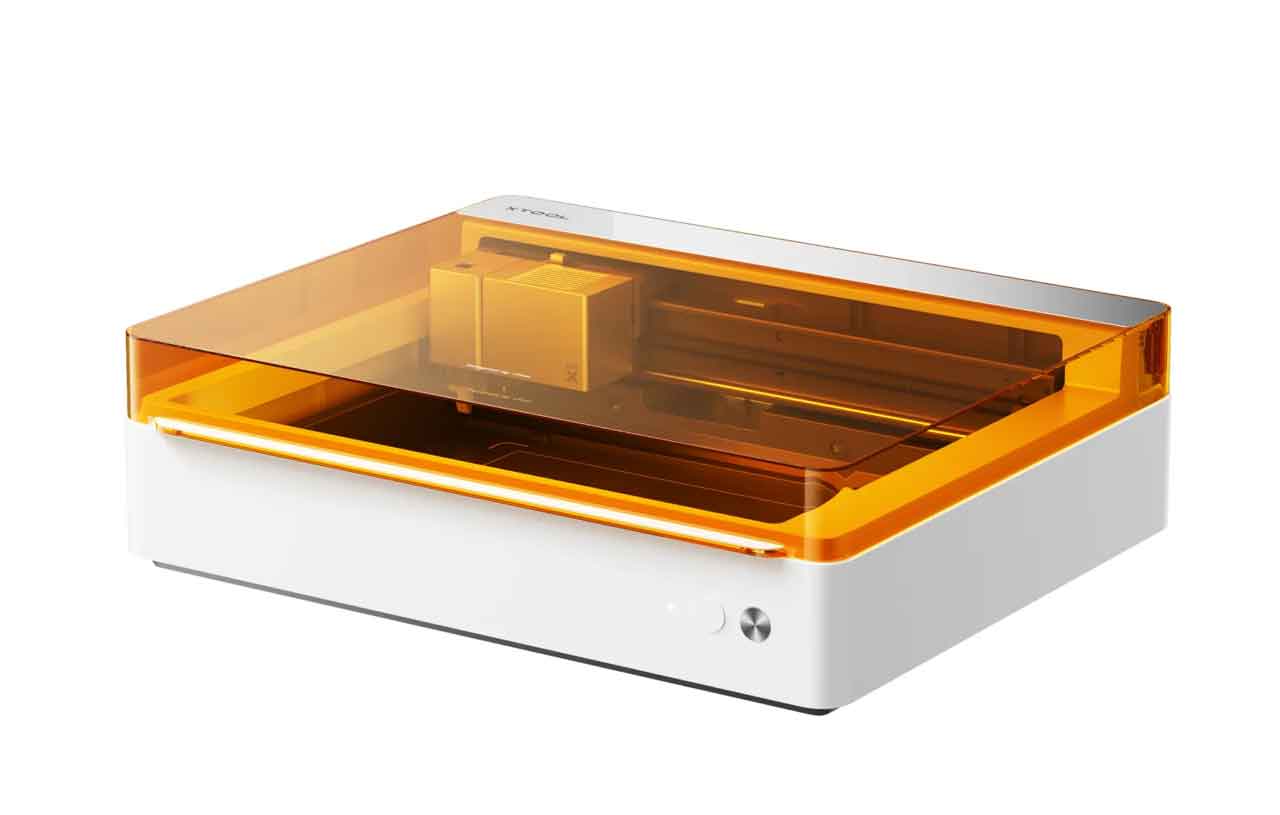
Laser machines are gaining ground because they do three things woodworkers value: precision, speed and repeatability. A laser is excellent for engraving logos, marking measurements onto shop fixtures, producing inlays, making templates, cutting thin stock, and adding personalization to products that would otherwise look generic. For side-hustle makers, that can turn an ordinary cutting board, plaque or gift box into a premium product. Glowforge’s Craft series and xTool’s enclosed systems reflect how this market has moved toward desktop-friendly machines designed for home and small-shop users.
Good laser choices for a woodshop:
Glowforge Spark — compact, lightweight and well suited to smaller engraving and craft-scale cutting jobs.
Glowforge Aura — a step up for users focused on engraving, signage and customized product work.
xTool S1 — a more serious enclosed diode laser with larger working area, up to 600 mm/s working speed, and options that better suit a shop moving toward batch work.
For woodworkers selling products online or at local markets, the laser may be the fastest path from “nice craftsmanship” to “recognizable brand.”
Why the xTool M1-style machine is so appealing
Not every woodworker has room for several separate machines. That is why all-in-one systems like the xTool M1 Ultra are drawing attention. xTool markets the M1 Ultra as a 4-in-1 machine combining laser, blade, inkjet and pen modules, which means one benchtop tool can engrave, cut, draw and support mixed-media projects. For the woodworker who also makes packaging, decals, stencils, labels or craft-market products, that kind of flexibility can unlock new categories without taking over the whole shop.
The xTool route makes particular sense for makers who are part woodworker, part crafter, part entrepreneur. It is less about replacing core shop tools and more about expanding what the shop can produce in a single afternoon.
The welder: the upgrade many furniture makers did not know they needed
A welder may seem like the oddest addition to a woodshop, but it may be the one that opens the widest design door. Modern furniture increasingly combines warm wood tops with steel legs, minimalist frames, industrial shelving and custom brackets. Having even a compact 120-volt multi-process machine in the shop means a woodworker can build table bases, reinforce carts, repair trailers and fabricate hardware instead of waiting on a metal shop. Lincoln Electric’s POWER MIG 140 MP, for instance, is a 120-volt multi-process unit for MIG, flux-cored, stick and DC TIG welding aimed squarely at home, hobby and shop use. Miller’s Millermatic 142 is another garage-and-shop oriented option in the 140-amp class.
Good welding choices for a woodshop:
Lincoln Electric POWER MIG 140 MP — versatile and approachable for the woodworker who wants one compact machine for furniture bases and repairs.
Miller Millermatic 142 — a straightforward MIG option for shop and garage users building light fabrication skills.
For many woodworkers, welding is not about becoming a full-time metal fabricator. It is about controlling more of the finished product.
What to buy first
The smartest first purchase depends on what kind of work you do most.
If you build furniture and cabinetry, start with a 3D printer. It will quietly improve daily efficiency by making custom fixtures, templates and replacement parts.
If you sell gifts, signs, decor or branded pieces, start with a laser cutter/engraver. It adds the most visible customer-facing value, especially for personalization.
If you make tables, benches, shelving or shop infrastructure, a compact MIG welder may be the biggest creative leap because it expands your material palette immediately.
If you are tight on space and want versatility, an xTool M1-style multi-function machine can be a practical bridge between crafting, branding and light fabrication.
One caution: the hybrid shop needs hybrid safety thinking
As shops evolve, safety has to evolve with them. Wood dust is a fire and explosion hazard, and welding fumes and gases require proper control.
The Canadian Centre for Occupational Health and Safety says local exhaust ventilation is the preferred method for removing welding fumes, while both CCOHS and OSHA warn that wood dust can create serious combustible-dust hazards if it is allowed to accumulate. In plain language: if you add lasers or welding to a woodshop, also think about dust collection, spark control, ventilation and separation between clean woodworking and hot work.
The future shop is a creative shop
The woodshop is evolving because the work is evolving. Clients want personalization. Makers want speed. Side hustles demand flexibility. And the newest generation of compact fabrication tools makes it possible for one person to design, prototype, personalize and finish a project under one roof. The table saw is not going anywhere. Neither is the jointer, planer or router. But beside them, more woodworkers are making room for a printer, a laser and even a welder, because the future of craftsmanship is not less hands-on. It is more capable.