Thunder Bay and Kakabeka Falls remain dry, with clear nights and a pronounced morning-to-afternoon temperature swing
Clear skies replace last week’s rain
THUNDER BAY, Ont. – Saturday, Nov. 14, 2026, 6:11 a.m. EST – Weather DESK – Thunder Bay and Kakabeka Falls are beginning a dry three-day stretch under high pressure. Environment and Climate Change Canada had no weather alerts in effect in Ontario at publication time.
At Thunder Bay Airport, the temperature was -6 C at 5 a.m. EST under clear skies, with a west-southwest wind of 8 km/h and a wind chill of -10. Visibility was 24 kilometres. The morning wind chill is forecast to fall near -13 before the sun lifts temperatures above freezing.
Saturday: sunny, with a colder Kakabeka Falls night
Thunder Bay will be sunny with light wind and a high of 4 C. The city falls to about -9 C tonight under clear skies, with an overnight wind chill near -13.
Kakabeka Falls is sunny with a high near 2 C. The rural interior cools more sharply tonight, reaching about -10 C, with a wind chill near -12.
Sunday: another sunny day
Thunder Bay stays sunny with a high near 5 C. The morning wind chill can reach -14 before temperatures rebound. Sunday night brings some cloud and a low near -4 C.
Kakabeka Falls is sunny near 6 C after a morning wind chill around -13. Cloudy periods arrive Sunday night, with a low near -4 C.
Monday: mild with some cloud
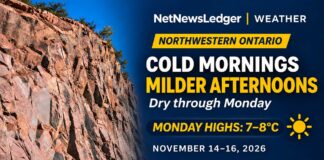
Thunder Bay reaches about 8 C with a mix of sun and cloud, then falls to about -1 C Monday night. Kakabeka Falls reaches about 6 C with a mix of sun and cloud, followed by a low near 0 C.
The three-day period is dry, but drivers should watch for isolated refreezing on shaded roads, parking lots and sidewalks after daytime melting.
Wardrobe
Use a winter coat, gloves and toque for the early morning, then shed a layer as temperatures rise. Waterproof footwear with good traction remains useful for icy patches and any meltwater that refreezes after dark.
Weather trivia
Kakabeka Falls often cools more quickly than central Thunder Bay on clear nights. Inland rural locations have less heat stored in buildings and pavement, while Lake Superior can moderate temperatures closer to the shoreline.