Officials report 100 rescues in Georgia after rainfall exceeded the one-in-1,000-year threshold over six- and 12-hour periods
McCAYSVILLE, Ga., Nov. 7, 2026 — One person is dead and flood-damaged communities along the Georgia-Tennessee border face a prolonged recovery after extraordinary rainfall overwhelmed rivers, roads, businesses and municipal services.
Georgia officials said a 56-year-old woman died after her vehicle was swept away in Murray County. The Georgia Emergency Management and Homeland Security Agency reported 100 water rescues, including 97 in Fannin County and three in Gilmer County.
Those figures are separate from the 68 rescues previously coordinated by the Tennessee Emergency Management Agency in Polk County.
Rainfall exceeded a rare statistical threshold
The National Weather Service said 261 millimetres of rain fell near Blue Ridge, Ga., in six hours, while the 12-hour total reached 284 millimetres. Both totals exceeded the National Oceanic and Atmospheric Administration’s one-in-1,000-year rainfall threshold for their respective durations.
That designation does not mean such rain can occur only once every 1,000 years. It represents an estimated 0.1-per-cent chance of that amount being exceeded at a particular location in any given year.
The flood was the second major inundation in three months for McCaysville, Ga., and neighbouring Copperhill, Tenn.
Water system and downtown remain disrupted
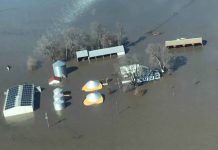
Floodwater filled downtown McCaysville, damaged its police station and left its water-treatment plant out of service. Access remained restricted to residents, business owners and authorized personnel Friday, with a dusk-to-dawn curfew in effect.
Georgia’s governor declared a state of emergency for Fannin, Gilmer, Murray and Union counties. Tennessee maintained an elevated Emergency Operations Center activation for the Polk County response.
Tennessee officials cited a provisional Ocoee River crest of 5.50 metres at Copperhill. However, the United States Geological Survey said the stream gauge was damaged and did not record the actual peak. Surveying of high-water marks is needed before the peak of record can be confirmed.
Recovery hazards continue after water recedes
Flooded buildings may contain unstable flooring, electrical hazards, fuel, sewage and mould. Residents should follow local drinking-water instructions and avoid using generators or fuel-burning equipment indoors.
Drivers should not enter flooded roads. Moving water can conceal washouts and can sweep away vehicles at depths that appear manageable.
Weather trivia
A one-per-cent annual flood is commonly called a “100-year flood,” while a 0.1-per-cent annual event is called a “1,000-year flood.” These are probability terms, not schedules, and rare floods can occur in consecutive years.
Source note: National Weather Service Atlanta/Peachtree City, United States Geological Survey flood notice, Tennessee Emergency Management Agency report, Georgia emergency-order index.