A suspicious $500 payment notice shows how convincing an offer can look. Do you click the link? Will your parents? Your Grandparents?
THUNDER BAY — Almost everyone has received them, emails promising you money. Emails that explain how you can get rich quick helping some foreign former government official get their money.
That is precisely when it pays to stop.
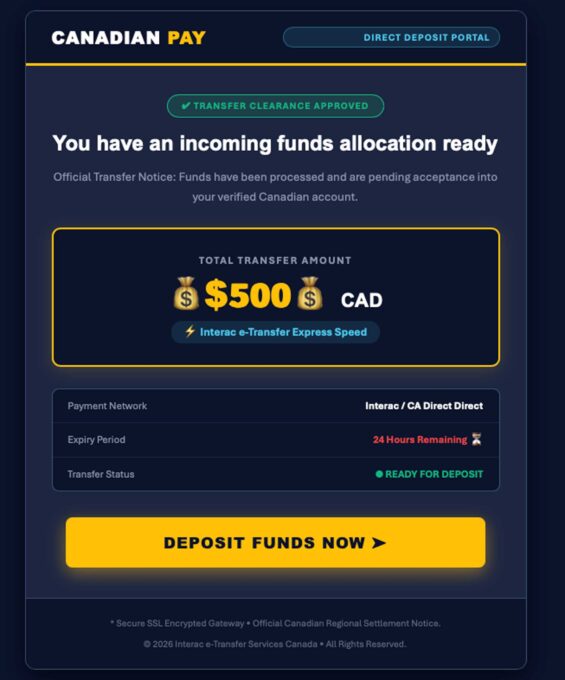
A screenshot supplied to NetNewsLedger uses the heading “CANADIAN PAY,” references Interac and claims a transfer has been approved.
The email promises $500. A bright yellow button says “DEPOSIT FUNDS NOW,” while a countdown warns there are only 24 hours remaining. For someone struggling to pay for groceries, rent or prescriptions, the offer could be hard to ignore.
Yet it gives no clear explanation of who owes the money or why. Its urgency and vague payment language are warning signs. The screenshot does not show the sender’s address or the button’s destination, so it cannot establish the message’s authenticity.
A professional appearance, familiar payment name and claim of secure encryption are not proof that money is waiting.
Statistics Canada’s research shows how widespread fraud is, but receiving a suspicious message, being victimized and losing money are different measures.
Its 2019 General Social Survey found that nearly 2.5 million people — 7.8 per cent of Canadians aged 15 and older — experienced fraud during the previous 12 months. That covered several forms of fraud, including misuse of personal information. It is a historical estimate of all fraud, not a current annual count of people losing money to Internet scams.
The 2022 Canadian Internet Use Survey, covering people aged 15 and older in the 10 provinces, found that 70 per centexperienced a cybersecurity incident, a broad category that included unsolicited spam. Forty per cent received fraudulent content.
Among people who experienced a cybersecurity incident, six per cent reported a financial loss. Those figures do not mean seven in 10 Canadians handed money to scammers.
More recent reports show the financial damage continuing. The Canadian Anti-Fraud Centre recorded more than 112,000 fraud reports and over $704 million in reported losses in 2025. These figures cover fraud through multiple channels; reports should not be treated as a count of unique victims.
During the first six months of 2026, Canadians reported approximately $351 million in losses to the centre. It estimates that only five to 10 per cent of fraud is reported, leaving a large amount of harm outside the official totals.
The question of how many people lose their entire life savings has a less definite answer: the Statistics Canada surveys and Anti-Fraud Centre totals cited here do not provide that count.
Statistics Canada did estimate that about 170,000 people lost $10,000 or more in their most serious fraud during the five years preceding its 2019 survey. Its accompanying summary reported that 0.5 per cent of fraud victims lost $100,000 or more. These are historical loss measures, not counts of people whose savings were completely wiped out.
The distinction matters. A $10,000 loss could exhaust one person’s savings, while a much larger loss might leave another with substantial assets. A reliable “life savings” count would need information about what each victim had before the fraud, what was lost and what was recovered.
The RCMP has documented the scale of individual harm. In one Toronto case, a person befriended on Facebook lost $355,000 in a romance and cryptocurrency investment scam. Authorities returned $225,000 in December 2024. The case also shows that a recovery can be partial; it should never be assumed that all stolen money will come back.
A fake transfer notice can begin with a modest promise. Police have warned about messages that lead to a counterfeit banking website. When a recipient enters their login information, criminals can use it to access the real account. The risk is much greater than the $500 supposedly being offered.
There is no need to download an email attachment to receive an Interac e-Transfer. New Brunswick’s financial regulator warns that legitimate Interac transfer notifications do not contain attachments. Unexpected payment notices should be checked with the supposed sender through a separate, trusted channel.
Inheritance scams use a different story. Someone claiming to represent a lawyer, estate or wealthy relative announces that a large sum is available. The recipient is then asked to pay fees before receiving it. The Canadian Anti-Fraud Centre describes this as a foreign-money offer: the promised funds do not exist.
For someone expecting a genuine inheritance, the sensible response is to verify the lawyer and estate independently, using contact information obtained separately from the message.
These approaches exploit trust, hope, financial pressure and fear. Treating victims as foolish can make it harder for them to disclose what happened. The RCMP reports that shame and embarrassment can cause people affected by fraud to withdraw from family and friends, adding to the harm.
For Thunder Bay residents, several habits can help protect both money and personal information:
- Pause before clicking. An unexpected payment and a deadline are reasons to verify the message independently.
- Contact the supposed sender separately. Use a number you already know. Do not rely on contact details supplied in the questionable email.
- Use your trusted banking app or a saved bank website address. Ask your financial institution how to verify an unfamiliar transfer.
- Consider Interac Autodeposit. Eligible transfers go directly into the registered account without a security question, reducing exposure to fraudulent acceptance links. It does not make an account immune to fraud.
- Protect your credentials. Do not send banking passwords, PINs or verification codes in response to an unsolicited message or caller. Use strong, unique passwords and available account security features.
If you have already entered banking details on a suspicious site or sent money, contact your financial institution immediately using its official app or the number on your card. Ask it to secure the account and investigate the transaction. Secure any affected email account as well, and preserve the messages, transaction records and screenshots.
Report the incident to local police and the Canadian Anti-Fraud Centre at 1-888-495-8501 or through Canada’s online fraud-reporting service.
Thunder Bay Police Service also accepts eligible fraud and cybercrime complaints through its online reporting system. Suspicious Interac messages can be forwarded to phishing@interac.ca.
Be wary of anyone who subsequently promises to recover the money in exchange for an upfront payment. The Anti-Fraud Centre warns that recovery scammers deliberately target people who have already been victimized.
For families helping an older relative — or anyone feeling pressured by an unexpected message — a useful agreement is simple: pause and check with a trusted person before acting. If money has already been lost, respond with practical help. The responsibility for the crime belongs to the fraudster.