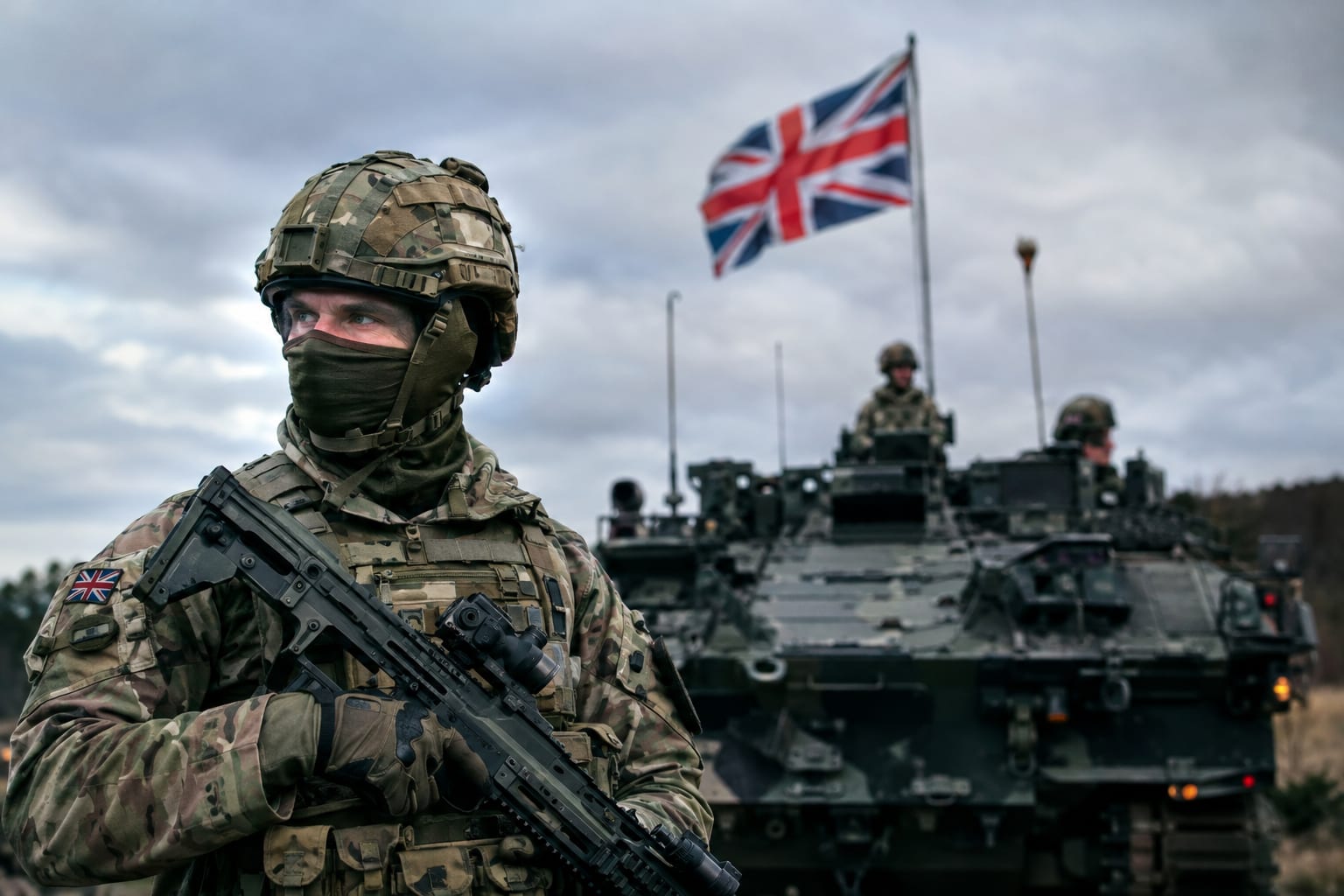
International Conditions Merit Military Upgrades
LONDON – World News – Britain’s top defence officials have issued a stark warning: the window to prepare for potential conflict with Russia is closing fast, and the clock is already ticking toward 2030.
National Armaments Director Rupert Pearce told defence industry leaders last week that the UK and its allies have “until the end of 2030, at best, to deter and be ready to fight.”
Chief of the Defence Staff Sir Richard Knighton framed the stakes in blunter terms, describing the current moment as a race in which Britain must be “faster and better than our adversaries.”
Both are correct in their diagnosis, according to defence analysts Blythe Crawford and Johan Vaernholt, but they argue that declaring a race is not the same as building an institution capable of winning one.
The analysts point to a telling moment from this April, when a Ukrainian drone costing roughly $500 destroyed a Russian tank worth $4.5 million. The anecdote has become familiar, but its deeper lesson, they argue, remains underappreciated: military advantage no longer flows to whoever fields the most sophisticated equipment. It flows to whoever can innovate fastest, scale quickest, and keep costs lowest — all while facing an enemy that is adapting in parallel.
Russian tactics, electronic warfare capabilities and armour have all evolved since the 2022 invasion began, meaning Ukraine’s battlefield edge at any given moment simply reflects how much faster it is changing than Moscow.
That logic, the analysts say, doubles as a theory of deterrence.
A country that can visibly out-innovate and out-price its rivals discourages aggression not through what it currently possesses, but through the credible threat of what it will field next — and how quickly it can respond to whatever an adversary develops. A Russian planner contemplating a gamble in 2029 needs to believe that any new capability Moscow deploys will be swiftly and cheaply neutralised. Cultivating that belief, they stress, has to happen well before any crisis erupts.
Pearce appears to grasp this dynamic, having called for an “innovation engine” that scans the horizon for emerging technologies and matures core capabilities so they can absorb future breakthroughs. The government’s Strategic Defence Review similarly called for continuous innovation across the integrated force at wartime pace.
The trouble, according to Crawford and Vaernholt, lies in how that ambition is currently organised. Britain’s innovation efforts are scattered across separate initiatives — UK Defence Innovation with its £400 million budget, a pledge to funnel 10 percent of the equipment budget into novel capabilities, plus programmes like Commercial X and the Defence Tech Scaler. All of these sit within an acquisition bureaucracy that judges itself by money spent, competitions held and agreements signed, rather than genuine readiness. Unlike the Land, Maritime and Air commands, none of these innovation efforts has a dedicated sponsor, a protected budget or a readiness benchmark. The result, the analysts argue, is activity rather than actual capability, since a system built around decade-long platform cycles will inevitably reassert its own priorities over underfunded, powerless innovation funds.
They point to Israel and Ukraine as models worth emulating. Israel’s defence research body, MAFAT, operates alongside established military branches as an equal, while Ukraine’s Brave1 initiative is jointly overseen by multiple government bodies. In both cases, innovation functions as a core military responsibility rather than a bureaucratic afterthought.
Crawford and Vaernholt recommend Britain adopt the same approach, treating innovation as a full warfighting function built on five permanent pillars: sensing, experimentation, scaling, absorption and talent. They insist this wouldn’t require massive new spending, since much of the necessary funding already exists but remains fragmented. Instead, it needs a senior sponsor with standing equal to the heads of Land, Maritime, Air, Cyber and Space; a ring-fenced, multi-year budget shielded from annual cuts; and success measured by how quickly problems identified on the battlefield get fixed and deployed, rather than contracts signed.
Absorption, they note, is particularly neglected. Building a prototype is often the easy part; ensuring troops receive proper training, doctrine and support to actually use new capabilities is far harder and currently left to individual units rather than funded centrally.
With the DSEI 2027 defence exhibition expected to draw 65,000 visitors and nearly 1,700 companies, the analysts argue industry will not be Britain’s bottleneck — its institutions will be. Waiting until 2030 to discover whether the system can keep pace, they warn, will already be too late.