Top Indigenous News Wrap – September 5 2026
From Lake Ontario and the High Arctic to Marten Falls First Nation and Thunder Bay, the leading stories centre on who makes decisions, who owns essential infrastructure and whether public spending is reaching Indigenous communities
THUNDER BAY – INDIGENOUS NEWS – The top Indigenous news stories heading into Saturday, September 5, 2026, share a clear theme: Indigenous governments and organizations are pressing for authority, investment and services that match the needs of their people.
Internationally, Indigenous leaders are defending the names, rights and knowledge connected to their territories. Across Canada, education infrastructure and residential-school denialism are leading concerns. In Northwestern Ontario, roads, airports and community decision-making remain central. In Thunder Bay, Indigenous-led housing and the return of Wake the Giant are the main local developments.
This roundup covers confirmed developments reported through Saturday morning. It is a selected news overview, not a claim that one organization or leader speaks for all First Nations, Inuit or Metis people.
International: Seneca Nation Opposes the Lake America Presidential Executive Order
The Seneca Nation is calling for the United States to reverse President Donald Trump’s executive order directing U.S. federal agencies to use Lake America as the name for Lake Ontario.
Seneca Nation President J. Conrad Seneca said the order disrespects the Indigenous origin of the lake’s name and conflicts with the relationship set out in the 1794 Treaty of Canandaigua between the United States and the Haudenosaunee Confederacy.
The order governs U.S. federal usage. It does not change what Canada, international bodies or other organizations call the lake. Apple and Google have changed their map labels for U.S. users, while Canadian users continue to see Lake Ontario.
The issue therefore reaches beyond political symbolism: it raises questions about treaty relationships, Indigenous history and whether technology companies should reproduce a government’s disputed naming decision.
International: Inuit-Led Stewardship Takes Centre Stage in the High Arctic
New reporting from the North Water Polynya between Nunavut and Greenland is drawing attention to Inuit-led research and protection of one of the Arctic’s most productive marine areas.
The Canadian side is called Sarvarjuaq in Inuktitut, meaning “the place that never freezes”. In Kalaallisut, the wider area is known as Pikialasorsuaq. It supports whales, walrus, seals, fish and millions of seabirds, along with travel, harvesting and cultural connections between Inuit communities.
Canada designated a roughly 73,700-square-kilometre Sarvarjuaq Marine Protected Area in March 2026. Its objectives include supporting Inuit leadership, knowledge and governance. Current scientific work is examining less-predictable ice-bridge formation and other climate changes. The larger international question is whether Canada and Greenland can build a cross-border protection system that is genuinely directed with Inuit, not simply imposed as conservation policy.
Sources: Fisheries and Oceans Canada
International: UN Moves Toward Greater Indigenous Participation
The United Nations reported that the General Assembly adopted a draft resolution on August 31 aimed at enhancing the participation of Indigenous Peoples’ representatives and institutions in UN bodies dealing with matters that affect them.
The development is important because Indigenous governments and institutions do not always fit the UN’s state-or-non-governmental-organization structure. The practical test will be how accreditation, speaking rights and participation rules are implemented. A seat in the room is not the same as decision-making authority, and participation should not be confused with consent.
Source: United Nations Department of Economic and Social Affairs.
National: AFN Says First Nations School Infrastructure Gap Is Growing
The Assembly of First Nations released a new needs assessment as students returned to school, saying the education infrastructure crisis in First Nations is getting worse.
The assessment covers 395 schools and 1,222 teacher residences on reserve. According to the AFN, more than 225 schools are overcrowded under federal space standards, 77 require immediate replacement, and suitable teacher housing remains essential for recruiting and keeping educators.
The AFN estimates that closing the gap will require $19 billion in capital investment over 20 years and $550 million each year for operations and maintenance. The organization wants education to be a major issue in the 2026 federal budget and at the First Nations First Ministers meeting planned for October.
For northern and fly-in communities, the issue is larger than classrooms. Construction costs, crowded housing and limited transportation can affect whether teachers can be hired and whether students have a safe and stable place to learn.
National: Indigenous MPs Condemn Residential-School Denialism Campaign
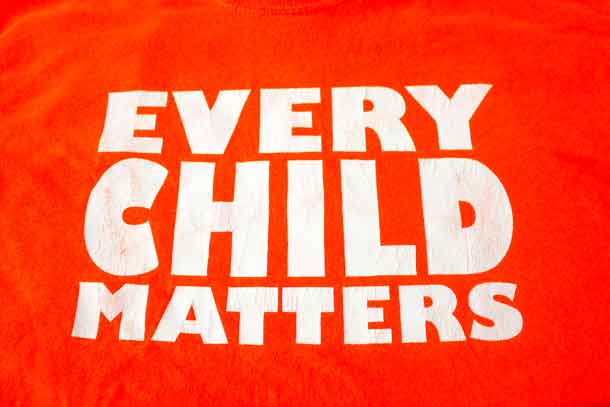
Indigenous members of Parliament are condemning a commercial shirt campaign that questions evidence connected to residential schools and unmarked burial sites.
APTN News reported on September 4 that Conservative MP Billy Morin and members of the Liberal Indigenous Caucus called the campaign harmful and divisive. The MPs said it makes money from the suffering of survivors and communities as Canada approaches the National Day for Truth and Reconciliation on September 30.
The debate is not only about political speech. Communities continue careful archival, ground-search and identification work. Technical arguments about one site must not be used to erase the documented residential-school system, survivor testimony or the children who died or never returned home.
Regional: NAN Calls for Northern Roads and Airport Investment
Nishnawbe Aski Nation responded to Ottawa’s $4.7-billion passenger-rail manufacturing announcement in Thunder Bay by asking Prime Minister Mark Carney to bring the same scale and urgency to First Nations infrastructure.
NAN says more than 30 First Nations in Northern Ontario do not have year-round road access. Shorter and less reliable winter-road seasons can interrupt the movement of food, fuel, building supplies and emergency services.
NAN also says the 29 remote airports serving its communities require major upgrades. Community runways average about 3,500 feet, while NAN says 5,000-foot paved runways are needed for safer medical, evacuation and supply flights. The organization estimates the airport work would cost between $1.2 billion and $1.5 billion.
The comparison is direct: governments can find billions for national transportation and industrial policy, while many First Nations still depend on temporary roads and underfunded airports for basic access.
Source: Nishnawbe Aski Nation.
Regional: Marten Falls Road Moves From Planning to Construction
Ontario and Marten Falls First Nation marked the start of work on the 184-kilometre Marten Falls Community Access Road on August 31.
The proposed all-season road would connect Marten Falls to Ontario’s highway system for the first time. Plans call for 35 bridge and culvert structures, with the road scheduled to open by November 2031. Early work includes tree clearing, a work camp and access to aggregate sites.
Piinahzii Limited Partnership, a majority Indigenous-owned partnership formed by Marten Falls First Nation and Bird Construction, has expanded its agreement to include the road’s construction. The partnership says it is intended to create employment, training and contracting opportunities for community members and Indigenous businesses.
The road is also part of the wider Ring of Fire network. That distinction matters: Marten Falls is advancing its own community-led project, but there is no single First Nations position on mining development or the wider road network. Other affected First Nations retain their own rights, concerns and decision-making processes.
Sources: Ontario Newsroom
Regional Watch: Treaty #3 Healing Gathering Set for September 9 and 10
Grand Council Treaty #3 is listing a two-day gathering called “Gwayakwaadiziwin, Manaajiâ€idiwin and Aakodeâ€ewin: Walking the Path of Healing Together for September 9 and 10 at the Eagle Lake Youth Centre in Migisi Sahgaigan First Nation.
The event is identified with health, social and Indian Residential School-related work. It is an upcoming community event rather than a breaking-news announcement, but it is an important regional file for survivors, families and service organizations to watch.
Source: Grand Council Treaty #3.
Local: Matawa Acquires Bertrand Court Housing Complex
Matawa Non-Profit Housing Corporation has acquired Bertrand Court, a 65-unit social-housing complex on Court Street North, from the District of Thunder Bay Social Services Administration Board.
The transfer is locally significant because Thunder Bay is a regional centre for education, health care and other services used by people from remote First Nations. Indigenous-led housing can bring property management and tenant supports closer to the people and communities being served.
The next reporting questions are practical: What repairs are planned? Will current tenants see any changes? How will units be allocated, and will culturally grounded supports be added? NetNewsLedger first flagged the transfer in its September 3 NewsHawk report.
Local Watch: Wake the Giant Returns September 12
Wake the Giant returns to the Thunder Bay waterfront on Saturday, September 12.
The project began in 2019 to help Thunder Bay welcome Indigenous youth who move to the city to attend Dennis Franklin Cromarty High School. Organizers describe it as both a cultural-awareness project and a music festival.
This year’s announced performers include Flo Rida, The Wallflowers, Plain White T’s, Tia Wood, Sebastian Gaskin, Shawnee Kish and Lov. The deeper local story is not the celebrity lineup. It is whether Thunder Bay students feel welcomed, supported and safe throughout the school year.
Sources: Wake the Giant
The Bottom Line
Across these stories, the central issue is not simply whether Indigenous Peoples are consulted. It is whether Indigenous governments, institutions and communities have the authority, resources and ownership needed to shape the outcome.
That test applies to a lake’s name, a UN meeting, an Arctic protected area, a school, a runway, a road and an apartment complex. The details are different, but the question is the same: who decides, who benefits and who is accountable?
Sources were checked through the morning of September 5, 2026.