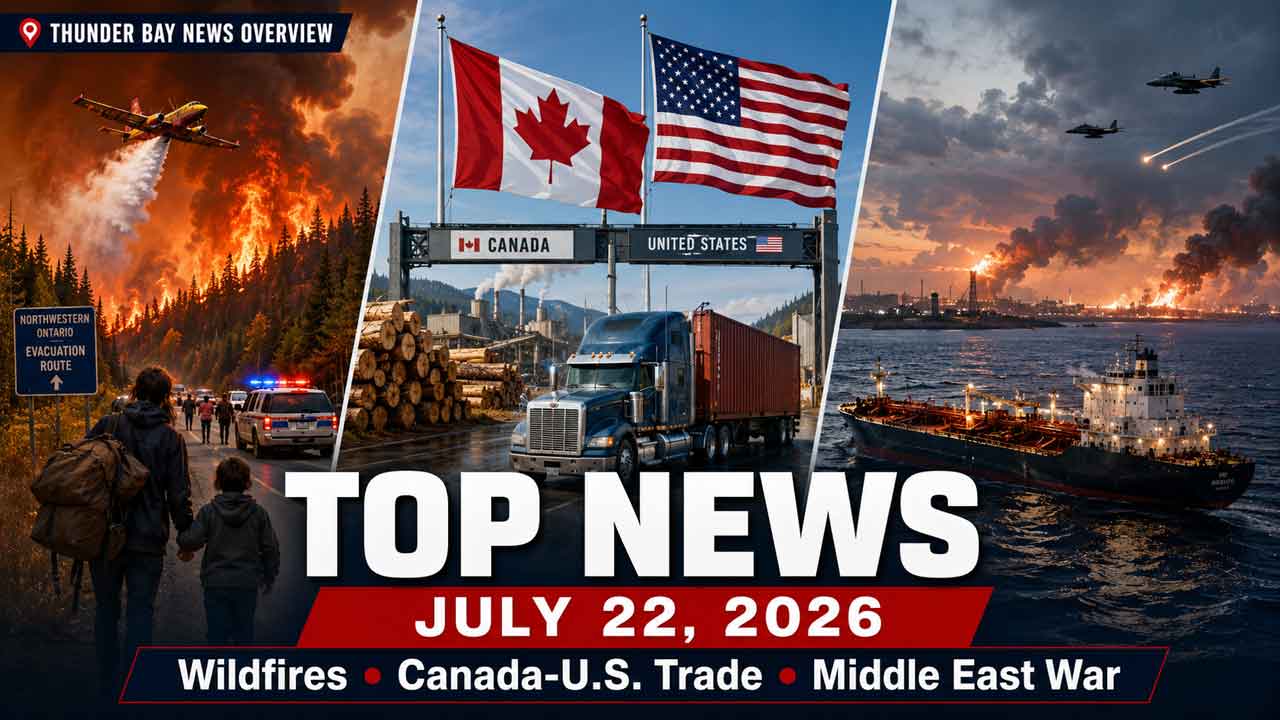
Top News for July 22, 2026: Wildfires, Canada-U.S. Trade and Middle East War Lead the Day
THUNDER BAY — Northwestern Ontario’s wildfire emergency remains the leading regional story Wednesday as the number of active fires rises again, evacuation measures continue and First Nations leaders demand stronger government co-ordination.
Nationally, Canada is confronting a new U.S. tariff threat while separate American negotiations with Canada and Mexico raise questions about the future of continental trade.
Internationally, another night of U.S. attacks on Iran has driven oil prices higher and increased concern about shipping through two of the world’s most important energy corridors.
What NetNewsLedger Readers Need to Know Today
For Thunder Bay and Northwestern Ontario, the immediate priorities are wildfire conditions, community evacuations and the region’s ability to support displaced residents.
The most significant economic risks come from U.S. tariffs and rising oil prices, which could affect forestry, mining, trucking, aviation, construction and household transportation costs.
This briefing is based on information available Wednesday morning. Wildfire activity, evacuation instructions, commodity prices and international military developments remain fluid.
Regional: Twelve New Fires Bring Northwest Total to 146
Twelve new wildland fires were confirmed across Northwestern Ontario Tuesday, bringing the Northwest Fire Region total to 146 active fires.
Aviation, Forest Fire and Emergency Services reported that 53 fires were not under control Tuesday evening. Five were being held, seven were under control and 81 were being observed. Several of the new fires were burning near remote First Nations in Ontario’s Far North.
Thunder Bay 36 remained out of control at approximately 318,813 hectares. Crews, helicopters and heavy equipment operators continued suppression work after rainfall reduced fire behaviour in parts of the region.
Large fires also remained active near Cat Lake First Nation, Atikokan and the Brightsand River area.
The fires near Cat Lake have affected electrical infrastructure, while property-protection systems have been established around the community and nearby cabins.
A Restricted Fire Zone remains in effect across the Northwest Fire Region and part of Northeastern Ontario. Open-air burning, including campfires, is prohibited, and existing fire permits are suspended. Portable gas and propane stoves may be used with extreme caution.
The concentration of new fires around Webequie, Fort Hope and other northern locations is especially concerning because many communities have limited road access and rely on aircraft for emergency evacuations, medical transportation and essential supplies.
Indigenous News: First Nations Leaders Challenge Wildfire Response
First Nations leaders are continuing to challenge Ontario’s account of the wildfire response, saying some communities received inadequate warning and were forced to organize their own evacuations as fires approached.
Namaygoosisagagun First Nation members escaped by boat before fire destroyed the community’s buildings and infrastructure.
Whitewater Lake First Nation has also reported extensive losses involving homes, community property and culturally significant lands.
Leaders from the Anishinabek Nation and affected First Nations say Indigenous governments must be included directly in decisions involving fire intelligence, evacuation timing, transportation, accommodations and recovery planning.
Ontario has said it is supporting evacuations and working with federal, municipal and First Nations partners. The province also requested federal assistance as the number of threatened remote communities increased.
The dispute is about more than emergency transportation.
Rebuilding remote communities could require years of work involving housing, power, water systems, communications, cultural sites and mental-health supports.
Thunder Bay will remain central to that response because the city serves as the primary transportation, accommodation, health-care and service hub for much of Northwestern Ontario.
Local: Thunder Bay Air Quality Returns to Low Risk
Thunder Bay’s Air Quality Health Index was measured at one, or low risk, at 7 a.m. Wednesday.
Environment and Climate Change Canada forecast a maximum AQHI of three, still in the low-risk range, during the day and two Wednesday night. Moderate-risk conditions were possible Thursday night.
The City of Thunder Bay says all municipal facilities, outdoor programs, parks, beaches, pools and recreational amenities are operating normally. Outdoor municipal crews have also returned to regular duties.
The improvement offers relief after wildfire smoke forced the temporary closure of pools, beaches, splash pads, golf courses and other outdoor facilities.
Conditions can change quickly as smoke moves across the region. People with heart or lung conditions should continue monitoring the AQHI and adjust strenuous outdoor activity if they experience symptoms.
Thunder Bay Continues Supporting Wildfire Evacuees
Thunder Bay remains prepared to receive additional evacuees even as local smoke conditions improve.
Physical donation sites have reached capacity and are no longer accepting goods. Monetary donations continue through the United Way of Thunder Bay. The City says cash contributions allow emergency organizations to purchase the specific items required by displaced families.
A veterinary field hospital has also been established at Grandview Arena to assist wildfire evacuees and people caring for displaced animals. The service is intended specifically for animals affected by the emergency.
Thunder Bay Police Service reported Tuesday that its community toy drive delivered 13 vehicle loads of toys, books, games and comfort items to children and families displaced by the fires.
The local response is placing demands on hotels, food programs, the airport, community organizations and health services. Those pressures could continue even after evacuation orders are lifted because some residents may not have homes or functioning infrastructure to return to.
National: Separate U.S. Trade Talks Put CUSMA Under Pressure
Separate American negotiations with Canada and Mexico are testing the future of the Canada-United States-Mexico Agreement.
The trade agreement remains in force, but the United States did not agree to extend it for another 16 years during the July 1 review. That means the agreement will face annual reviews until the three countries approve an extension or the pact expires in 2036.
American talks with Mexico are reported to be several months ahead of negotiations with Canada. Trade analysts warn that separate discussions could produce terms that the third country is later pressured to accept or challenge.
The three countries conduct approximately US$1.6 trillion in annual trade under the agreement. Changes could affect automotive manufacturing, agriculture, energy, forestry, mining and the integrated transportation systems connecting Canadian and American businesses.
For Northwestern Ontario, access to the American market is critical. Regional mills, forestry contractors, mining suppliers, trucking firms and manufacturers depend directly or indirectly on predictable cross-border trade.
New U.S. Tariff Threat Raises Concerns for Forestry
The United States has threatened tariffs of 50 per cent on a broad range of Canadian goods beginning Aug. 19.
The proposed measures would cover almost US$20 billion in imports, including furniture, cement, clothing, dairy products, hockey equipment and other consumer and construction goods. Products already covered by separate national-security tariffs may be treated differently.
The Forest Products Association of Canada says an expansion into additional forest-product categories would hurt workers, forest-dependent communities and American consumers.
The association argues that tariffs on construction materials would increase the cost of building and renovating homes in the United States while disrupting supply chains operating on both sides of the border.
Northwestern Ontario communities will be watching whether American buyers reduce orders, demand lower prices from Canadian suppliers or shift to other sources. Any reduction in production could affect mills as well as logging contractors, equipment dealers, railway operations, truck drivers and Indigenous forestry businesses.
Gordie Howe Bridge Ceremony Cancelled Amid Trade Tensions
Canada has cancelled a planned joint ceremony with the United States marking the opening of the Gordie Howe International Bridge between Windsor and Detroit.
The federal government said a joint celebration would be inappropriate in light of the latest U.S. trade threat. Canada plans to hold its own event Friday, while the bridge remains scheduled to open to traffic Monday, July 27.
The $4.7-billion bridge was financed by Canada and is expected to reduce pressure on the Ambassador Bridge, the busiest commercial land crossing between the two countries.
The cancelled ceremony is largely symbolic, but it demonstrates how the tariff dispute is affecting the broader political relationship between Ottawa and Washington.
International: United States Conducts Eleventh Night of Strikes on Iran
The U.S. military completed an 11th consecutive night of attacks on Iran late Tuesday.
U.S. Central Command said the operation targeted Iranian military command sites, aircraft hangars, drone-storage facilities, maritime capabilities and military logistics infrastructure.
The strikes lasted approximately 75 minutes.
Iran has responded with attacks against Israel and Gulf countries hosting American military facilities. Fighting has also expanded concerns beyond the Strait of Hormuz as Yemen’s Iran-aligned Houthi movement threatens ships carrying Saudi Arabian oil through the Bab el-Mandeb Strait and Red Sea.
The two waterways are critical routes for petroleum, liquefied natural gas and international commercial shipping.
Continued disruption could increase the cost of fuel, marine insurance and transported goods. Those effects could eventually reach Northwestern Ontario through higher gasoline, diesel, aviation and freight costs.
Oil Rises Above US$95 as Shipping Risks Grow
Brent crude briefly moved above US$95 a barrel Wednesday, reaching its highest level since June 11.
West Texas Intermediate crude also climbed as traders assessed threats to shipping through the Strait of Hormuz and Bab el-Mandeb. Three tankers carrying Saudi crude reportedly reversed course in the Red Sea after warnings from the Houthis.
Higher crude prices do not translate immediately or evenly into local pump prices. Refining costs, wholesale markets, taxes, transportation and retail competition also affect what drivers pay.
However, a sustained oil-price increase would place pressure on Northwestern Ontario households and businesses because the region depends heavily on personal vehicles, commercial trucking and aviation.
Mining, forestry and construction companies would also face higher operating costs, particularly at remote sites where diesel is required for generators, heavy equipment and transportation.
World Bank Warns War Could Cut Global Growth
The World Bank’s chief economist says a prolonged U.S.-Iran war could reduce global economic growth to as little as 1.3 per cent in 2026, compared with 2.9 per cent in 2025.
The worst-case modelling assumes hostilities continue for six months or longer. Under that scenario, global inflation could rise to 4.5 per cent as energy costs, shipping delays and shortages affect businesses and consumers.
The World Bank warned that disrupted shipments of fertilizer, sulphur and other agricultural inputs could increase food insecurity. Higher inflation could also force central banks to maintain or raise interest rates.
For Canadian households, those risks could appear through higher food and transportation prices and delayed relief from borrowing costs. Export industries could also face weaker international demand if global economic growth slows.
Canada Calls for Middle East Ceasefire and Asian Trade Diversification
Foreign Affairs Minister Anita Anand called Wednesday for de-escalation and a permanent ceasefire in the Middle East.
Speaking during meetings with Southeast Asian counterparts in Manila, Anand said civilian lives, hospitals, schools and other essential infrastructure must be protected. She also raised concerns about confrontations involving Chinese and Philippine vessels in the South China Sea.
Canada is also seeking to conclude a free-trade agreement with the Association of Southeast Asian Nations as Ottawa looks to diversify trade beyond the United States.
That effort could become more important if Canada-U.S. trade disputes continue. Additional Asian markets could offer opportunities for Canadian agriculture, forest products, minerals and manufactured goods, although building new supply relationships takes time and requires competitive transportation routes.
Ukraine Appoints New Military Commander
Ukraine’s new military commander says the country will increase counteroffensive operations and plan additional missions behind Russian lines.
Major-General Mykhailo Drapatyi, 43, replaced Oleksandr Syrskyi in Ukraine’s largest military leadership change since Russia’s full-scale invasion began in 2022. Ukrainian President Volodymyr Zelenskyy has identified mobilization, battlefield technology and offensive operations as priorities.
Russia continues pressing in strategic areas of eastern Ukraine despite reports that the pace of its advance has slowed.
What to Watch Through Wednesday
Regional residents should monitor new wildfire starts, evacuation instructions, Restricted Fire Zone rules and any changes affecting northern transportation routes.
Businesses will be watching for details about the proposed U.S. tariffs and the progress of separate CUSMA negotiations involving Canada and Mexico.
Internationally, the leading indicators will be further U.S.-Iran attacks, vessel movements through the Strait of Hormuz and Red Sea, and oil-price changes that could eventually affect Canadian fuel costs.