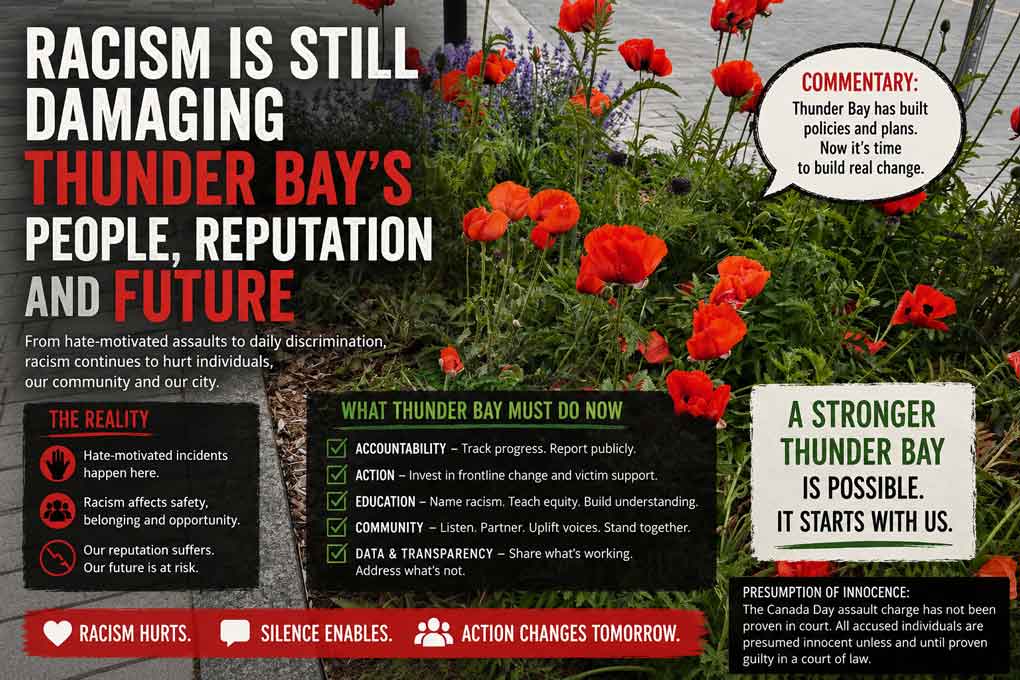
Racism Is Still Damaging Thunder Bay’s People, Reputation and Future
THUNDER BAY — A Canada Day assault near Villa Street and Cumberland Street North has again forced Thunder Bay to confront a question the city has faced for years: are anti-racism commitments changing daily life for people who experience hate, or are they mainly creating reports, committees and statements after harm is already done?
Thunder Bay Police say officers responded just after 12:45 p.m. on July 1 to reports of an assault in the area. A suspect was arrested and charged with assault, and the victim was treated by Superior North EMS before being taken to hospital with non-life-threatening injuries.
Police also said they were aware of social media posts and comments suggesting the assault may have been racially motivated.
Canada Day assault adds to concern over hate and public safety
The National Council of Canadian Muslims said the Thunder Bay incident involved a man of Palestinian descent who was assaulted while walking with family members, and that anti-Muslim language was allegedly used during the confrontation. Local reporting also noted the police investigation and the concern that the incident may have been hate-motivated.
Those allegations have not been proven in court.
But the public reaction matters. For Muslim families, Indigenous residents, newcomers and racialized people in Thunder Bay, even one visible assault can carry a wider message: some people still do not feel fully safe in public space.
That is the reputational damage Thunder Bay must take seriously.
Racism is not only something that happens to individuals. It changes how families choose routes through the city, where students feel safe, whether professionals move here, whether tourists return, and whether communities across Northwestern Ontario trust Thunder Bay as a regional hub.
The Bushby case remains part of the city’s memory
The name Barbara Kentner still weighs heavily in Thunder Bay.
Kentner, an Anishinaabe woman from Wabigoon Lake Ojibway Nation, died in 2017 after being struck by a metal trailer hitch thrown from a moving vehicle in January of that year. Brayden Bushby was convicted of manslaughter and sentenced in 2021 to eight years in prison.
The case became a national symbol not only because of its violence, but because many Indigenous people understood it as part of a broader pattern of dehumanization.
During sentencing, Justice Helen Pierce acknowledged the far-reaching effect of the attack and the fear and sadness felt by Indigenous people who questioned whether their lives were valued.
Nokiiwin Tribal Council’s Audrey Gilbeau told the court Indigenous people in Thunder Bay frequently reported similar assaults involving objects thrown from vehicles, and that some people tried to hide their features while walking down the street. “When racism is left unchecked, the consequences lead to death,” she said.
Ongoing racism is documented, not anecdotal
Thunder Bay’s racism problem is not based only on high-profile incidents.
The city-supported Incident Reporting and Referral Service, administered through the Lakehead Social Planning Council with the City’s Anti-Racism and Equity Advisory Committee and Diversity Thunder Bay, was created to document incidents of racism and discrimination. The third report, covering February 2020 to November 2021, said the data “continue to reinforce the reality of racism and discrimination in Thunder Bay,” particularly for Indigenous people and increasingly for other racialized groups.
The city’s own anti-racism support page directs people who experience or witness racism to report online, by calling 211, or in person at the Lakehead Social Planning Council office in Victoriaville Centre.
Statistics Canada has also shown why Thunder Bay’s reputation has been difficult to shake. In a 2020 Safe Cities profile, Statistics Canada reported that Thunder Bay’s 2018 police-reported hate crime rate was higher than Ontario and Canada as a whole.
What has the City of Thunder Bay done?
The City has not been inactive.
The Anti-Racism and Inclusion Accord was signed in 2018 by major public-sector organizations in Thunder Bay. Signatories committed to setting goals and reporting on progress to address racism and discrimination.
The City’s Indigenous Relations and Inclusion Strategy, running from 2021 to 2027, commits the corporation to fulfilling obligations under the Accord and strengthening staff capacity through training to work more effectively with Indigenous Peoples.
The City’s 2023-2027 strategic plan, Maamawe, Growing Together, also identifies Truth and Reconciliation as a core direction. Its performance indicators include improving quality-of-life responses from First Nations, Métis and Inuit community members, increasing acceptance of people of all backgrounds, decreasing experiences of discrimination, and tracking whether residents agree racism is a serious issue in Thunder Bay.
These are real structures. They matter. The city has created tools, committees, strategies, reporting channels and public commitments that did not exist in the same form a decade ago.
The effectiveness question: are systems changing behaviour?
The harder question is whether those efforts are changing the lived experience of people targeted by racism.
On that test, the evidence is mixed at best.
Reporting tools help document harm, but they do not by themselves stop someone from shouting slurs, throwing objects, denying service, harassing a student, following someone in a store, or assaulting a family in public. Advisory committees can guide policy, but they need resources, authority and public visibility.
Strategic plans can set direction, but residents judge progress by what changes in streets, schools, workplaces, businesses and public services.
The city’s anti-racism work appears strongest in framework-building. It is weaker in public accountability. Residents should be able to see, in plain language, what commitments have been met, what remains overdue, how many incidents are being reported, what patterns are emerging, what departments have changed practices, and whether racialized and Indigenous residents report improved safety and belonging.
Thunder Bay needs anti-racism work that people can feel
A more effective municipal approach would move beyond awareness and into measurable community change.
That means annual public reporting on the Anti-Racism and Inclusion Accord, including which institutions have met their commitments. It means a public dashboard for racism incident trends, with privacy protected. It means stronger support for victims after incidents, not just referral pathways. It means training that reaches frontline city staff, recreation spaces, transit, libraries, bylaw, business districts and event organizers.
It also means a rapid civic response when hate incidents happen. When a Muslim family, an Indigenous woman, an international student or a newcomer is targeted, the city should not wait for the story to fade. It should communicate clearly, support affected communities and show what will be done to reduce repeat harm.
Public education must also be more direct. Thunder Bay does not need vague messaging about “kindness” alone. It needs anti-racism education that names anti-Indigenous racism, Islamophobia, anti-Black racism, antisemitism, anti-Asian racism and discrimination faced by newcomers and international students.
Reputation will improve only when reality improves
Thunder Bay’s reputation is not repaired by insisting the city is misunderstood. It is repaired when people who have been harmed can say life here is safer, fairer and more respectful.
That requires honesty.
The city has made progress in building anti-racism infrastructure. But high-profile incidents, continuing reports of discrimination, and the persistence of racist commentary online and in daily life show that the work is far from complete.
For Thunder Bay, this is not only a moral challenge. It is an economic, social and regional challenge. The city needs Indigenous students and families to feel safe.
Thunder Bay needs newcomers and international students to feel welcome. It needs employers to recruit and retain skilled workers. It needs tourists and investors to see a community that faces problems directly rather than dismissing them.
The path forward is not another slogan. It is public accountability, visible action and a community standard that racism is not merely regrettable — it is unacceptable.
Presumption of innocence
The Canada Day assault charge has not been proven in court. All accused individuals are presumed innocent unless and until proven guilty in a court of law.