How to stay safer on Thunder Bay streets as public concern over assaults and robberies grows
Thunder Bay – LIVING – Thunder Bay residents are increasingly talking about street safety after recent robberies, purse thefts and assaults in public places, including while shopping and walking on sidewalks.
Additional reports have also circulated on social media near some homeless encampments, though not all of those reports have been publicly confirmed by police. What is clear is that many people — especially women, seniors, downtown workers and shoppers — are feeling more vulnerable than they did even a year ago.
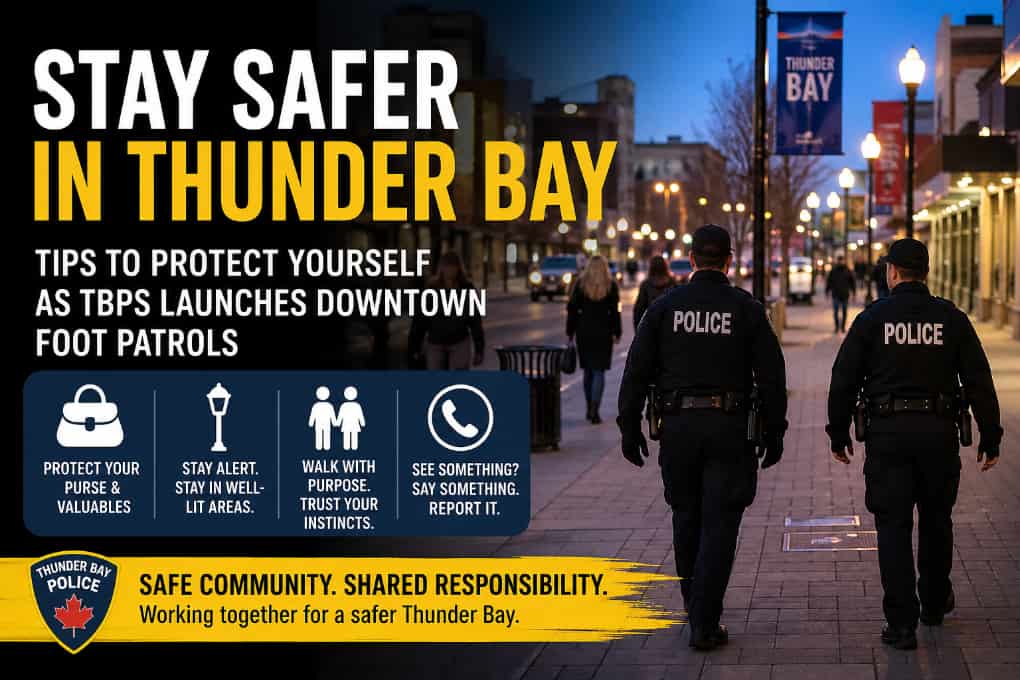
Thunder Bay Police Service has responded by launching Project Support, a downtown core stabilization initiative that began April 20. Police say the project uses increased foot patrols in the city’s downtown cores, with a focus on transit stops, storefronts, parking areas, public plazas, commercial zones and pedestrian walking areas.
TBPS says the initiative is meant to improve safety while also connecting people experiencing addiction, mental-health challenges or housing instability to services before enforcement is used.
Awareness, not panic, is the first step
The most consistent safety advice from police services is simple: stay alert. Toronto Police says robberies often happen where people are waiting or standing for a period of time, including transit stops, parking lots, garages and isolated areas. Police also warn that distractions such as texting, loud music and phone calls can make a person look like an easy target.
That does not mean people should blame themselves for being victimized. It means small habits can reduce risk. Walking with purpose, scanning the space around you, and keeping your attention up rather than on your phone can make it easier to notice someone closing distance too quickly or acting suspiciously.
Toronto Metropolitan University’s safety guidance similarly advises people to stay alert, decrease distractions and notice loitering or unusual behaviour.
Protect your purse, phone and wallet before trouble starts
For shoppers, one of the most practical steps is to carry less and carry it more securely.
Good advise is for people not to carry large bags or purses, to keep valuables out of sight, and to bring only the identification, money and cards needed for the specific trip. Use a bag that closes securely and can be carried in front of the body, rather than loosely over one shoulder or open at the top.
That matters in everyday Thunder Bay situations: outside big-box stores, at mall parking lots, while loading groceries, or while waiting for transit downtown. A purse in a shopping cart, a wallet in a back pocket, or a phone held out while walking can all create opportunities for an opportunistic thief.
Thunder Bay Police recently issued similar advice in its vehicle-theft prevention messaging, warning that thieves often look for quick opportunities created by distraction.
Choose the safer route, not just the shorter one
Police advise people walking alone to stay on well-lit streets near the curb and away from alleys, and to head for a populated area if they think they are being followed. Avoiding isolated shortcuts and sticking to well-lit, high-traffic areas is often a good idea. Also avoiding pathways near some of the homeless encampments will keep you safer.
In Thunder Bay, that may mean choosing a busier block, crossing to the other side of the street, or walking into an open business if something feels off.
It may also mean timing errands differently, arranging a ride after dark, or asking someone to walk with you between stores, parking areas or transit stops. These are not dramatic steps, but they can create distance and witnesses, which often matters.
Trust your instincts and create space early
Police and safety agencies make the same point: if something feels wrong, act early. Police say to trust your instincts. People who think they are being followed to move toward safety by crossing the street or heading into an open store or another area with more people.
That is especially important in situations that begin with conversation. Not every stranger approaching you is a threat, but not every approach is harmless either. Keep your personal space. Do not let someone close in while you search your purse, unlock a vehicle or stand with your attention fixed on your phone.
If you feel pressured, move, speak clearly and head toward other people.
If a robbery happens, your safety matters more than your property
The hardest advice can also be the most important. Police services say that if you are approached, threatened or physically assaulted in a robbery, it is safer to give the person the property they want rather than argue or fight back, because resisting can make the situation worse.
That advice will not feel satisfying, especially if the item is a purse, wallet or cellphone that contains personal information.
But phones and bank cards can be replaced. A serious injury may not be. Once you are safe, call police immediately, cancel bank cards and try to write down what you remember: clothing, direction of travel, height, build, what was said, and whether a vehicle was involved.
What Thunder Bay Police are doing downtown
Project Support is TBPS’s most visible recent response to the sense of disorder and insecurity in the downtown cores. Police say the initiative is being led by the Community Oriented Response and Engagement Unit and is intended to improve safety, reduce visible disorder and open drug use, strengthen collaboration with service agencies and use consistent, proportionate enforcement when required.
Operational Support Insp. Jason Rybak said the project is meant to start with help, not punishment. According to TBPS, the first point of contact during patrols will often be a social navigator or community inclusion co-ordinator who can offer referrals to housing or addiction supports. Police say enforcement is meant to be the last option, and they have also emphasized that the initiative is not about penalizing poverty or addiction, but about improving safety and focusing on people who exploit vulnerable individuals.
That distinction matters. Homelessness itself is not a crime, and many people living rough are themselves victims of violence and exploitation. Residents can reasonably ask for safer sidewalks, parking lots and shopping areas while also supporting a response that does not simply criminalize crisis.
Report what you see, and report it quickly
Police depend on timely reporting, especially when community fear is being amplified through social media. If someone is in immediate danger, call 911. For non-emergency matters, Thunder Bay Police Service lists 807-684-1200 as its main line.
One of the biggest problems in any city is the gap between what is posted online and what is formally reported. A social media post can alert neighbours, but it does not replace a police report. If people want more patrols, better data and a clearer picture of where robberies and assaults are happening, incidents need to be reported through official channels.
The bottom line
No one should have to feel afraid to shop, walk to work, wait for transit or move around downtown Thunder Bay. But until the city gets a stronger grip on violence, addiction, disorder and the exploitation of vulnerable people, personal safety habits matter.
Stay alert. Carry less. Keep your purse or bag closed and close to your body. Pick the brighter, busier route. Trust your instincts. Step into a store or toward other people if something feels wrong.
And if you are robbed, protect yourself first and report it right away. Those are not perfect solutions, but they are practical ones — and right now, practical matters.