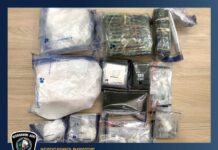
Winnipeg police arrest seven in Weston drug probe; cocaine, pills and replica firearms seized
A Winnipeg Police Service investigation into alleged drug trafficking in the Weston neighbourhood has led to seven arrests and the seizure of cocaine, pills, replica firearms, weapons, cash and a travel trailer. The case stands out because it shows how neighbourhood-level drug investigations can quickly expand into broader public-safety concerns involving weapons and suspected proceeds of crime.
All allegations remain unproven in court. Under section 11(d) of the Charter, every person charged with an offence is presumed innocent until proven guilty according to law.
Search warrant on Logan Avenue leads to seven arrests
Winnipeg police say members of the Central District Community Support Unit began investigating suspected drug trafficking in the Weston neighbourhood in February. On March 7, with help from the Tactical Support Team, officers executed a search warrant at a residence in the 1400 block of Logan Avenue and arrested four men and three women found inside.
Police say they seized about 11 grams of cocaine, 27 gabapentin pills, 30 Percocet pills, several replica air pistols, ammunition, a collapsible baton, a machete, a fixed-blade knife, body armour, about $550 in cash, drug packaging and paraphernalia, and a 2015 Rockwood Roo travel trailer valued at about $20,000.
Who was charged
Police say a 58-year-old man, a 25-year-old man and a 19-year-old woman, none of whom were publicly named in the release, each face two drug-trafficking-related possession counts, one weapon-possession count, and two property-obtained-by-crime counts. Police said those three were released on undertakings.
David Richard Walsh, 61, faces the same core drug, weapon and property counts, along with one count of failing to comply with a condition of a release order and one count of failing to comply with a probation order.
Marcus Fredrick Jones, 46, faces the same core counts, four counts of failing to comply with a condition of a release order, and police also listed a warrant for failing to comply with a probation order.
Christina Roberta Barto, 45, faces the same core counts plus two counts of failing to comply with a condition of an undertaking. Police said those three were detained in custody.
A 31-year-old woman was released without charge.
Legal context on the drug and property charges
The trafficking-related allegations appear to fall under section 5(2) of the Controlled Drugs and Substances Act, which makes it an offence to possess a substance in Schedules I to V for the purpose of trafficking. Justice Canada says that where the substance is in Schedule I or II, the maximum penalty is life imprisonment; for Schedule III or V substances, the maximum is 10 years on indictment or 18 months on summary conviction; and for
Schedule IV substances, the maximum is three years on indictment or one year on summary conviction. Police specifically identified cocaine for one count, but did not specify in the release which substance grounds the second scheduled-substance count, so the exact ceiling for that second allegation cannot be pinned down from the public record alone.
The proceeds allegations are rooted in section 354(1) of the Criminal Code, which covers possession of property or proceeds obtained by crime. Under section 355, the maximum penalty is 10 years if the value is alleged to be more than $5,000 and the Crown proceeds by indictment, or two years if the value is $5,000 or less and the Crown proceeds by indictment. Both can also proceed summarily.
Release-order, undertaking and probation allegations carry their own penalties
The alleged breach of an undertaking matches section 145(4)(a) of the Criminal Code, while an alleged breach of a release order matches section 145(5)(a). In both cases, Justice Canada says the offence can proceed by indictment with a maximum penalty of two years, or by summary conviction.
An alleged breach of probation is dealt with under section 733.1(1) of the Criminal Code. That offence carries a maximum penalty of four years if prosecuted by indictment, or it can proceed by summary conviction. Actual sentences in any case depend on the facts proved in court, the accused person’s record, and how the Crown elects to proceed.
Weapon count remains less clear from public release
Police listed a charge simply as “possession of a weapon,” but the release did not identify the exact Criminal Code section alleged. Because Canadian weapons charges can arise under different provisions depending on the item and the circumstances, the precise sentencing range for that count cannot be stated accurately from the public information released so far.
Why the case matters
While this investigation is centred in Winnipeg, it reflects a broader pattern seen across central Canada: local drug probes increasingly turn up not just narcotics, but imitation firearms, edged weapons, cash and suspected crime-linked property. For NetNewsLedger readers, that makes it another example of how city-based trafficking investigations can spill into wider public-safety concerns beyond the drugs themselves.