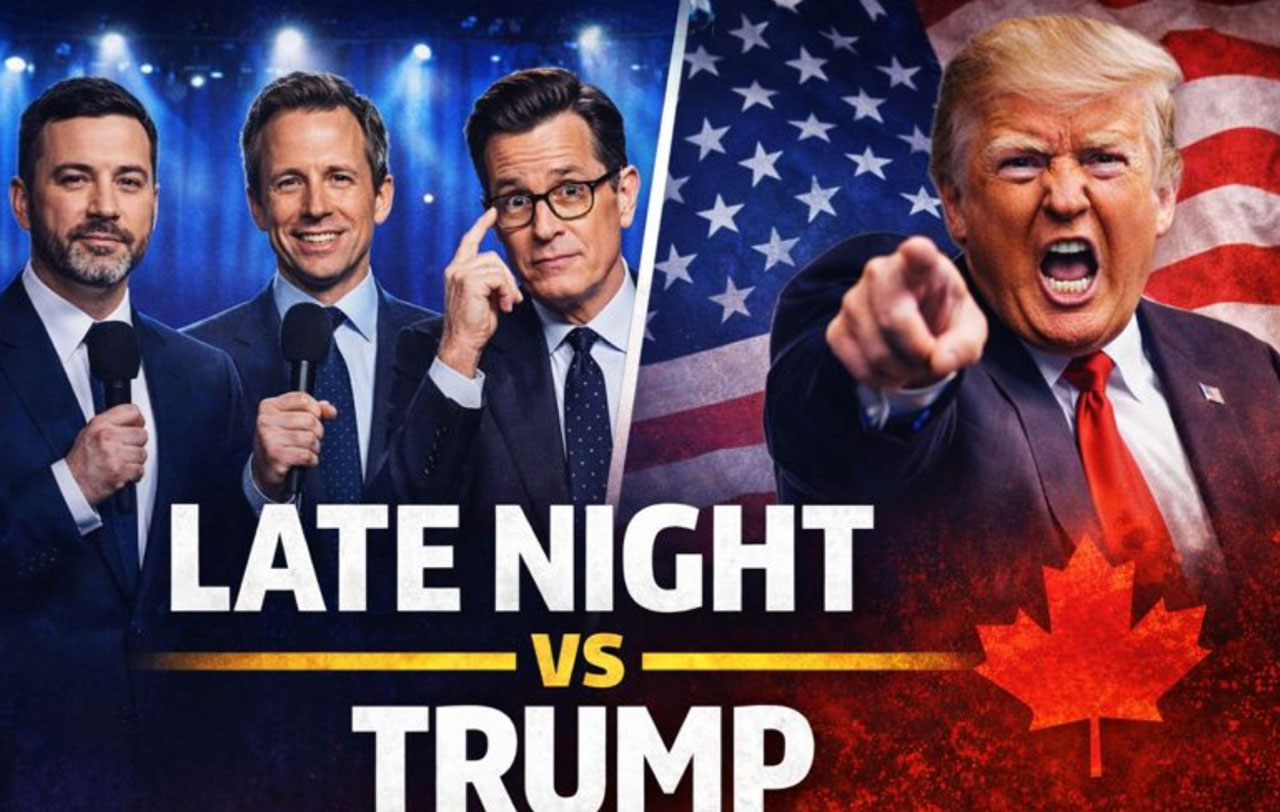
Late-night comedy has become a parallel political arena—shaping attention, trust, and candidate image in the clip-first age.
Late night isn’t “just entertainment” anymore
For decades, American late-night television has mixed jokes with politics. But over the last 20 years—especially since the rise of The Daily Show–style satire and the collapse of shared trust in institutions—late night has evolved into something closer to an alternative political media layer: part comedy, part commentary, part interview platform.
That shift matters because millions of people now encounter politics first through monologues, satirical segments, and viral clips, not through a newspaper front page or a nightly newscast. Pew Research highlights how younger Americans increasingly rely on social platforms for news and show comparatively high trust in what they see there—conditions that favour shareable late-night clips.
1) The “agenda-setting” effect: what late night talks about becomes what people talk about
Late-night hosts don’t just react to politics—they curate it. A monologue can elevate a story that might otherwise stay niche, and a recurring segment can keep a topic alive long after it would normally fade.
In political communication terms, that’s agenda-setting: not telling audiences what to think, but what to think about. And in a fragmented media environment, late-night can be an unusually efficient “signal booster”—especially when clips circulate widely outside the TV broadcast.
2) Satire changes how viewers process politics—for better and worse
Satire can lower the barrier to entry. People who find politics confusing or exhausting may still watch comedy—and come away with a basic understanding of who’s doing what, and why it matters.
But satire also has side effects. A major study on The Daily Show found that exposure could increase political cynicism among young viewers, even while intersecting with political engagement and information habits.
And satire is often interpreted through ideology. A widely cited study of The Colbert Report found viewers frequently “see what they want to see” in ambiguous satire—meaning the same bit can reinforce opposing beliefs depending on the audience’s politics.
Bottom line: late night can inform, but it can also deepen “team-based” processing of facts.
3) Late night as a political “gateway” for low-attention audiences
Candidates increasingly treat entertainment shows as strategic terrain: a place to appear relatable, funny, human—and to reach people who don’t follow traditional political coverage closely.
Scholars have long described these programs as “soft news,” where political information is delivered in a lighter format that can still affect what viewers learn and remember.
The most concrete examples are when comedy-driven appearances create measurable public response. When a sitting president joined a comedy web-interview format in 2014 to promote health insurance enrollment, news reports documented a major spike in traffic to the government sign-up site afterward.
That’s political impact, delivered through laughs.
4) The interview dilemma: “humanizing” power vs. accountability
Late-night interviews can reshape candidate perception. A friendly couch interview can make a polarizing figure seem normal; a sharper interview can force clarity or highlight contradictions.
This is why high-profile late-night moments become political flashpoints—like the ongoing debate over whether some “light” interviews inadvertently help candidates by softening public edges. (The famous 2016 hair-tousle moment is still cited in that context.)
In election seasons, there’s also a fairness question: when candidates appear in entertainment, critics sometimes argue it functions like free publicity. That debate has even triggered “equal time” arguments around candidate cameos on major broadcast comedy shows.
5) The real battleground now is the clip economy
Traditional late-night TV audiences have been shrinking. Industry tracking shows year-over-year declines in linear late-night viewership, especially among younger demographics.
But the influence hasn’t disappeared—it has migrated. Viral distribution can turn a single monologue into a political event, reaching far beyond the broadcast audience. Reuters reporting on a recent late-night controversy showed how a single episode could rack up tens of millions of social views, illustrating why politicians increasingly treat late-night as social media content production as much as television.
So while the “TV ratings” era is fading, the political reach can still be enormous—because the internet is the new channel.
6) Polarization, counter-programming, and the rise of ideological comedy lanes
Late night is often criticized for skewing left in its political targets, while conservative audiences gravitate to their own ecosystems—talk radio, podcasts, and now late-night-style shows with explicit ideological branding.
Academic work is now examining conservative late-night formats as distinct political communication spaces, not just entertainment.
This matters because once comedy becomes partisan-coded, it stops being a shared cultural reference point and becomes another identity signal—which can intensify polarization even as it boosts engagement.
What this means for Thunder Bay readers
Even in Northwestern Ontario, U.S. late-night content influences daily political talk—because clips travel instantly across platforms Canadians use every day. And U.S. political narratives don’t stay “American” for long: they can shape cross-border issues that matter locally, from trade and resource markets to border policy and diplomatic friction.
For NetNewsLedger, late-night isn’t fluff—it’s a barometer of what themes are catching public attention in the U.S., and a preview of which frames may spill into Canadian discourse.