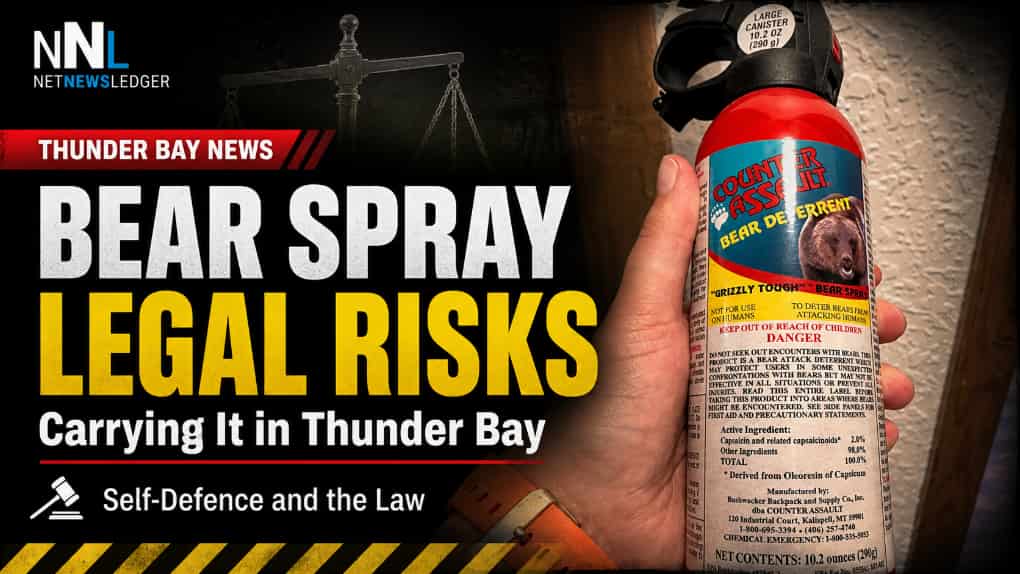
Bear Spray In Thunder Bay: What Residents Need To Know Before Carrying It For Safety
THUNDER BAY — As public concern about safety grows in Thunder Bay, some residents have started carrying bear spray or are urging others to do the same. Posts on social media have many people advocating that this spray is a self protection tool that they carry.
So looking into this, what does the Criminal Code say? What could happen if you use bear spray to defend yourself against a potential attacker?
The legal reality is more complicated: bear spray may be lawful when carried for wildlife protection, but carrying it in the city for use against people can expose a person to serious Criminal Code charges.
The Legal Line Is Purpose, Place And Use
Bear spray is not automatically illegal in Canada when it is designed, labelled and carried as an animal deterrent. That matters in northwestern Ontario, where residents may reasonably carry it while camping, hunting, hiking, fishing, working in remote areas or travelling in bear country.
The legal risk increases sharply when bear spray is carried in an urban setting for protection against people.
Under the Criminal Code, a “weapon” includes anything used, designed to be used or intended for use in causing injury, death, or for threatening or intimidating another person.
Section 88 also makes it an offence to carry or possess a weapon for a purpose dangerous to the public peace or for the purpose of committing an offence. That charge can proceed by indictment with a maximum sentence of 10 years in prison, or by summary conviction.
Carrying Bear Spray Downtown Can Create Criminal Liability
A person walking on a rural trail with bear spray clipped to a pack for wildlife protection is in a very different legal position from someone carrying bear spray in a purse, coat pocket or vehicle console while saying it is for use against people.
If police find bear spray during a traffic stop, street check, arrest or public disturbance, the key questions will likely include why the person had it, where they were, whether it was concealed, whether there was any realistic wildlife purpose and what the person said about it.
Section 90 of the Criminal Code also makes it an offence to carry a concealed weapon unless authorized under the Firearms Act. That offence carries a maximum sentence of five years if prosecuted by indictment, or it can proceed by summary conviction.
This does not mean every person with bear spray in Thunder Bay is committing a crime.
A person heading to camp, working in the bush or travelling in an area with bear activity may have a legitimate explanation. But carrying bear spray in the city “just in case” it is needed against another person can be treated very differently by police, prosecutors and the courts.
Using Bear Spray On A Person Can Lead To Serious Charges
If bear spray is used against another person, police may consider charges including assault with a weapon, possession of a weapon for a dangerous purpose, carrying a concealed weapon, or administering a noxious thing.
Section 267 of the Criminal Code covers assault with a weapon or causing bodily harm. A person commits that offence if, while committing an assault, they carry, use or threaten to use a weapon, or cause bodily harm. The offence carries a maximum sentence of 10 years in prison if prosecuted by indictment.
Section 245 covers administering a noxious thing. It applies where a person administers, causes to be administered, or causes another person to take a poison, destructive substance or noxious thing.
Where the Crown proves intent to endanger life or cause bodily harm, the maximum sentence is 14 years in prison.
Self-Defence Is Possible, But It Is Not Automatic
Canadian law recognizes self-defence, but it is not a blanket permission to carry or use bear spray.
Section 34 of the Criminal Code says a person is not guilty if they believe on reasonable grounds that force is being used or threatened against them or another person, their act is committed for the purpose of defending or protecting themselves or another person, and the act is reasonable in the circumstances.
The court must consider factors such as the nature of the threat, whether force was imminent, whether there were other options, the person’s role in the incident, whether a weapon was used or threatened, the size and physical capabilities of the people involved, any history between them, and whether the response was proportionate.
In practical terms, bear spray may be easier to justify where a person is facing an immediate threat and uses only the force needed to escape.
It becomes much harder to justify if it is used after the danger has passed, during retaliation, during a mutual fight, against someone who is retreating, or against a person who poses no immediate threat.
Case Law: R. v. Eriksen And Profeit
One of the clearest Canadian cases involving bear spray and self-defence is R. v. John Abraham Eriksen and Tanana Mae Profeit, a 2012 Yukon Territorial Court decision.
The case involved an altercation in Carcross, Yukon. Both accused faced charges including assault with a weapon involving bear spray and possession of a weapon for a dangerous purpose.
The court found that bear spray did meet the Criminal Code definition of a weapon when it was used or threatened against a person. However, the judge also found the accused acted in self-defence.
The court accepted that Profeit approached with bear spray while another man had Eriksen pinned in an arm lock and could have injured him. The court also accepted that Eriksen used bear spray when Profeit was pinned down, finding the response was not excessive and that he backed off once the threat ended. Both accused were acquitted.
The decision is important because it shows two things at the same time: bear spray can legally become a weapon when used against a person, but self-defence may still apply if the response is reasonable, immediate and proportionate.
Case Law: Bear Spray Versus Pepper Spray
The Yukon court in Eriksen and Profeit also considered whether bear spray was a prohibited weapon. It reviewed R. v. Jordan, a British Columbia Court of Appeal decision dealing with the distinction between products designed for use against people and products designed for use against animals.
The key point is that human-use pepper spray or Mace-type products designed to incapacitate people are treated as prohibited weapons.
Bear spray designed for animals is not automatically a prohibited weapon simply because it could incapacitate a person. The design and intended purpose of the product matter.
That distinction does not make bear spray safe to carry for urban self-defence. Once the purpose changes from wildlife protection to use against people, the Criminal Code risk changes as well.
Case Law: Possession For Self-Defence Has Limits
The Supreme Court of Canada considered weapon possession and self-defence in R. v. Kerr. The case did not turn on bear spray, but it is important for understanding the broader law. The court restored an acquittal on a possession of a weapon for a dangerous purpose charge where the accused had possessed weapons in response to what the court considered an imminent and unavoidable attack.
The principle is narrow. Possessing a weapon for self-defence is not automatically lawful.
Courts will look closely at whether the threat was immediate, whether there were safer alternatives, and whether the person was preparing for a possible future confrontation rather than responding to a real and imminent danger.
Why This Matters In Thunder Bay
Thunder Bay is a city with real public safety concerns and real wildlife realities.
Bear spray can be a legitimate safety tool in the bush, on rural properties, near camps, on trails and in areas where bear encounters are reasonably possible.
Thunder Bay police have also issued public safety messaging about bear activity in the city when calls increase.
But using bear spray as an urban safety strategy can create new risks. It can affect bystanders, children, transit users, workers and people inside businesses or apartment buildings.
It can also escalate an encounter, lead to arrest, result in bail conditions, and expose the person carrying it to a criminal record or weapons prohibition if convicted.
NetNewsLedger has previously reported on the legal distinction between pepper spray and bear spray, noting that bear spray is lawful only when carried and used for its intended wildlife purpose, not as a weapon against people.
Practical Guidance For Residents
Residents should not carry bear spray in Thunder Bay for the purpose of using it against people. Anyone who carries bear spray for legitimate wildlife reasons should keep it properly labelled, use it only in appropriate outdoor settings, and understand that their explanation, location and conduct may all matter if police become involved.
For personal safety in the city, safer options include avoiding confrontations, leaving an area when possible, calling 911 in emergencies, travelling with others, using well-lit routes, carrying a phone, using personal alarms where appropriate, arranging a ride, or reporting unsafe conditions to police, property owners or outreach services.
If a person is charged after carrying or using bear spray, the charge is an allegation that must be proven in court. Every accused person is presumed innocent unless and until proven guilty. Anyone facing charges should speak with a criminal defence lawyer.
This is not legal advice, and the author is not a lawyer. It is simply an overview of the Criminal Code along with some incidents in Canada for educational purposes.