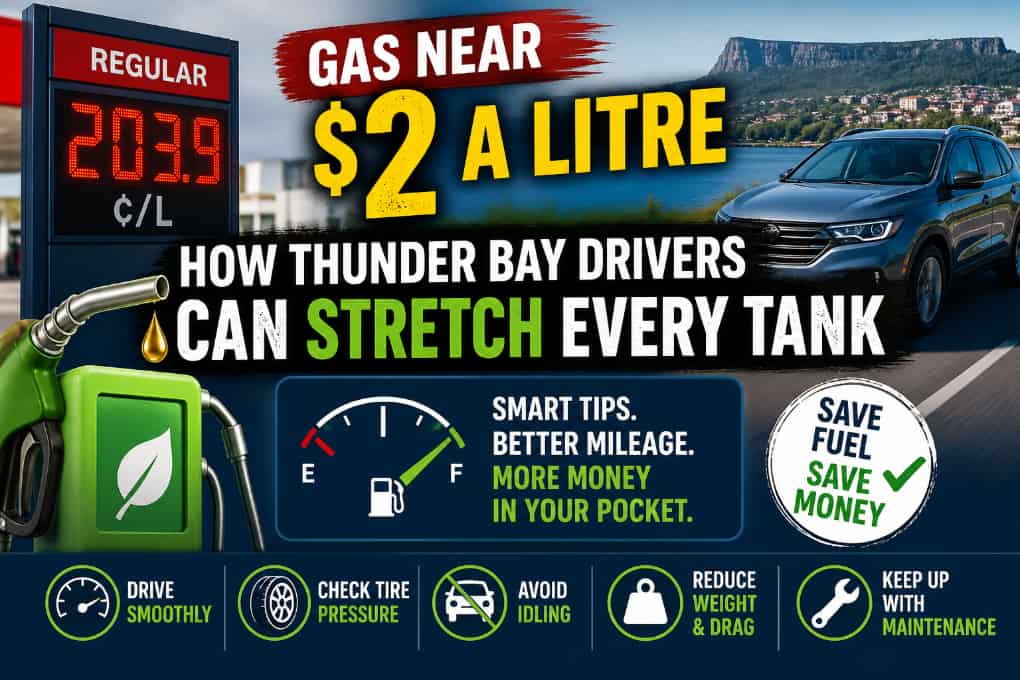
Gas Prices Near $2 a Litre: How Thunder Bay Drivers Can Stretch Every Tank
THUNDER BAY — With gasoline prices in Thunder Bay already reported above $2 per litre at some stations, drivers across the city and Northwestern Ontario are looking for practical ways to get more kilometres from every tank. For households, commuters, contractors and rural residents who cannot simply stop driving, small changes in driving habits and vehicle maintenance can add up quickly.
Fuel Savings Start With How You Drive
The biggest savings often come before the vehicle ever reaches the mechanic.
Natural Resources Canada says fuel-efficient driving can cut fuel use and emissions, while CAA recommends gentle acceleration, coasting when safe, avoiding unnecessary idling and removing extra weight from the vehicle.
Ease Up on the Gas Pedal
Hard starts burn more fuel. CAA advises drivers to avoid “jackrabbit” starts and take about five seconds to accelerate to 20 km/h from a stop. In Thunder Bay traffic, that means smoother starts from stop lights!
Watch Your Speed on the Highway
Speed matters, especially in Northwestern Ontario where many trips involve highway driving. CAA North & East Ontario says most vehicles are most efficient between 50 km/h and 80 km/h where possible, and that travelling at 120 km/h can use about 20 per cent more fuel than travelling at 100 km/h.
For drivers heading to Nipigon, Dryden, Kenora, Marathon or Fort Frances, staying near the posted limit can save money and improve safety, especially in spring when wildlife, potholes and changing weather remain concerns.
Stop Idling When You Can
Idling is expensive when fuel is close to $2 per litre. CAA says a vehicle can waste about one litre of gasoline for every 20 minutes of idling, and recommends turning the engine off when stopped for 60 seconds or more, where safe and practical.
That matters in school pickup zones, drive-thru lines, parking lots and while warming a vehicle longer than necessary. In winter, some warm-up time may be needed, but long idling periods still burn fuel without moving the vehicle.
Check Tire Pressure Every Month
Underinflated tires are one of the easiest fuel-wasters to fix. Transport Canada says a tire underinflated by 56 kPa, or eight psi, can increase fuel consumption by four per cent and reduce tire life by 15,000 kilometres. It also says tire pressure should be checked at least once a month, when tires are cold.
Drivers should use the pressure listed on the sticker inside the driver’s door or in the owner’s manual, not the number printed on the tire sidewall.
Reduce Weight and Drag
Extra weight makes the engine work harder. Remove tools, sports gear, bags of salt, roof boxes and bike racks when they are not needed. CAA says roof and bike racks reduce aerodynamics, while several short trips with a cold engine can use more fuel than one longer, planned trip.
For Thunder Bay families, that means combining errands: groceries, pharmacy stops, school pickups and appointments can often be grouped into one route instead of several separate drives.
Use Air Conditioning Carefully
Air conditioning adds load to the engine. CAA North & East Ontario says air conditioning can increase fuel use by about one-fifth. At lower city speeds, opening windows may help; at highway speeds, open windows create drag, so using ventilation or moderate air conditioning may be more efficient.
Keep Up With Maintenance
Regular maintenance helps a vehicle operate as designed. That includes oil changes, clean filters, proper wheel alignment, brake service and fixing warning lights. A dragging brake, poor alignment, low tire pressure or neglected engine issue can quietly reduce mileage.
Drivers should also use the grade of fuel recommended in the owner’s manual. Unless the vehicle requires premium gasoline, paying more for premium usually does not improve fuel economy.
Track Your Real Fuel Economy
The best way to know whether a vehicle is getting good mileage is to track it.
Fill the tank, reset the trip odometer, drive normally, then record how many litres it takes to refill. Use this formula:
Litres used ÷ kilometres driven × 100 = L/100 km
For example, if a vehicle uses 45 litres to travel 500 kilometres, it is getting nine L/100 km. If that same vehicle suddenly starts using 11 or 12 L/100 km under similar driving conditions, it may be time to check tire pressure, driving habits or maintenance.
Why This Matters More in Northwestern Ontario
Fuel prices hit Northwestern Ontario differently than larger urban centres. Many residents have longer commutes, fewer transit options and regular highway travel for work, medical appointments, family responsibilities and supplies. Higher gasoline prices also affect contractors, delivery drivers, taxi operators, small businesses, tourism operators and people travelling between regional communities.
NetNewsLedger reported Friday that Thunder Bay prices ranged from 203.9 cents per litre at some city stations to 160.0 cents per litre on Fort William First Nation, based on local GasBuddy listings reviewed at the time.
Prices can change quickly, and drivers should compare nearby stations before filling up while also considering whether a detour will burn more fuel than it saves.
The Bottom Line
Drivers cannot control global oil markets or daily pump prices, but they can control speed, tire pressure, idling, maintenance and trip planning. At $2 per litre, saving just five litres a week keeps $10 in a driver’s pocket. Over a month, that is about $40. Over a year, it becomes real money.
For Thunder Bay and Northwestern Ontario drivers, the most effective fuel-saving plan is simple: drive smoothly, slow down, keep tires properly inflated, avoid idling, remove unnecessary weight and track fuel use before small problems become costly ones.