Power returned Tuesday, but leaders warn the remote community remains at risk without reliable backup and long-term infrastructure fixes.
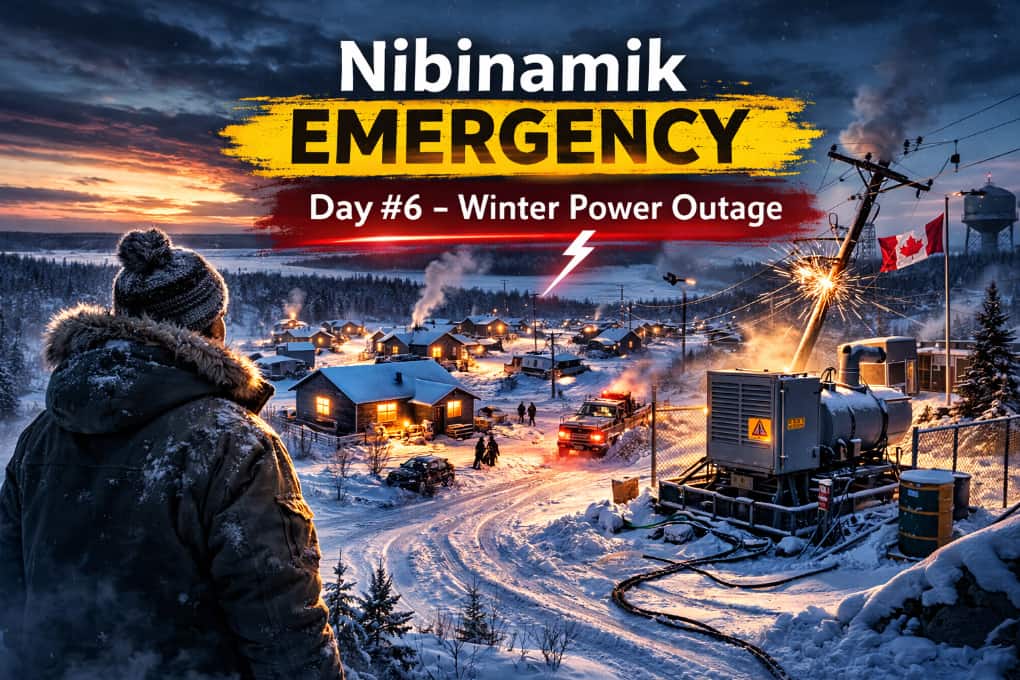
THUNDER BAY — The Matawa Chiefs Council is calling on the federal and Ontario governments to respond to Nibinamik First Nation’s state of emergency, declared Friday, February 20, 2026, as the community moves into Day 6 of a winter power outage crisis.
Nibinamik was without electricity for five days. While power was restored late Tuesday afternoon, the Chiefs Council says the situation remains fragile because the community’s diesel generating system is already operating at full capacity and lacks backup if another failure occurs. Initial recovery efforts, they add, are only beginning.
Critical services disrupted
Matawa leadership says the outage affected essential infrastructure across the remote First Nation, including:
-
Community buildings and critical operations
-
The grocery store and food supplies
-
The school
-
Homes and heating
-
Water and wastewater systems
-
The airport, including emergency operations
-
The community “black radio” communications system
As temperatures stayed below freezing with significant wind chills, community members worked to keep homes warm and protect water lines from freezing. By Day 5, leadership also evacuated medically vulnerable residents, according to the Chiefs Council.
“Infrastructure gap” and reliance on diesel
In its statement, the Matawa Chiefs Council says remote First Nations continue to face an “infrastructure gap,” with communities relying on diesel generating stations that constrain development and create major safety risks when systems fail.
“Our communities are forced to continue to operate diesel generating stations that limit our communities’ development,” the Chiefs Council said, adding that breakdowns like the one experienced in Nibinamik put “the lives and safety” of community members at risk.
Treaty 9 cited as part of long-term grievance
The Chiefs Council also points to the history of Treaty No. 9 (James Bay Treaty) and argues that longstanding inequities have contributed to today’s realities in remote communities, including limited access to stable power infrastructure.
They describe the current emergency as “the result of failure of the Crowns of Canada and Ontario,” and characterize the issue as a legitimate grievance for Treaty 9 beneficiaries past, present, and future.
Chiefs Council demands working group and immediate supports
Matawa Chiefs are demanding Canada and Ontario appoint a specifically mandated working group to remain in place until Nibinamik lifts the state of emergency. Their outlined priorities include:
-
Supporting Nibinamik First Nation to resolve the emergency
-
Immediate deployment of the Canadian Rangers and additional personnel to support a 24/7 response process
-
Compensation for loss of food and the emergency supplies required during the crisis
-
Addressing potential damage to buildings and homes caused by freezing conditions
-
A First Nation–approved recovery and prevention plan
Why it matters in Northwestern Ontario
While the emergency is centered in Nibinamik First Nation, Matawa leadership is framing the issue as a broader regional challenge across remote and fly-in communities in Northwestern Ontario—where winter conditions, limited redundancy, and aging infrastructure can quickly turn power disruptions into life-safety emergencies.