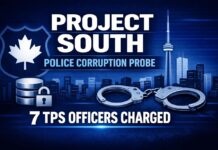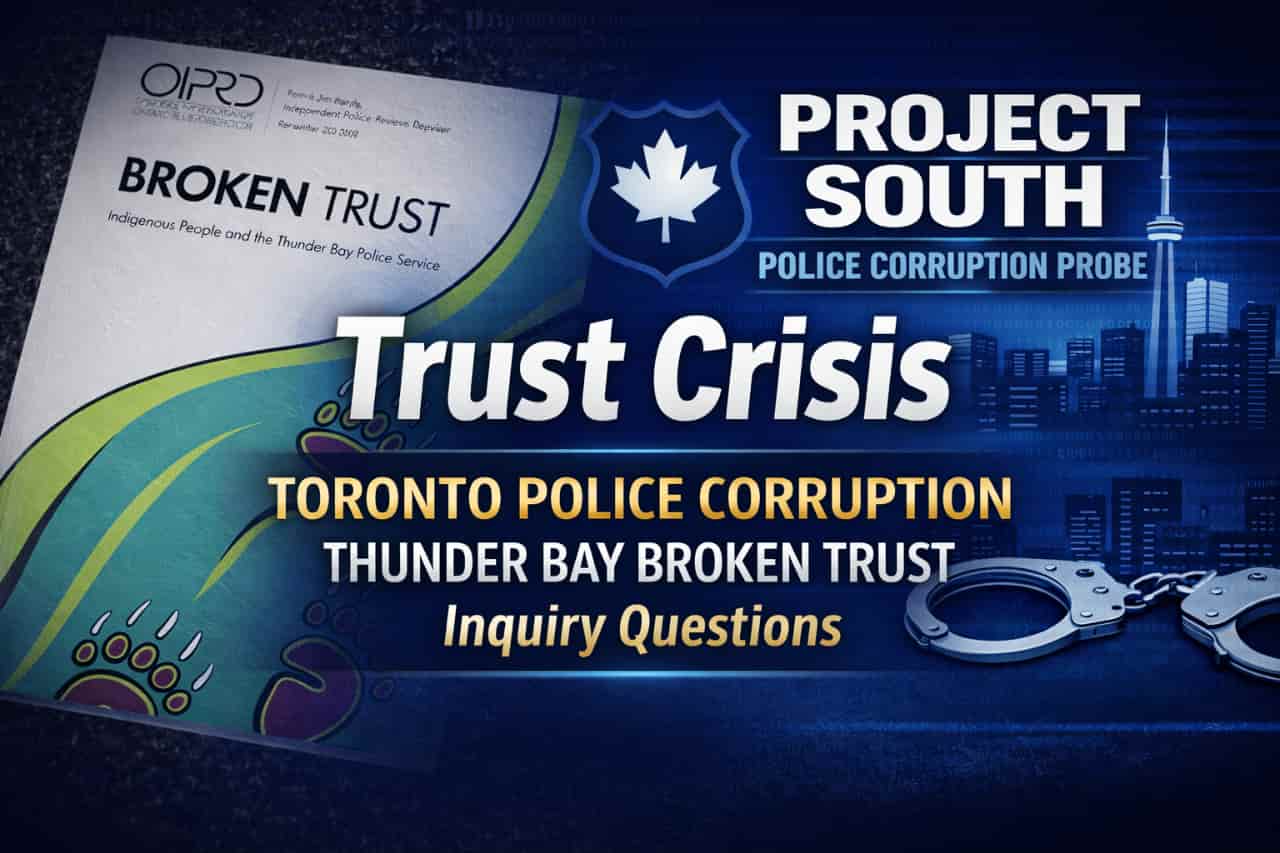
THUNDER BAY – NEWS ANALYSIS – Toronto woke up Thursday to one of the most jarring policing scandals in its modern history: seven Toronto Police Service (TPS) officers, one retired officer, and 19 other suspects charged in a sweeping organized crime and corruption probe led by York Regional Police (YRP).
The allegations are unproven in court, and the accused are presumed innocent.
However the scale of the case — and the alleged consequences of police information being fed to criminal networks — has reopened old questions that few Ontario communities, except Thunder Bay, know all too well:
How could this happen? How long has it been going on? What’s being done to root it out — fully? And will the province demand an inquiry?
What happened: The Project South investigation, in plain terms
YRP says Project South began in June 2025 after police uncovered and stopped a conspiracy to commit murder at a home in York Region. On June 20, investigators say a suspect vehicle attended the residence and collided with a marked YRP cruiser stationed there; three suspects — two youths and one adult (Almar Heath) — were arrested.
From there, investigators allege the case widened dramatically:
-
A TPS constable allegedly used a police database unlawfully to obtain confidential information.
-
That information was allegedly shared with civilians tied to criminal networks, and YRP says addresses returned in unlawful queries later became locations of extortion, commercial robberies, and shootings.
-
Police allege a broader web of crimes tied to drug trafficking, firearms, and bribery — including alleged bribes to help shield illegal cannabis dispensaries from enforcement.
YRP also says a firearm seized after a Vaughan shooting in September was forensically linked to at least eight shootings across southern Ontario.
Who has been charged — and what the allegations say
According to YRP, 27 suspects face charges, including seven TPS members and one retired officer.
The public charge list names multiple TPS officers and details alleged offences that include (among others) breach of trust, unauthorized use of a computer, obstruction-related conspiracies, and bribery-related allegations.
YRP alleges confidential information was shared with Brian Da Costa and Elwyn Satanowsky, among others, described by police as connected to criminal networks.
Key point: these are allegations. The justice system now has to test them in court.
Why the “database leak” allegations are so serious
Most corruption stories involve money, gifts, or off-duty side deals. Project South, as described by YRP, is more corrosive: information as a weapon.
If police databases can be accessed and distributed “near real time,” the impact isn’t abstract:
-
targets can be located,
-
witnesses can be threatened,
-
investigations can be compromised,
-
and criminal networks can operate with a level of protection they didn’t earn.
This is why the scandal is not just about “bad actors” — it becomes about controls, supervision, auditing, and culture inside a large organization.
Remember during the COVID-19 pandemic it was the Thunder Bay Police Service which led Ontario in Police looking at personal data of residents of our city.
What Thunder Bay Police said they were doing
In a detailed response to the Thunder Bay Police Services Board (shared publicly in 2020), TBPS legal counsel said 52 Communications Centre employees (call-takers, dispatchers, supervisors, managers) had access and were tasked with checking the portal whenever a call for service came in.
The Service said staff checked names involved in the call and the address, and that multiple searches were sometimes required because of inconsistencies in how information was stored (particularly addresses).
TBPS reported 14,831 “hits” between April 7 and July 9, 2020, linking the volume to 12,383 police and fire calls where checks occurred, plus additional searches to update the computer-aided dispatch (CAD) system. TBPS also cited early-pandemic PPE shortages, arguing the portal helped “ration” equipment by flagging known positive results.
The situation with the Toronto Police Service is very different. In this case, YRP express that the accused were accessing police records and selling them to criminals.
Are the accused officers still working?
TPS Chief Myron Demkiw says the seven arrested members are suspended, and that he will seek suspension without pay where appropriate.
That distinction matters in Ontario policing law, but the practical reality is the same for public confidence: people want to know what safeguards failed before suspensions were ever on the table.
Will there be an inquiry — or something like one?
Not every crisis becomes a formal public inquiry. But in Ontario today, there’s a major mechanism that can look a lot like one in effect: an inspection by the Inspector General of Policing under the Community Safety and Policing Act (CSPA).
Toronto Mayor Olivia Chow says she supports an independent review and that Torontonians need to get “to the bottom” of how this happened.
The Toronto Police Service Board has asked Ontario’s Inspector General of Policing to review multiple issues stemming from Project South — including:
-
supervision and span of control
-
recruitment screening and ongoing vetting
-
access to police databases and information systems
-
evidence and property management practices
-
substance use and fitness for duty
Under the CSPA, the Inspector General’s work can produce a public report, and the office can issue binding directionswhere it finds non-compliance or risk of non-compliance.
So… is that an inquiry?
It isn’t a traditional commission of inquiry with broad subpoena-style public hearings — but it can deliver the two things the public usually demands:
-
a credible, arm’s-length diagnosis, and
-
mandatory corrective actions that can’t be waved away as “internal process.”
A full public inquiry remains a political call that would likely have to come from the province, depending on what the criminal case and Inspector General inspection uncover.
Will the Chief keep his job?
Right now, Demkiw’s immediate political reality is complicated by one very recent fact: the Toronto Police Service Board renewed his contract for a further four years in September 2025, explicitly citing stability and confidence in his leadership.
On Thursday, the mayor framed the challenge clearly: the Chief must “earn trust back” by rooting out wrongdoing and making systemic changes after the independent review.
Translation: his job security may hinge less on today’s arrests and more on what the oversight process reveals about:
-
whether warning signs were missed,
-
whether internal controls were weak,
-
and whether leadership responds with meaningful structural reform rather than damage control.
The Thunder Bay parallel: why “Broken Trust” is the cautionary tale Ontario can’t ignore
Thunder Bay readers have lived through what happens when policing failures become a system problem.
In 2018, Ontario’s police complaints watchdog (then the OIPRD, now LECA) concluded: “systemic racism exists in TBPS at an institutional level”, particularly affecting investigations involving Indigenous people.
That report did more than criticize. It demanded reinvestigations, changes to supervision and investigative standards, and a framework to rebuild legitimacy.
And it’s not just history: Ontario’s Inspector General initiated an inspection of the Thunder Bay Police Service and its Board in October 2024, focused on death and missing person investigations — with findings expected to be made public.
Much of the investigations are still not public. (More on this in future reports).
The common thread between Toronto and Thunder Bay
Different facts, different harms — but one shared lesson:
When trust collapses, the fix can’t be only arrests and press conferences. Trust returns when the public sees:
-
structural vulnerabilities identified,
-
controls tightened,
-
accountability enforced consistently,
-
and oversight made visible (with timelines and follow-through).
What steps can actually “root out” corruption — beyond slogans
Based on what officials have already flagged for inspection, Toronto’s next phase likely comes down to fundamentals:
1) Database access that is provably monitored
If unlawful queries are central to the case, the response must include stronger auditing, tighter role-based access, and real-time flagging of abnormal searches — with consequences.
2) Vetting that doesn’t end at hiring
The Board’s request explicitly points to ongoing vetting — the reality that risks can develop mid-career (debt, coercion, associations, substance use, grievance culture).
3) Evidence/property controls that can’t be gamed
If any part of the allegations touches internal property handling, the response has to harden chain-of-custody and inventory systems.
4) Independent oversight that reports publicly
Ontario has shifted its oversight architecture in recent years — the OIPRD was renamed the Law Enforcement Complaints Agency (LECA) when the CSPA came into force April 1, 2024.
For the public, names matter less than outcomes: transparency, timelines, measurable reform.
What we still don’t know — and what to watch next
This story is moving, and the biggest questions are still open:
-
How far back do the alleged unlawful queries go? YRP cites a seven-month investigation, but the timeline of alleged conduct may be broader — or may not.
-
How many cases might be tainted by leaked information?
-
Will more arrests follow? Authorities have said the investigation continues.
-
Will the Inspector General’s inspection find systemic gaps — or isolated failures?
-
Will the province face pressure for a full public inquiry depending on what emerges in court?
Why this matters in Thunder Bay — even if it’s “a Toronto story”
Organized crime does not respect municipal borders. YRP describes a network touching drugs and firearms across southern Ontario and involving multi-agency resources — including TPS and the OPP.
For Northwestern Ontario, the takeaway isn’t schadenfreude — it’s vigilance:
-
Ontario’s police services are linked by shared systems, shared training standards, shared oversight frameworks, and shared public expectations.
-
When one of the country’s largest services is accused of being infiltrated, the credibility of policing everywhere takes collateral damage.
Thunder Bay’s experience shows what happens when communities stop believing the system will correct itself. Toronto may now be approaching its own version of that turning point.