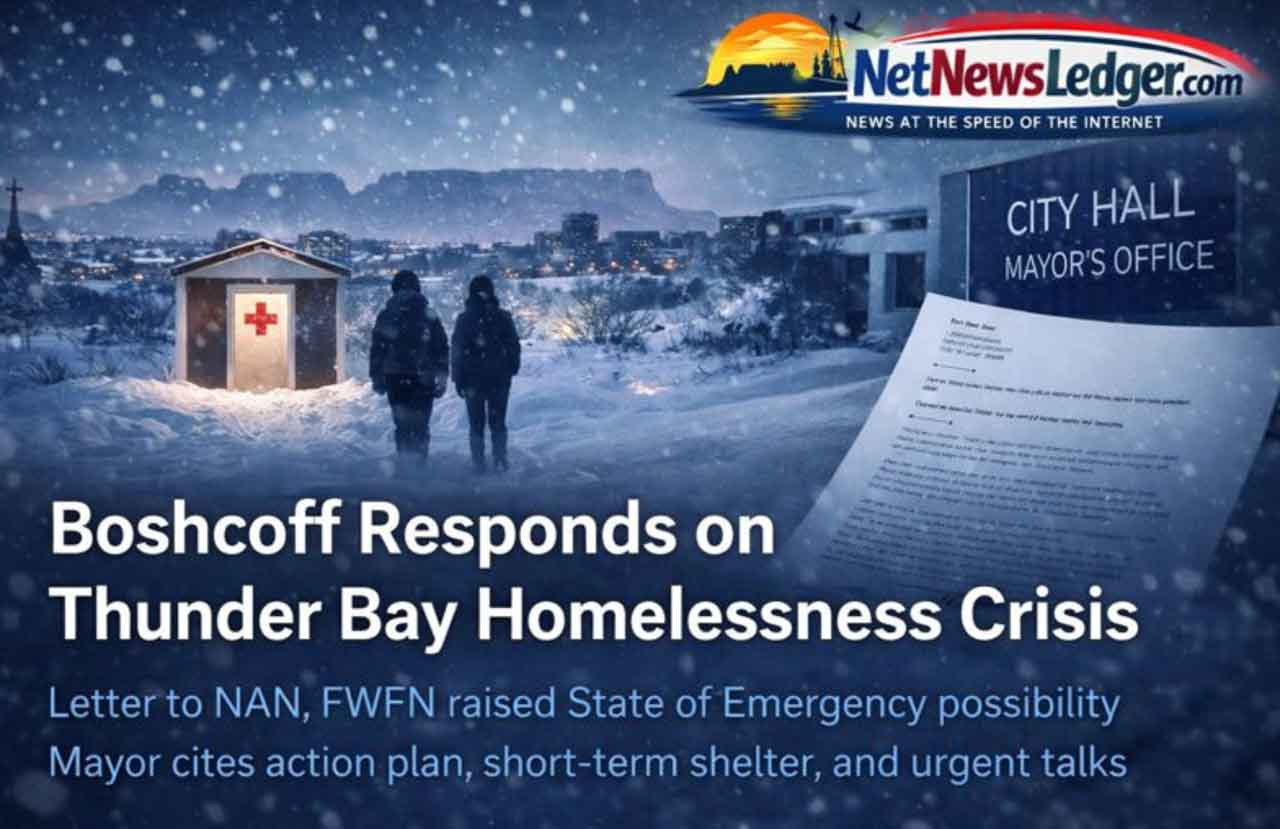
Boshcoff considers emergency declaration, requests leadership meeting “as soon as possible”
THUNDER BAY — Mayor Ken Boshcoff has written to Nishnawbe Aski Nation (NAN) Grand Chief Alvin Fiddler and Fort William First Nation Chief Michele Solomon, acknowledging what he calls an “urgent and unacceptable reality” as homelessness worsens in Thunder Bay.
In the January 29, 2026 letter, Boshcoff agrees the situation is a crisis, noting people are sleeping outdoors in dangerous conditions and that “during extreme cold the risk to life is real.” He also acknowledges the leaders’ call for the City to declare a State of Emergency—while emphasizing that the City cannot solve the problem alone and that sustained provincial and federal investment is needed.
The State of Emergency request
Boshcoff writes that he is still considering the request to declare a State of Emergency, but cautions that such a declaration “will not in itself unlock new housing or funding.”
Regardless of whether an emergency is declared, he says the next step should be a joint assessment of immediate actions and coordinated advocacy, and asks to meet with Indigenous leadership “as soon as possible.”
Thunder Bay as a regional service hub
In the letter, the mayor frames Thunder Bay’s role as a regional centre for Northwestern Ontario, saying the city supports residents from surrounding First Nations and municipalities—reinforcing the need for a broader intergovernmental response.
City actions highlighted in the letter
Boshcoff outlines several initiatives the City says are underway or expanding:
-
A 10-part Enhanced Encampment Response Action Plan, described as grounded in a human rights-based approach.
-
A Temporary Village, targeted to open Spring 2026, with the City reporting funding secured, a site selected, and an operator and design-build team procured.
-
Investment figures cited as more than $15 million over five years for the Temporary Village, plus over $2 million annually in the City’s baseline operating budget for related initiatives.
-
A recently established Encampment Response Team, intended to build consistent engagement with people sheltering outdoors and strengthen connections to health and social services.
-
Continued work on affordable housing, including development of a Housing Affordability Strategy for longer-term solutions.
Extreme cold response and short-term indoor options
During the period of severe winter weather, Boshcoff says the City activated its Severe Weather Response Plan, coordinated with partners to extend services, and provided financial resources to expand short-term indoor options for people sheltering in encampments.
Acknowledging disproportionate impacts on Indigenous peoples
The mayor also acknowledges that Indigenous peoples are disproportionately represented among those experiencing homelessness, linking this to the ongoing impacts of colonization, residential schools, systemic racism, and long-standing inequities. He states that a meaningful response must be grounded in reconciliation and strengthened partnerships that respect Indigenous rights, knowledge, and self-determination.
What happens next
Boshcoff’s letter closes with a request to convene leadership in the coming days to discuss next steps—both immediate actions and opportunities for coordinated advocacy—while reiterating the City’s commitment to working with Indigenous leadership, community partners, and other orders of government.
Complete Text of Mayor Boshcoff’s Letter
January 29, 2026
RE: Working Together on Urgent and Long-Term Actions to Address Homelessness
Dear Grand Chief Fiddler and Chief Solomon,
Thank you for your letter and for your leadership in highlighting the urgent and unacceptable reality of homelessness in our community.
I want to be clear: I agree this is a crisis. People are sleeping outside in dangerous conditions, and during extreme cold the risk to life is real. No one should be without safe shelter, and we recognize the profound human toll this situation is taking.
I also acknowledge your call for the City to declare a State of Emergency.
Your message underscores both the immediate danger and the need for increased resources and coordinated action across all orders of government. We agree that the City cannot solve this alone.
As a regional service hub for Northwestern Ontario, Thunder Bay supports residents from surrounding First Nations and municipalities, reinforcing the need for a regional, intergovernmental response supported by sustained provincial and federal investment.
At the same time, I want to share the concrete steps the City has taken to strengthen its role within a broader community response.
Council approved a 10-Part Enhanced Encampment Response Action Plan grounded in a human rights-based approach. As part of that plan, we are actively advancing the Temporary Village toward opening in Spring 2026, having secured funding, selected a site, and procured both an operator and design-build team.
This represents more than $15 million in investment over five years. In addition, the City’s baseline operating budget includes over $2 million annually for complementary initiatives that support people experiencing homelessness and help build a more coordinated community response.
Recognizing the importance of consistent, relationship-based engagement, examples of our initiatives include the City’s recently established Encampment Response Team to work directly with people sheltering outdoors, strengthening connections to health and social services, and supporting voluntary pathways to safer options.
At the same time, we continue to invest upstream in affordable housing and are developing a Housing Affordability Strategy to guide longer-term solutions.
During this extended period of extreme cold, the City activated its Severe Weather Response Plan and coordinated with partners to extend critical services.
We also provided financial resources to expand short-term indoor options for individuals sheltering in encampments. These actions reflect our shared commitment to protecting life when risks escalate. I share this not to suggest that the work is complete – far from it – but to demonstrate that we are acting urgently on both immediate needs and on long-term system change.
Housing and homelessness remain priority areas in the City’s Community Safety and Well-Being Plan and will continue to guide our work.
I also want to recognize that Indigenous peoples are disproportionately represented among those experiencing homelessness, reflecting the ongoing impacts of colonization, residential schools, systemic racism, and long-standing inequities.
Any meaningful response must be grounded in reconciliation and strengthened partnerships with Indigenous leadership, respecting Indigenous rights, knowledge, and self-determination. We recognize there is more to do, and we are committed to continuing to listen, learn, and act.
While a state of emergency is one possible tool, it will not in itself unlock new housing or funding. I am still considering your request but whether there is a declared state of emergency or not, it is important to jointly assess how we can better work together to solve this crisis.
Therefore, I support the opportunity to convene our collective leadership in the coming days to discuss next steps – including the potential role we can all play to take additional immediate actions and explore opportunities for coordinated advocacy. I would kindly request your support to meet as soon as possible. We care deeply about those affected by this crisis.
The City will continue this work within its capacity and in collaboration with Indigenous leadership, community partners, and other orders of government to strengthen coordinated responses and support meaningful pathways to housing.
Most Sincerely,
His Worship Mayor, Ken Boshcoff
City of Thunder Bay
CC: City of Thunder Bay Executive Leadership Team