How Did Canada Become a Tent City Country?
Thunder Bay – NEWS – Residents in cities and towns across Canada are seeing greater numbers of homeless people in their communities. Tent encampments which a decade ago in cities across Canada were almost unheard of.
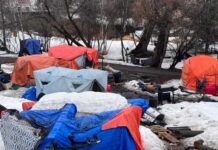
Today, our walkways, public parks, and in some cities right on the sidewalks have become mini-encampments with tents, firepits, propane barbecues, campfires on the grounds, and all the mess that these unofficial little communities generate.
Social services are stretched to the limits they set on themselves.
Police have basically been handcuffed – they are asked to be social workers, part-time councillors, psychologists and finally peace officers. It is a tough tall order of business.
In Thunder Bay up to 40 police officers are off on medical leave. The stress of the job is taking a real toll.
Solving the situation has been put on municipal governments, while the courts often tie their hands.
Municipal governments across Canada face a legal and humanitarian balancing act when dealing with homeless encampments in public spaces.
Court decisions—mainly in British Columbia—have affirmed the constitutional rights of unsheltered people, significantly influencing how cities can draft and enforce bylaws.
The City of Penticton is moving forward with new bylaws that could be tested in court, but at the least the City is trying.
Perhaps there is a learning opportunity for Thunder Bay City Manager John Collin and his staff? More about that later.
How did the Courts Mandate the Homeless Encampments?
Here is an overview of the court cases that have brought the situation to its current state of affairs:
1. Victoria (City) v. Adams, 2008 BCSC 1363
Court: British Columbia Supreme Court
Key Finding:
-
The court ruled that prohibiting homeless individuals from erecting shelter overnight in public parks, when there is no adequate indoor shelter available, violates Section 7 of the Charter of Rights and Freedoms (right to life, liberty, and security of person).
-
The ban was deemed unconstitutional if shelter space is insufficient.
Impact:
-
First major case to legally affirm a Charter right to shelter in public when no alternative is available.
-
Forced municipalities to modify or repeal blanket anti-camping bylaws.
2. Abbotsford (City) v. Shantz, 2015 BCSC 1909
Court: British Columbia Supreme Court
Key Finding:
-
The City of Abbotsford’s bylaw banning camping in parks and seizing belongings of unhoused individuals was struck down.
-
The court ruled these actions were unconstitutional and discriminatory, again referencing Section 7 rights and adding Section 15 protections (equality rights).
Impact:
-
Reinforced the legal obligation of municipalities to respect the dignity and survival needs of unhoused individuals.
-
Added further legal limits on policing encampments or removing shelters.
3. British Columbia v. Adamson, 2016 BCSC 584
Court: British Columbia Supreme Court
Key Finding:
-
In the context of the Tent City in Victoria, the court ruled that long-term encampments on provincial land were not a Charter right, especially once adequate shelter space became available.
Impact:
-
Clarified that the right to shelter in public is conditional on lack of access to indoor alternatives.
-
Once sufficient shelter is offered, governments can lawfully require people to move.
4. Ontario Court of Appeal – Various Lower Court Precedents
While B.C. courts have led the jurisprudence, Ontario municipalities (including Toronto, Hamilton, and Waterloo Region) have seen recent injunction hearings regarding tent encampments:
-
Courts in Ontario have sometimes granted municipalities permission to clear encampments, but only if:
-
Adequate shelter beds are available
-
The removal process respects due process and Charter rights
-
Displacement does not lead to greater harm for vulnerable individuals
-
For Thunder Bay, it seems that the solution Administration has presented
Legal Framework Moving Forward
Municipalities must now design sheltering bylaws that balance:
-
Public safety and park usability
-
The rights of unhoused individuals under the Charter
-
The availability and suitability of emergency shelter options
Most cities, including Penticton, Kelowna, Victoria, and Vancouver, have adopted time-based sheltering rules (e.g., allowing tents overnight from 7 p.m. to 9 a.m.) and exclusion zones (e.g., no tents near playgrounds, schools, trails, or heritage sites).
Key Legal Principles for Municipal Shelter Bylaws
| Legal Principle | Explanation |
|---|---|
| Charter Section 7 | Right to life, liberty, and security includes survival shelter in absence of housing. |
| Charter Section 15 | Bylaws cannot discriminate against people based on housing status. |
| Proportionality | Municipal actions must be reasonable and not cause undue harm. |
| Conditional legality | Right to camp applies only when indoor shelter is unavailable or unsuitable. |
Penticton Moves to Update Parks Bylaw Amid Ongoing Homelessness Response
New Regulations Aim to Balance Public Access with Legal Rights of Unsheltered Residents
The City of Penticton is moving forward with an updated Parks Bylaw aimed at modernizing rules governing the city’s public spaces while aligning with legal precedents on overnight sheltering for people experiencing homelessness.
The new bylaw—up for consideration by City Council during a special meeting—seeks to replace a decades-old 1974 version that officials say no longer meets the needs of a changing community.
“These updates will ensure our parks amenities – including playgrounds, trails and sports fields – remain safe and accessible to all,” said Kristen Dixon, Penticton’s General Manager of Infrastructure.
Sheltering Rules Reflect Legal Obligations and Public Safety
A key feature of the revised bylaw is the introduction of clear guidelines on overnight sheltering in parks, following multiple B.C. court rulings that found municipalities cannot impose blanket bans on outdoor sheltering when indoor shelter is unavailable.
“An outright prohibition on overnight sheltering in parks is unconstitutional and unenforceable,” said Julie Czeck, General Manager of Public Safety & Partnerships. “These updates will bring Penticton’s bylaw in line with other cities across the province and remove any confusion.”
While recreational camping remains prohibited, the bylaw will allow for temporary overnight sheltering in public spaces under specific conditions—intended to both protect community safety and respect individual rights.
Areas Where Overnight Shelter Will Be Prohibited
The proposed bylaw outlines areas where overnight sheltering will not be allowed, including high-traffic waterfront parks and sensitive public spaces:
-
Okanagan Beach, SS Sicamous Park, and the Rose Garden
-
Rotary Park, Gyro Park, and Okanagan Lake Park
-
Japanese Garden, Marina Way Park, and Marina Way Beach
-
The northern section of Lakawanna Park (886 Lakeshore Dr. W)
-
Skaha Lake Beach, Sudbury Beach, and Skaha Lake Park
Regulations on When and How Shelter Can Be Used
The updated bylaw includes strict limits on when and where temporary shelters can be set up:
-
Permitted hours: 7:00 p.m. to 9:00 a.m. only
-
Prohibited zones:
-
Within 15 metres of playgrounds
-
Within 4 metres of trails, sports fields, or sensitive areas
-
Within 50 metres of school property
-
Within 15 metres of building entrances
-
Other regulations include:
-
Maximum shelter area: 9 square metres
-
Minimum distance between shelters: 4 metres
-
Shelter materials and belongings must be removed each day after 9:00 a.m.
Part of a Broader Strategy on Homelessness
The bylaw update is one piece of a larger strategy by the City of Penticton to address homelessness and housing insecurity. The city is collaborating with:
-
100 More Homes Penticton
-
Penticton Indian Band
-
BC Housing and provincial ministries
These partnerships are focused on expanding supportive housing, enhancing mental health and addiction services, and increasing shelter capacity.
Among ongoing initiatives:
-
Participation in B.C.’s Heart & Hearth program, which provides integrated housing and support for people who are unsheltered
-
Extension of the city’s temporary winter shelter
-
A forthcoming Social Housing and Infrastructure Plan
-
Major projects, including the Skaha Assembly Site (approx. 600 units), three city-owned properties for social housing, and a downtown Indigenous-focused affordable housing project
Penticton is taking action – and working to protect the city and its permanent residents.
It is something that the City of Thunder Bay could be learning from. The question is anyone at 500 Donald interested?
Bottom Line for Cities Like Thunder Bay & Penticton
Municipalities cannot legally enforce blanket bans on overnight sheltering in public spaces. However, they can regulate sheltering:
-
By limiting sheltering to certain hours
-
By excluding sensitive public areas
-
By requiring removal once housing or shelter is made available
Bylaws must always be backed by outreach, adequate shelter capacity, and respect for constitutional rights.