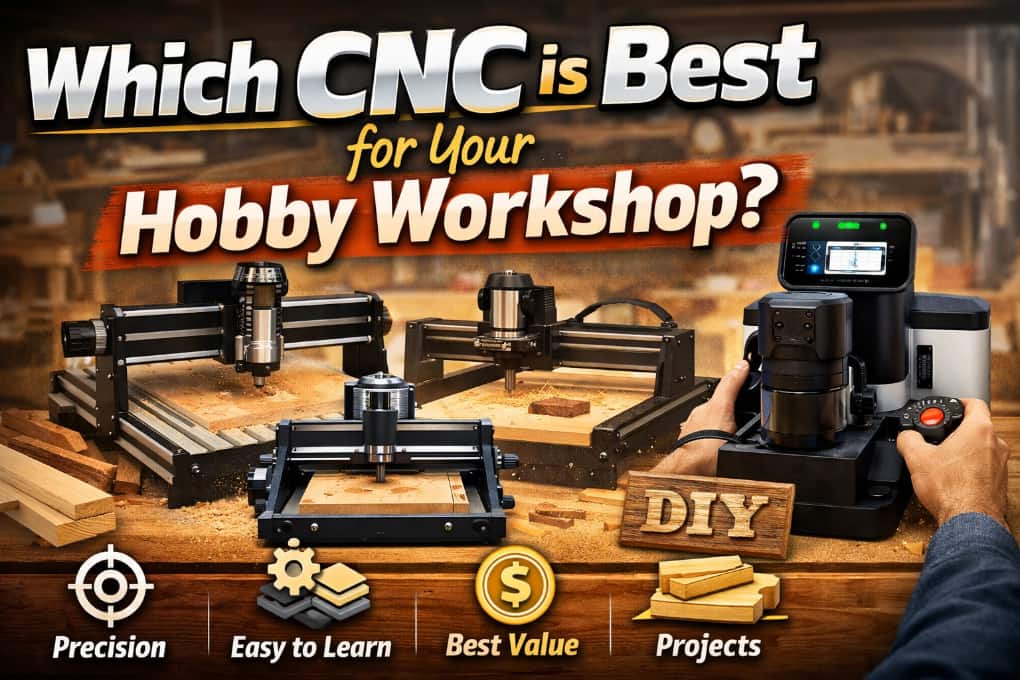
Thunder Bay – TECH – Home shops or people looking to start a side hustle often think adding a CNC to their shop is a great stop.
A CNC can be a very smart addition to a hobby shop, but only if you buy the right class of machine for the work you actually do. The real payoff is repeatability: making the same part twice, cutting clean joinery, signs, inlays, templates, fixtures, and small production runs without laying everything out by hand every time.
Current hobby machines are built to cut wood, plastics, and in many cases aluminum or soft metals, while larger machines let you nest more parts and run longer jobs.
The other big benefit is that a CNC can handle the dull, repetitive work while you keep the hand-work for fitting, assembly, shaping, and finishing. That is where a home shop often gets more efficient: you stop using your router table, drill press, and templates for every repeated cut. The catch is simple: a CNC is not a magic box. You still need to learn design, workholding, zeroing, bits, feeds, and dust collection.
For the easiest learning curve, the best machines are usually the ones with the best software and training ecosystem, not the absolute cheapest hardware. Carbide 3D says Carbide Motion gets users up and running quickly “even if you don’t know a thing about CNC,” and Carbide Create is free CAD/CAM with beginner training.
Sienci’s gSender is also positioned as easy for people with no prior CNC experience and includes built-in tools for setup, surfacing, and calibration. Shaper Origin goes even further by skipping traditional full-machine programming for many jobs and letting you steer a handheld CNC on-screen.
An expert shortlist would be this:
Best overall beginner ecosystem: Shapeoko 4
This is one of the safest buys for a first “real” CNC. Carbide calls it a cost-effective, low-maintenance machine with 90% of Shapeoko Pro performance at a lower price, and says it is ideal for people just getting started in CNC. Paired with Carbide Motion and Carbide Create, it likely has the smoothest on-ramp for a woodworker who wants less tinkering and more cutting.
Best value in Canada: Sienci LongMill MK2.5
For a Canadian hobby shop, this is a strong value play. Sienci describes the LongMill MK2.5 as accessible, powerful, and affordable, with size options from 12″ x 30″ up to 48″ x 30″. Its gSender software is built to be clean and beginner-friendly, and Sienci says most first-time buyers can put together a complete setup for under CAD $3,000 including common accessories. For many hobby woodworkers, that is the sweet spot between toy and overkill.
Best sub-$1,000 step-up machine: FoxAlien Masuter 3S
This is where value starts to get serious. FoxAlien says the Masuter 3S comes with a 400W spindle and four Nema23 closed-loop stepper motors, and markets it as under $1,000. That makes it much more appealing than the bargain-bin 3018 clones if you want to cut real woodworking projects instead of just learning the motions on tiny stock.
Best cheap machine to learn CNC fundamentals: Genmitsu 3018-PROVer V2
If your main goal is to learn CAD/CAM, zeroing, toolpaths, and machine setup without spending much, this is a fair entry point. SainSmart lists 20–35 minutes assembly time and a working area of about 11.4″ x 7.1″ x 1.6″. That said, it is a learner machine, not a forever woodworking machine. It is fine for small engravings, tags, test cuts, and tiny parts. It is not the machine I would buy first for sign work, cabinetry, or furniture parts.
Best compact midrange desktop: Genmitsu 4040-PRO / 4040-PRO MAX
The 4040-PRO gets you into a much more useful work envelope at 15.7″ x 15.7″ x 3.31″. SainSmart explicitly positions it for beginners, hobbyists, and small-business users. The 4040-PRO MAX adds a reinforced chassis and a 710W router, which gives you more room to grow if you know you will stay with CNC. Between the two, the plain 4040-PRO is the value pick; the MAX is the “buy once, cry once” version.
Best newer beginner machine worth watching: Onefinity Apprentice
Onefinity says the Apprentice is designed to give beginners an approachable entry into CNC without giving up ball screws, linear motion components, and an all-metal frame. It is compact at 16.5″ x 16.5″, and Onefinity lists it starting at $995 USD. For small signs, fixtures, and learning CNC in a tight shop, it looks promising. The trade-off is obvious: the cutting area is small.
Best “grow into it” options: FoxAlien XE-PRO or Shapeoko 5.1 Pro
These are for the hobbyist who already knows CNC is going to stick. FoxAlien’s XE-PRO uses ball screws, closed-loop motors, a 400W spindle, and has built-in offline control with a roughly 400 x 400 x 95 mm work area. Shapeoko 5.1 Pro is the more business-ready step, using hardened linear rails and ballscrews, with Carbide positioning it as a heavy-duty machine for productivity and larger jobs. They are stronger picks for harder use, but they are not the cheapest or simplest first buy.
Easiest learning curve of all, but a different category: Shaper Origin
If your work is mostly joinery, template routing, hardware installation, and one-off custom furniture details, Shaper Origin deserves a look. Shaper says it is a handheld CNC that does not require programming for many tasks, works with almost any design software, and has a full getting-started tutorial path. It is easier to grasp for many traditional woodworkers because it feels like using a router with digital help. The downside is that it is not the same thing as owning a gantry CNC that can batch parts unattended.
My plain-spoken buying advice:
-
If you want the easiest first experience, buy a Shapeoko 4.
-
If you want the best Canadian value, buy a LongMill MK2.5.
-
If you want the best budget machine that is still worth owning, look hard at the FoxAlien Masuter 3S.
-
If you only want to learn CNC cheaply, buy the Genmitsu 3018-PROVer V2 and accept its limits.
-
If you want digital precision without a full gantry CNC workflow, consider Shaper Origin.
Suggestions for most hobby wood-shops are this: skip the ultra-cheap clone machines unless your only goal is training. Buy either a LongMill MK2.5, Shapeoko 4, or Masuter 3S, depending on budget and how much support ecosystem matters to you. Those are the machines most likely to get used instead of becoming a half-finished project in the corner.