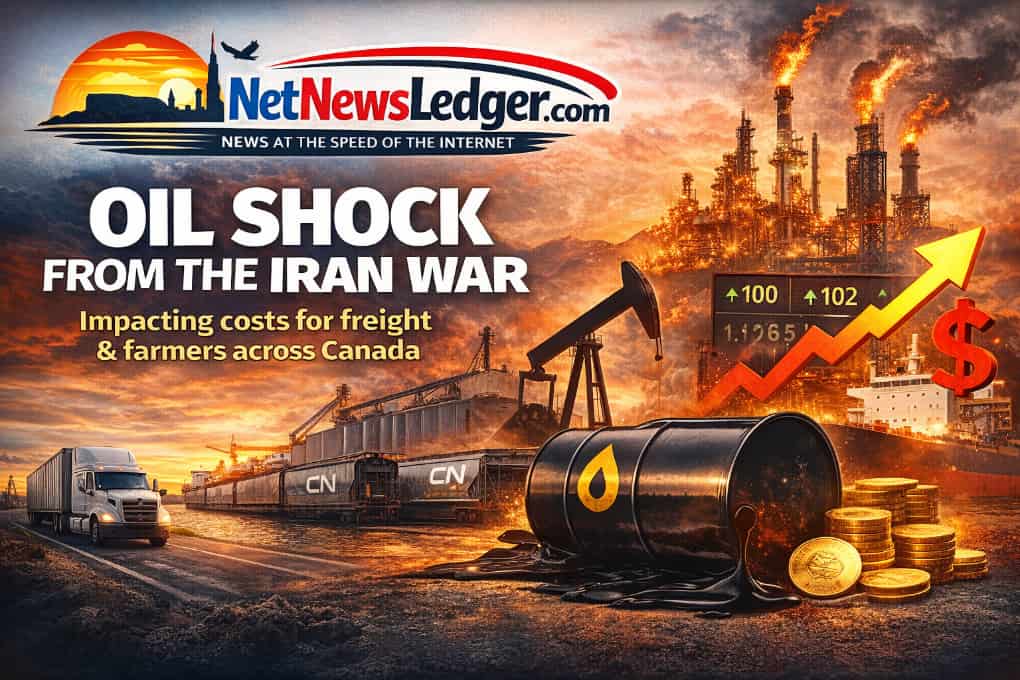
Oil shock from the Iran war is set to raise freight and farm costs across Canada
Thunder Bay – Energy Analysis – The conflict now roiling energy markets is not a war with Iraq. It is an escalating U.S.-Israeli war on Iran, with Iraq and other Gulf producers caught in the same regional supply shock.
That distinction matters because the economic damage is moving through the Strait of Hormuz, one of the world’s most important oil chokepoints.
Brent crude surged above US$100 this week and briefly hit US$119.50 before easing back below that level Friday.
For Thunder Bay and Northwestern Ontario, the immediate effect is higher diesel, rail and marine fuel costs; over the next six months, the likeliest result is a fresh inflation bump and thinner margins for farmers and shippers rather than an outright collapse in grain movement.
What the next six months are likely to look like
Most forecasters still see this as a sharp but potentially temporary oil shock, not yet a permanent re-pricing of energy.
The U.S. Energy Information Administration says Brent should remain above US$95 a barrel through the next two months, then fall below US$80 in the third quarter and toward US$70 by year end if disruptions ease.
Goldman Sachs is more cautious in the near term, expecting Brent to average above US$100 in March and US$85 in April, while still seeing prices drift back to the low US$70s later in 2026.
Canada’s base case is more inflation than recession
Before the latest oil shock, the Bank of Canada’s January outlook called for modest growth of about 1¼ per cent and inflation near the two per cent target. Since the war began, private-sector forecasters have nudged inflation expectations higher without yet calling for a major downgrade to national growth.
RBC Investor Services now pegs Canadian headline inflation at 2.4 per cent for 2026 because of higher oil-price assumptions, while leaving GDP, unemployment and Bank of Canada rate expectations unchanged.
That fits the broader expert view. Scotiabank’s model says a persistent US$10 increase in WTI crude would add about 0.2 percentage points to Canadian CPI and lift real GDP by 0.5 per cent in year two because Canada is a net energy exporter. Desjardins reaches a similar conclusion: higher oil tends to raise both Canadian growth and inflation nationally, but the benefits are concentrated in energy-producing provinces while provinces such as Ontario and Quebec get more of the inflation and less of the growth.
Based on those models, the most credible six-month forecast is this: if oil stays roughly US$20 to US$30 above pre-war assumptions through the spring, Canada’s headline inflation rate could run about 0.3 to 0.6 percentage points above its pre-conflict path at the peak of the shock, mainly through gasoline, diesel, freight and food.
That is an inference from Scotiabank’s rule of thumb and RBC’s revised forecast, not a direct published forecast. The hit to national GDP over just six months is likely to be small on net, because gains in Alberta, Saskatchewan and Newfoundland and Labrador partly offset weaker household spending and higher costs in Central Canada.
Why households in Ontario and the North may feel the pain first
Canada’s economy was already softening before oil spiked. Statistics Canada reported a loss of 83,900 jobs in February, pushing the unemployment rate to 6.7 per cent.
January inflation was 2.3 per cent, but that was held down by gasoline prices that were still 16.7 per cent lower than a year earlier; excluding gasoline, CPI was running at three per cent. In other words, households entered this energy shock with a weaker labour market and less room to absorb another jump in living costs.
For Thunder Bay and Northwestern Ontario, that likely means a faster pass-through into delivered prices than into incomes. The region depends heavily on trucking, rail and marine links for food, consumer goods, construction materials and industrial inputs.
BMO says Canada faces the same stagflation risks as the United States, though less intensely because a firmer Canadian dollar and Canada’s oil-exporter status cushion some of the blow.
That is a national average, however; communities farther from major distribution hubs usually feel freight-driven price pressure quickly.
Farmers are heading into planting season with costs rising on two fronts
Ottawa’s own crop outlook says input costs and input availability are among the main factors shaping 2026 seeding decisions.
Farm Credit Canada says the Middle East historically accounts for nearly one-quarter of global nitrogen fertilizer trade, and that urea futures jumped about US$130 a tonne, nearly 30 per cent, in the first two days after the bombing began. FCC had already projected Canadian crop input spending at $22.5 billion in 2026, with fertilizer nearing $10 billion, even before this latest conflict.
That means Prairie and Ontario farmers are being squeezed by higher diesel and higher fertilizer risk at exactly the wrong time. Even if grain prices rise somewhat with the global oil shock, the timing is unfriendly: cash costs go up immediately, while any revenue benefit depends on crop choices, yield and later selling prices. The likeliest near-term effect is not a collapse in acreage, but tighter operating margins and more caution in seed, fertilizer and fuel purchases.
Freight costs are already moving higher
The transport channel is where higher oil becomes a Canada-wide inflation story. The Canadian Transportation Agency’s grain-revenue formula explicitly includes fuel as a key railway cost. CN’s posted bulk-carload fuel surcharge for intra-Canada traffic rose from $0.3883 per mile in March to $0.4475 per mile for April, based on a higher diesel benchmark.
On the marine side, the St. Lawrence Seaway had already announced a 2.5 per cent increase in tolls and wharfage charges for the 2026 navigation season.
That combination points to higher delivered costs for grain, potash, forest products, steel, consumer goods and food shipments over the next several months.
Trucking usually feels the diesel shock first, rail follows through fuel surcharges and regulated cost formulas, and marine freight absorbs both fuel and toll pressure.
That does not mean every sticker price jumps at once, but it does mean the cost floor under Canadian distribution is moving higher.
Will grain shipments through the Port of Thunder Bay be hit?
Yes on cost, probably not on volume in the base case. The Port of Thunder Bay moved 8,971,918 tonnes of grain in 2025 out of total cargo of 10,755,979 tonnes, confirming that grain remains the port’s dominant business.
CPKC’s 2025-26 grain outlook says it plans capacity for up to 685,000 metric tonnes a week when Thunder Bay is open and 525,000 metric tonnes a week when the port is closed for winter. CN’s grain planning documents also describe better use of eastern outlets such as Thunder Bay, Montreal and Quebec City as a way to free capacity elsewhere in the system.
So the more likely six-month outcome is this: grain will keep moving through Thunder Bay, but at a higher logistics cost. Rail fuel surcharges, marine fuel costs and Seaway tolls will all eat into the economics of routing grain east. That is more likely to show up in weaker netbacks to farmers, higher basis levels and tighter margins for grain handlers than in empty terminals at the port.
A material hit to Thunder Bay volumes would require one of three things: oil staying near US$90 to US$100 deep into the second half of the year, another serious rail disruption, or a simultaneous drop in grain demand and prices.
What this means for inflation by late summer
Canada’s headline inflation rate is likely to turn higher from here, with the biggest effects in fuel, freight, food distribution and selected manufactured goods.
In the base case, where Brent stays elevated through March and April and then eases through the summer, headline CPI probably moves back toward the upper half of the Bank of Canada’s one-to-three per cent target band before cooling later in the year.
In the risk case, where the Strait of Hormuz remains badly disrupted and oil stays near today’s stressed levels into summer, inflation could push toward or above three per cent and keep the Bank of Canada on hold longer than households and businesses had hoped.
For Thunder Bay, the story is straightforward. The first impacts will be felt in diesel bills, freight surcharges, farm-input invoices and the delivered cost of goods. The port should remain a key Prairie grain outlet, but it is set to become a more expensive one.