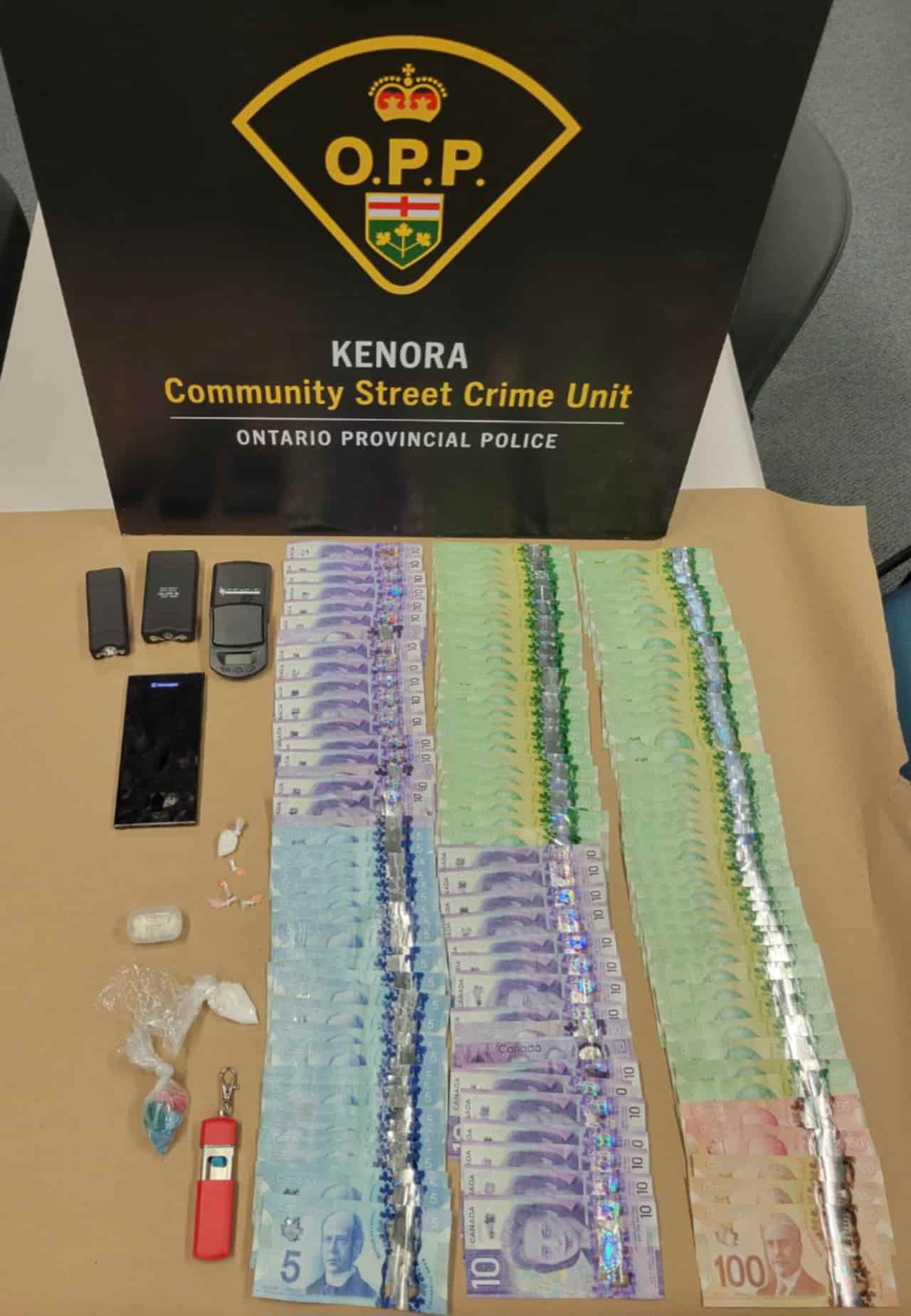
Search warrant also turns up cash and two conducted-energy weapons; one accused remanded, one released
KENORA, ON — Feb. 14, 2026 — Kenora OPP say two people are facing drug trafficking-related charges after officers executed a search warrant at a residence in the city, seizing suspected controlled substances, cash and two conducted-energy weapons.
Police say the warrant was carried out by the Community Street Crime Unit (CSCU) with assistance from the Kenora OPP detachment, the Organized Crime Enforcement Bureau (OCEB) and the Provincial Operations Intelligence Bureau (POIB). Investigators allege they located suspected methamphetamine, suspected fentanyl and suspected hydromorphone pills, along with Canadian currency and the weapons. OPP estimate the drugs’ combined street value at about $12,560.
Charges laid
Police have charged Logan McGuffin, 31, of Kenora, with:
-
Possession for the purpose of trafficking (methamphetamine)
-
Possession for the purpose of trafficking (fentanyl)
-
Possession for the purpose of trafficking (hydromorphone)
-
Possession of property obtained by crime under $5,000
-
Possession of a weapon for a dangerous purpose
-
Possession of a prohibited device or ammunition
-
Failure to comply with release order
OPP say McGuffin was remanded into custody and is scheduled to appear in the Ontario Court of Justice in Kenora on Feb. 19, 2026.
Police have also charged Rosalyn Read, 53, of Kenora, with the same CDSA and Criminal Code offences, with the breach allegation listed as fail to comply with probation order. OPP say Read was released and is scheduled to appear in court March 16, 2026.
Editor’s note: The allegations have not been proven in court.
What the drug charges mean—and the maximum penalties
All three substances listed by police — fentanyl, hydromorphone, and methamphetamine — are Schedule I drugs under Canada’s Controlled Drugs and Substances Act.
The charge police laid, “possession of a Schedule I substance for the purpose of trafficking,” is covered under CDSA section 5(2). For Schedule I substances, the law sets a maximum penalty of life imprisonment if convicted.
Sentences in trafficking cases vary widely and depend on factors such as the quantity, the role of the offender, prior record, and risk to public safety. Federal reforms in recent years also repealed a number of mandatory minimum penalties for drug offences, leaving judges with broader discretion within the maximums set by law.
Explaining the Criminal Code charges—and potential penalties
Possession of property obtained by crime (under $5,000)
This offence typically relates to possessing cash or property knowing it was obtained by crime. Where the value is $5,000 or less, the Criminal Code provides a maximum of two years’ imprisonment if prosecuted by indictment (it can also proceed by summary conviction).
Possession of a weapon for a dangerous purpose
Police allege the accused possessed a weapon (or prohibited device/ammunition) for a purpose dangerous to the public peace or for committing an offence. The maximum penalty on indictment is 10 years’ imprisonment.
Possession of a prohibited device or ammunition
This charge generally applies when someone possesses a prohibited weapon/device or prohibited ammunition without the required authorization. The maximum penalty on indictment is five years’ imprisonment.
Breach charges: release order vs. probation order
-
Failure to comply with a release order (bail/release conditions) carries a maximum of two years’ imprisonmenton indictment.
-
Failing to comply with a probation order now carries a maximum of four years’ imprisonment on indictment.
Why breach-of-conditions charges are so common
In Northern Ontario — as in the rest of Canada — it’s common for people accused of offences to be released on strict conditions while awaiting court, and for people serving sentences in the community to be bound by probation conditions (curfews, no-contact orders, geographic restrictions, abstinence clauses, and “keep the peace” requirements).
Breach charges often arise because:
-
There are many conditions to follow, and even “technical” violations (missing curfew, entering a restricted area, contact through a third party) can trigger charges.
-
Police contact is frequent in ongoing investigations, meaning breaches are more likely to be detected.
-
Breaches are categorized as administration of justice offences, and Justice Canada has noted that when bail violations occur, they overwhelmingly involve breaching release conditions or failing to attend court.
Breach allegations can also affect whether someone is detained or released going forward, because they may be raised at bail hearings as a public-safety and confidence-in-the-justice-system issue.
Police seeking information
OPP are asking anyone with information about drug trafficking to contact police at 1-888-310-1122 or provide an anonymous tip through Crime Stoppers.