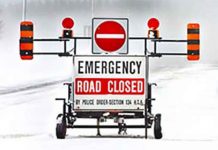
THUNDER BAY – NEWS – It seems like almost everyday there is a closure or Motor Vehicle Collision that closes Highway 11/17 in Northern Ontario. Over this winter the collisions, closures and sadly the fatalities seem to be increasing.
From November 1, 2025 to January 31, 2026, NetNewsLedger reviewed publicly posted collision/closure reports along the Kenora → Thunder Bay → Lake Superior North Shore → Sault Ste. Marie corridor, including the Highway 11 branch used when Hwy 17 is compromised.
Confirmed fatalities: 5 deaths in the period
Highway 11, Longlac area (Greenstone)
A 17-year-old pedestrian was killed after a crash involving a transport truck near Longlac (near Long Lake #58 First Nation).
Highway 11, Opasatika area (Kapuskasing/Hearst corridor)
A collision near Opasatika is described as claiming three lives (reported as one family) in the Highway 11 corridor.
Highway 11/17, Kakabeka Falls area (Thunder Bay)
A collision near Kakabeka Falls resulted in one death and a prolonged closure.
Total confirmed deaths (Nov 1–Jan 31): 5
Documented major collision events: at least 8 incidents
These are distinct, publicly reported events that either closed a highway segment or were fatal/major:
-
Hwy 17 west of Kenora: multiple collisions in poor conditions (reported as a multi-collision event)
-
Hwy 11 near Longlac: fatal pedestrian/transport crash
-
Hwy 11 near Opasatika: fatal crash reported with three deaths
-
Hwy 17 at Rossport (Cavers Hill): collision closed highway
-
Hwy 17 (Clearwater Bay/Kenora area): snowplow/tractor-trailer collision
-
Hwy 17 near Upsala: multi-vehicle crash closed highway for much of the day
-
Hwy 17 near English River: car hauler tipped/blocked highway (reopened later that day)
-
Hwy 11/17 near Kakabeka Falls: fatal collision
Minimum major collision incidents documented: 8
The fatalities are in the opinion of a growing number of Ontario residents simply unacceptable.
Road conditions, transport truck driver training, snow clearing are all factors.
What is also honestly terrible is that in 2026 that the Tran-Canada Highway remains a seemingly unthought of roadway – what should be a twinned divided highway. Not just in Northern Ontario but from coast to coast.
With the political noise from United States President Donald Trump constantly threatening Canada, our leaders need to fully grasp the importance of having a secure transportation route across the country.
When the highway is closed in Northern Ontario, Canada is cut in half.
A Highway of Tears
The deaths on Highway 11/17 are not mere statistics, the toll is devastating as families are left to pick up the pieces.
Transport Driver Training
It seems far too often that collisions involving transport trucks are far too frequent. Ontario needs to take action and ensure that drivers are certified by Ontario to drive in Ontario.
There needs to be proper training, especially for winter driving conditions. The provincial Minister of Transport needs to make this a national priority.
Closure time: at least 148 hours (6 days) of full shutdowns documented
Below are the closures with time stamps sufficient to calculate duration.
1) Lake Superior corridor choke point: Wawa ↔ Batchawana/Heyden (Hwy 17)
These closures repeatedly severed through-traffic between Northwestern Ontario and Algoma:
-
Dec 18, 22:13 → Dec 19, 13:06 = 14h 53m
-
Dec 28, 20:15 → Dec 29, 23:00 = 26h 45m
-
Jan 20, 12:30 → Jan 23, 11:29, with a brief reopening Jan 21 (15:12–22:12)
= 63h 59m of closure time -
Jan 26, 21:31 → Jan 27, 12:47 = 15h 16m
-
Jan 27, 23:31 → Jan 28, 05:56 = 6h 25m
Subtotal (Wawa–Batchawana/Heyden corridor): 127h 18m (5.3 days)
2) Northwest segment closures impacting Thunder Bay–West (Hwy 17)
-
Shabaqua ↔ Upsala (Hwy 17), ~02:30 → 15:32 = ~13 hours
3) Thunder Bay area fatal closure (Hwy 11/17)
-
Kakabeka Falls area fatal collision: reported closed ~8 hours
Total documented closure time (with calculable durations)
127h 18m + ~13h + ~8h = ~148h 18m (~6 days, 4 hours)
Again: this is a minimum; other closures in the period lacked a clear “reopened at” time stamp in public posts.
Economic impact: what 6+ days of shutdowns can cost
Why Thunder Bay cares (even when the closure is near Wawa)
Thunder Bay is the region’s distribution and services hub, so closures east (Algoma) and west (Kenora/Dryden) ripple into:
-
delayed retail shipments and groceries
-
postponed medical travel and staffing gaps
-
interrupted industrial supply chains (forestry/mining inputs, parts, fuel)
-
tourism cancellations and stranded travellers
A hard number to anchor the scale: goods movement value
Ontario has described the Thunder Bay–Nipigon Highway 11/17 link as moving more than $45.3B in goods annually.
That’s about $124M/day of goods value moving through that one link (value delayed, not “lost”).
If we apply the same daily order-of-magnitude to a 6.18-day equivalent of documented corridor shutdowns, that implies roughly $760M worth of goods movement was delayed/at risk of disruption during the closures we can time-stamp.
Direct trucking delay costs (conservative estimate)
Transportation Association of Canada research cites a midrange commercial-vehicle value-of-time around US$150/hour (2008), ~C$161/hour.
Using:
-
truck flow estimate: ~1,000–1,600 trucks/day along key Superior corridor segments (assumption range)
-
value of time: $160–$250 per truck-hour (to reflect higher current costs)
Then the ~148 hours of documented “full-stop” closures translate to roughly:
-
$1.0M to $2.5M in direct trucking delay costs (delay cost only)
This excludes passenger impacts, crash response, tow/recovery, and the bigger costs below.
The bigger (often hidden) costs
-
Hours-of-service knock-on effects: a “few hours” stranded can force a lost day when drivers hit legal duty limits; that compounds freight backlogs.
-
Lost sales + spoilage: missed deliveries for food and time-sensitive goods
-
Industrial downtime: mills/mines/contractors waiting on parts or inputs
-
Emergency response + recovery: multi-agency response, towing, cleanup
-
Consumer time + tourism losses: cancelled trips, hotel rebookings, missed work shifts
For context on how transportation stoppages can scale economically, Moody’s warned a national rail stoppage could cost hundreds of millions per day—this highlights how quickly freight interruptions become macroeconomic.
The real danger isn’t really economic, it is in lost lives and lost opportunities.
Canada and Ontario should set a goal to make it a national priority to build a two lane divided highway across the county.