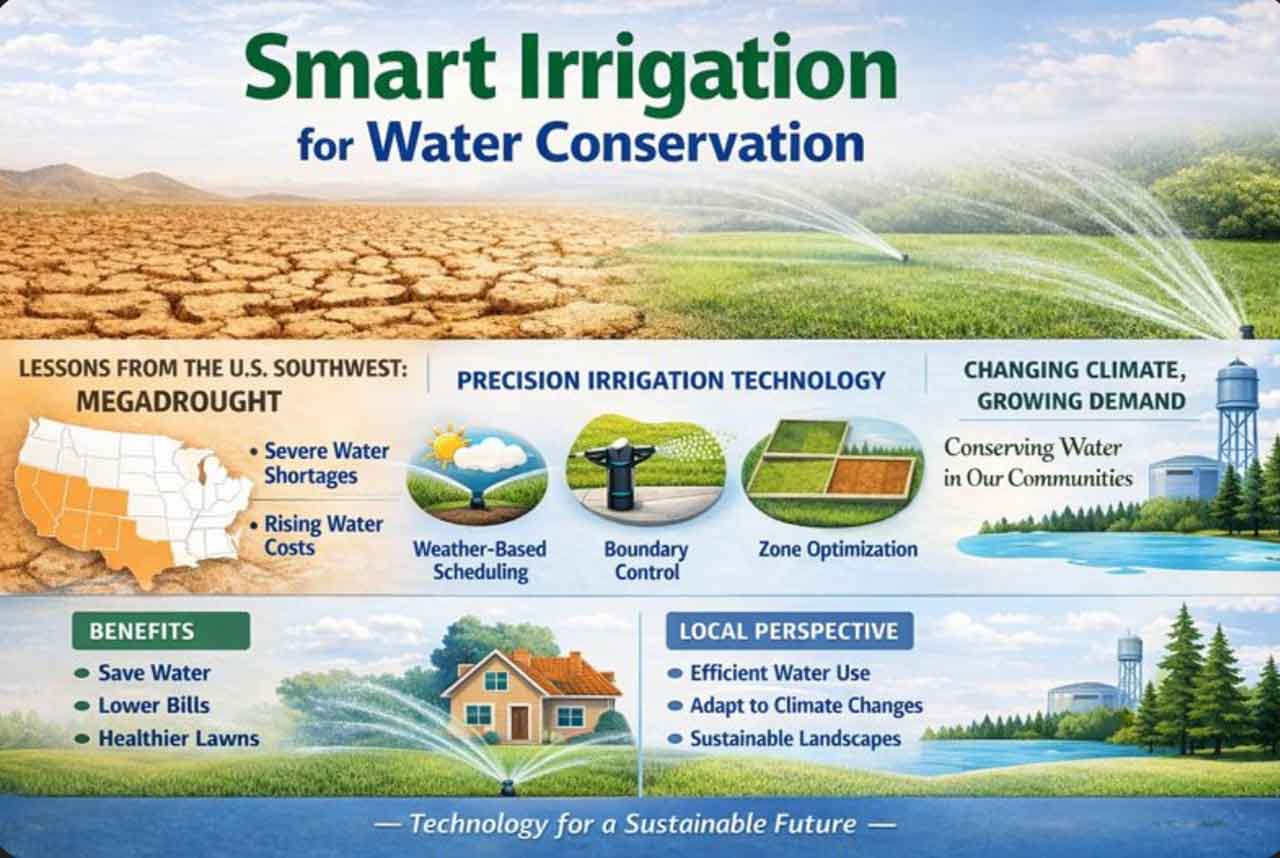
Every morning across the American Southwest, homeowners wake to a landscape caught between two impossibilities. Maintaining the green lawns and outdoor living spaces that define the region’s lifestyle requires water that simply doesn’t exist in sufficient quantities. Yet allowing properties to deteriorate into brown expanses threatens property values and livability.
This tension has intensified as the Southwest entered what scientists call a megadrought, the worst sustained water shortage in at least 1,200 years. From 2000 through 2022, the Colorado River lost 20% of its water levels. In California, water bills increased 56% in just the first half of 2022. Governor Gavin Newsom’s calls for voluntary 15% reduction highlighted the urgency, yet offered little guidance on how households could achieve such cuts.
Residential outdoor irrigation sits at the center of this crisis. In Southwest states, outdoor watering accounts for 50-70% of household water consumption during summer. Traditional responses have oscillated between restriction-based approaches and ineffective appeals for voluntary conservation. Technology-enabled precision irrigation systems like Irrigreen are emerging as a third path, allowing Southwest homeowners to maintain livable outdoor spaces while cutting water consumption dramatically.
Phoenix, Los Angeles, Denver: The Faces of the Megadrought
The megadrought manifests differently across Southwest cities, but the fundamental challenge remains consistent: maintaining residential landscapes within water budgets that shrink annually. Three representative homeowner experiences illustrate how precision irrigation enables compliance with restrictions.
Phoenix represents perhaps the most extreme Southwest water challenge. As the hottest major U.S. city, with 110°F+ days common from June through August, grass requires maximum water precisely when restrictions tighten most severely. A homeowner managing 8,500 square feet faced mounting pressure as Arizona implemented the lowest Colorado River allocation cuts. Their traditional irrigation system generated summer water bills averaging $180 monthly.
When municipal restrictions limited irrigation to twice weekly during peak summer, the homeowner attempted manual reduction by cutting each zone’s duration, resulting in stressed turf developing brown patches. Attempting to compensate by extending duration on allowed days consumed similar volumes while achieving worse results.
Summer water bills dropped to $95 monthly despite maintaining visibly healthier turf. “The system knows exactly how much water the lawn needs. During that 115-degree week, it ran longer on our allowed days without me touching anything.”
Los Angeles homeowners face a different dynamic. The Metropolitan Water District implementing unprecedented restrictions created a tiered rate structure where exceeding allocation triggers massive price increases reaching ten times the base rate.
A homeowner managing 12,000 square feet struggled with this pricing structure. Cutting watering duration left brown patches. Overcompensating pushed them into penalty tiers. The traditional system’s fixed spray patterns meant significant water landed on driveways regardless of duration settings.
Precision irrigation addressed both challenges. Eliminating overspray meant every gallon actually nourished grass. Weather-responsive scheduling prevented overwatering that previously triggered penalty tiers. The system cut outdoor consumption 52% while maintaining healthy turf.
Denver illustrates how Front Range cities face water stress despite sitting in Colorado River headwaters. Rapid population growth creates restrictions even in source regions. The high altitude environment presents unique challenges: intense UV radiation and low humidity accelerate evaporation.
A Denver homeowner with 7,000 square feet using well water faced community pressure over visible overspray. Their traditional system regularly sent water streaming down the driveway, creating neighborhood complaints.
After precision installation, hardscape overspray was eliminated. Pump runtime decreased 45%, translating to approximately $165 annual electricity savings. “Neighbors used to comment about water running down the driveway. Now they ask how the lawn stays so green.”
Irrigreen Technology as Drought Compliance Tool
The specific features enabling restriction compliance reveal how precision irrigation functions fundamentally differently than traditional systems.
Boundary control eliminates geometric waste. Fixed-pattern spray heads cannot distinguish between grass and hardscapes, meaning water inevitably lands on driveways and sidewalks. When municipalities implement restrictions limiting total consumption, this waste counts against household allocations. Precision systems contain every drop within lawn boundaries.
Schedule optimization within constraint windows addresses another challenge. Many Southwest restrictions specify exact days and times for allowed irrigation. Traditional approaches apply the same duration on fewer days, often proving insufficient during heat waves or excessive during mild periods.
Precision systems calculate optimal duration for each allowed window based on accumulated weather data. If Thursday reached 98°F and Saturday’s restriction day is forecast for 72°F with clouds, the system adjusts duration to account for reduced evaporation need. Professional adoption continues growing as contractors recognize these systems help clients achieve compliance while maintaining healthy landscapes.
Weather skip intelligence becomes critical for restriction compliance. Many municipal codes prohibit irrigation within 24-48 hours of measurable precipitation. Traditional timers require manual intervention. Precision systems automatically honor rain delay requirements while tracking precipitation amounts.
Allocation tracking provides households with consumption visibility previously unavailable. App dashboards show real-time consumption against allocation limits.
Zone-by-zone precision addresses microclimatic variations that uniform watering cannot optimize. Southwest properties often feature mixed sun and shade, slope variations, and mature landscaping creating complex moisture patterns.
The Future of Southwest Water Management: Technology Meets Conservation
Projecting forward requires acknowledging uncomfortable reality: the megadrought likely represents the new normal rather than a temporary crisis. Climate models suggest conditions may persist or intensify, meaning Southwest communities must adapt to permanent water constraints.
Municipal perspectives reveal the scale of the challenge. Cities face serving growing populations with shrinking supplies. Traditional response escalates restrictions, penalty rates, and enforcement.
Technology-enabled alternatives offer different pathways. Rather than demanding behavior change through restriction and punishment, municipalities can facilitate residential efficiency upgrades. Some Southwest water districts now offer rebates of $500-1,500 for high-efficiency irrigation installations, recognizing that subsidizing technology costs less than supply-side infrastructure.
The economic logic becomes clear when examining costs. Metropolitan Water District of Southern California calculates that every dollar spent on efficiency rebates saves approximately $3 in deferred infrastructure costs. Precision irrigation represents particularly attractive investment because savings accrue automatically and persist indefinitely.
Regulatory trajectory suggests increasing emphasis on technology requirements rather than behavioral restrictions. California is considering efficiency standards for new construction irrigation systems. Las Vegas Valley Water District already requires smart controllers for new developments. The trend moves toward mandating capability rather than relying on voluntary conservation. Irrigreen and similar precision systems position homeowners to meet evolving standards while maintaining landscape quality.
Homeowner association adaptation illustrates how community standards evolve under water pressure. Traditional HOA rules mandate maintaining green lawns or face fines, creating conflict when water restrictions make that standard unsustainable. Some associations now update requirements to mandate high-efficiency irrigation rather than lawn appearance. Visual evidence from precision irrigation installations demonstrates that green lawns remain achievable within water restrictions.
The cultural shift perspective matters as much as the technical one. Southwest lifestyle historically assumed water abundance. The megadrought forces recalibration: maintaining quality of life within tighter water budgets rather than abandoning outdoor living spaces.
Technology enables this adaptation without requiring lifestyle sacrifice. Precision irrigation doesn’t solve the underlying supply problem, but it maximizes value extracted from available water. This allows the residential sector to meet conservation targets without landscape abandonment.
Maintaining livability proves essential for attracting residents and businesses. Brown landscapes signal decline and reduce property values. Technology-enabled green spaces provide livability without unsustainable consumption.
The megadrought forces an uncomfortable question: which aspects of current lifestyle remain sustainable? The answer emerging from thousands of Southwest installations suggests that quality of life is maintainable if matched with appropriate technology. Precision irrigation represents climate adaptation infrastructure enabling communities to preserve outdoor living spaces while consuming water at levels the Colorado River can sustain.