Border Crossing – Why This Matters in Northwestern Ontario
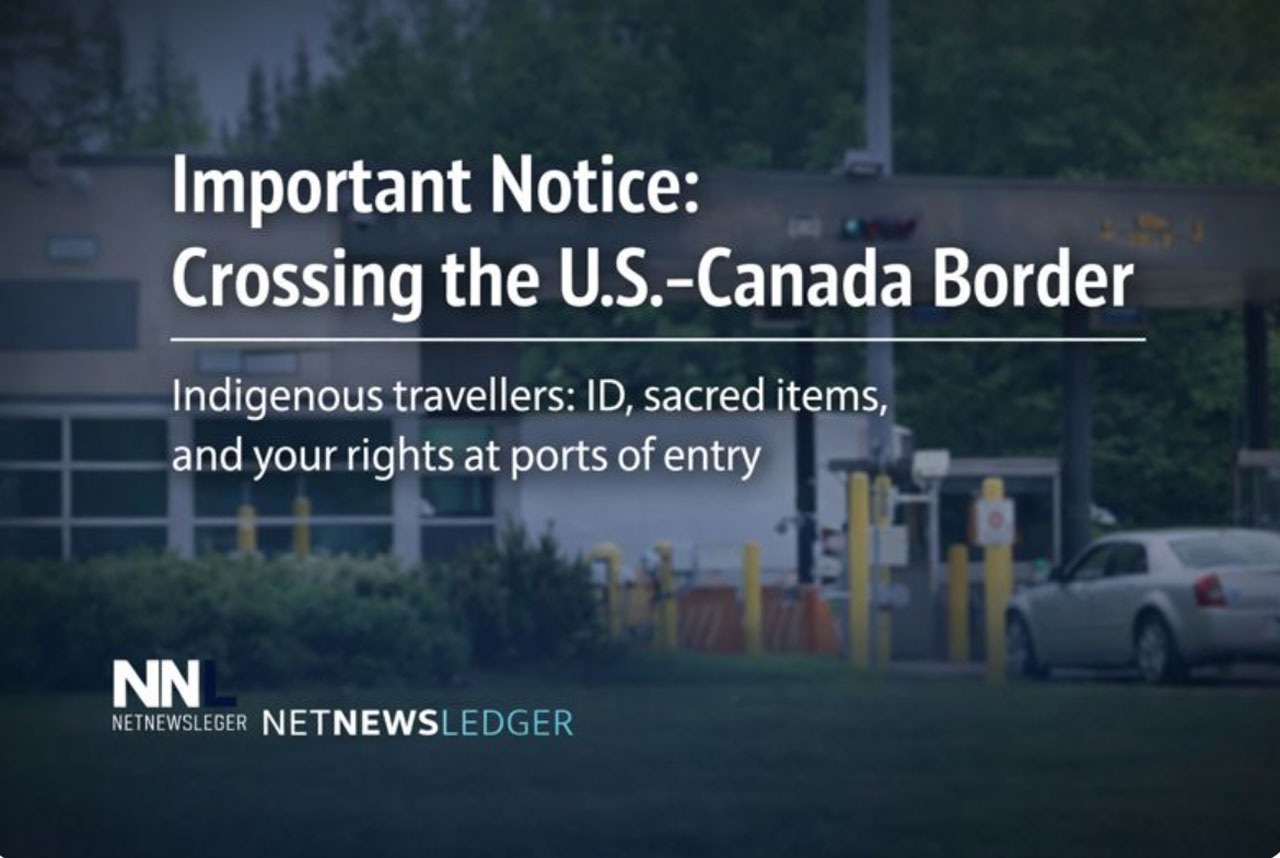
Thunder Bay – Indigenous News – From Thunder Bay and the North Shore to communities across Treaty 3 and Treaty 9, cross-border travel is part of daily life. Families visit relatives, attend ceremonies, shop, work, and return to traditional territories that long predate the international boundary.
Right now with the events happening in Minnesota with ICE it is noted that some First Nations and organization are suggesting postponing travel until things in the state stabilize.
As well, many Indigenous travellers are reporting a growing disconnect between the reality of Indigenous mobility and what happens at ports of entry: additional questioning, inconsistent acceptance of Indigenous ID, and scrutiny of ceremonial belongings. These encounters can disrupt family ties, cultural continuity, and the ability to participate in spiritual and community life.
A Right Rooted in History: The Border Was Placed Through Indigenous Lands
Indigenous Nations across the Great Lakes region have always moved across these territories for trade, kinship, and governance. The international border came later—drawn through homelands, waterways, and travel routes that were never surrendered in the way modern border regimes assume.
This is why many people refer to a historic “free passage” principle associated with the Jay Treaty era. In practice today, however, border mobility is shaped less by history and more by the modern legal rules each country applies—and those rules do not always align with Indigenous understandings of Nationhood.
What the Law Says Today in the United States: Section 289 and the “50% Rule”
In the U.S., cross-border entry rights for “American Indians born in Canada” are explicitly addressed in federal law. Section 289 of the U.S. Immigration and Nationality Act—codified at 8 U.S.C. § 1359—states that the right to pass the U.S. border extends only to persons who possess at least 50% “blood of the American Indian race.”
That single sentence is at the centre of many of the problems travellers describe today, because it makes a blood quantum threshold a gatekeeping requirement—regardless of how a Nation determines its own citizenship.
U.S. Customs and Border Protection (CBP) guidance also reflects this rule, noting that eligible individuals “cannot be denied admission” if they meet the criteria.
Why travellers are being asked about blood quantum
Because the statute itself contains the 50% requirement, border officers may ask for documentation to support it. This is where travellers often experience frustration: Indigenous identity is treated as a numeric proof exercise, rather than recognition of Indigenous citizenship and Nationhood.
Canada’s Position: Jay Treaty Not in Force—and Policy Still Evolving
On the Canadian side, the situation is different. The federal government’s own background materials note that the issue is frequently framed around the Jay Treaty—but also states that the Supreme Court of Canada determined in 1956 that the Jay Treaty is not currently in force in Canada (commonly cited as Francis v. The Queen).
Canada has taken steps aimed at reducing friction at the border for First Nations travellers—such as improvements to Secure Certificate of Indian Status (SCIS) cards and enhanced training—while acknowledging the long-standing nature of these concerns.
More recently, Ottawa introduced temporary measures (announced October 10, 2024) intended to support cross-border mobility for Indigenous people separated from family by the Canada–U.S. border—though these measures require applying in advance, not at the port of entry.
What Indigenous Travellers Are Reporting at the Border
Across both directions of travel, common issues include:
1) Requests to prove “blood quantum”
This is most directly tied to the current wording of U.S. law.
2) Tribal or First Nation ID not being accepted consistently
Even where cards are “generally accepted” at some land/sea crossings, Canada’s own travel guidance notes that acceptance can remain at the discretion of U.S. authorities, which creates uncertainty for travellers.
3) Delays or questioning when carrying sacred items
Cultural belongings—medicines, regalia, and feathers—can trigger additional scrutiny, especially where officers believe wildlife or agricultural rules may apply.
4) Denials or disruption that feel fundamentally unjust
For many families, the emotional reality is simple: Indigenous peoples were here long before the border. The modern system does not always treat Indigenous mobility as normal, expected, and legitimate.
Sacred Items and Cultural Belongings: What to Expect
Both countries have rules about plant, animal, and wildlife products—and those rules can intersect with ceremonial items.
Entering Canada with traditional medicines
CBSA has publicly stated that traditional medicines such as sage, cedar, sweetgrass, peyote, and tobacco are recognized as sacred items and “can be brought across the border.”
Canada’s travel guidance also notes that certain ceremonial tobacco quantities may still trigger duties/taxes.
Entering the United States with plant/animal items
U.S. rules require travellers to declare agricultural products (including plants and plant/animal materials), and inspection can occur even when items are personal or cultural.
Bottom line: declare, explain calmly, and protect sacred items respectfully
If you’re carrying medicines, feathers, or regalia, it can help to:
-
keep items secured and respectfully packaged (bundles intact where appropriate),
-
carry a short written note explaining the ceremonial purpose (especially for time-sensitive travel),
-
declare items up front to avoid misunderstandings later.
(These steps don’t guarantee smooth passage—but they can reduce avoidable escalation.)
Identification: Why It Sometimes Works—and Why It Sometimes Doesn’t
Travellers often assume that a First Nation or Tribal ID should be enough. In reality, border systems operate on specific document standards, and the U.S. side may still request documentation tied to the 50% threshold in U.S. law.
Canada’s guidance notes that secure status cards with a machine-readable zone can help facilitate processing at land and sea ports of entry—yet discretion still exists on the U.S. side.
The Jay Treaty Border Alliance: A Cross-Border Push for Respect and Reform
The Jay Treaty Border Alliance (JTBA) is working with Indigenous Nations on both sides of the border to address the real-world impacts of current policy and practice.
JTBA’s focus includes:
-
defending cross-border mobility as an Indigenous right grounded in history and Nationhood,
-
pushing governments to recognize Indigenous citizenship rather than blood quantum,
-
improving how border officials interact with Indigenous travellers,
-
supporting stronger Indigenous ID options and standards (including work related to REAL ID/Enhanced Tribal Cards).
What’s Next: Proposed U.S. Reform to Remove the Blood Quantum Requirement
In 2025, legislation was introduced in the U.S. House and Senate under a new title: the McCarran–Walter Technical Corrections Act.
The Senate bill (S.2577, introduced July 31, 2025) would amend 8 U.S.C. § 1359 by striking the 50% blood quantum language and replacing it with eligibility based on:
-
membership (or eligibility for membership) in a federally recognized U.S. Tribe, or
-
Indian status in Canada under the Indian Act, or
-
membership in a self-governing First Nation in Canada.
A companion House bill (H.R.4596) was introduced July 22, 2025 and referred to committee.
JTBA is urging cross-border Nations and communities to support this reform effort, framing it as a shift away from blood quantum and toward recognition of Indigenous citizenship.
Practical Tips Before You Travel
This is not legal advice—but for travellers trying to reduce risk of delays, these steps can help:
-
Build a “border folder”: carry multiple forms of ID where possible (and ensure names match across documents).
-
If you may qualify under 8 U.S.C. § 1359, be prepared for questions tied to the current wording of the law.
-
Declare ceremonial items rather than waiting to be asked—especially plants, animal materials, or feathers.
-
Give yourself extra time if travelling for a ceremony, funeral, or scheduled community event.
-
Document problems respectfully: if something goes wrong, write down the date, location, and what was said, then follow up through community leadership or advocacy channels.
Where to Get More Information
JTBA maintains resources for Indigenous travellers and communities, including information on identification and current advocacy efforts.
For Canadian guidance on status cards and travel considerations, see Canada’s Indigenous travellers information.
Closing Thoughts
For Indigenous peoples, mobility is not a modern convenience—it’s an expression of kinship, responsibility, and belonging across homelands that existed long before border checkpoints. As advocacy grows and legislation evolves, the message from many communities remains consistent:
Indigenous rights did not begin at the border—and they do not end there.