The Battle of Britain: An Overview
The Battle of Britain (10 July – 31 October 1940) was the first major campaign fought almost entirely in the air. After the fall of France in June 1940, the German Luftwaffe sought to gain air superiority over southern England, both to support the proposed invasion of Britain (Operation Sea Lion) and to destroy RAF Fighter Command so Britain could be neutralized or forced to surrender.
RAF Fighter Command, aided by radar, a network of ground observers, and fighter pilots from Britain and many Commonwealth and allied nations, opposed daily bombing raids, fighter sweeps, and attacks on airfields and radar stations.
The British victory—defending the skies—thwarted Hitler’s plans for invasion and marked a turning point in the war.
The Hawker Hurricane’s Role
Often overshadowed in popular memory by the more glamorous Supermarine Spitfire, the Hawker Hurricane was, in fact, the backbone of Fighter Command during the Battle of Britain. Some key points:
-
The Hurricane destroyed more German aircraft during the Battle of Britain than all the other air and ground defences combined in many estimates.
-
While Spitfires typically engaged enemy fighters (Bf 109s), Hurricanes often focused on the bombers—Heinkel 111s, Dornier 17s, Junkers Ju 88s, etc.—where their slightly less sleek performance relative to the Spitfire mattered less. They were stable gun platforms, robust, easier to repair, and produced in large numbers.
-
In numbers: at the start of the Battle many (around half) of Fighter Command’s squadrons were equipped with Hurricanes. They accounted for approximately 55% of German aircraft losses (or more, depending on the source) in the Battle.
Fort William / Thunder Bay’s CanCar Factory
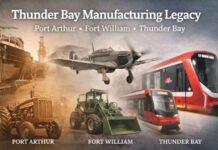
Fort William, Ontario (now part of Thunder Bay), had a large manufacturing plant called Canadian Car & Foundry (often abbreviated CanCar or CCF). Its contributions were vital in the war effort, especially with regard to the Hurricane fighter aircraft.
-
CanCar was contracted to build Hurricanes under licence from Hawker.
-
The plant began producing Hurricanes in November 1938, after receiving its initial contract.
-
Its output of Hurricanes helped bolster RAF’s capabilities by supplying aircraft, often shipped to Britain. These Canadian‑built Hurricanes participated in the Battle of Britain.
-
The workforce included women (“Rosies”) and many local labourers, who built key parts of the aircraft. The plant is recognized today as a national historic site.
Thus, the factory in Fort William provided much‑needed production capacity away from Britain, supplementing Hurricane output so that RAF Fighter Command could hope to hold its own despite heavy German assault.
How the Battle Was Lost by Germany & its Consequences
Though “lost” is perhaps a strong word: Hitler failed to achieve his objectives in the Battle of Britain.
The outcomes and long‑term consequences include:
-
Failure of Air Supremacy
The Luftwaffe could not destroy RAF Fighter Command nor permanently neutralize radar and airfield infrastructure. Without air superiority, the planned invasion of Britain (Operation Sea Lion) was postponed and eventually abandoned. The failure to win the skies over southern England was a serious strategic setback. -
Moral and Symbolic Boost to Britain and its Allies
The British public, and the Empire and Commonwealth, took heart. Leaders like Winston Churchill used the victory to rally public support. Internationally, it showed that Nazi Germany could be resisted. -
Strategic Reassessment by Germany
Hitler and the German High Command shifted focus: since Britain would not capitulate nor be invaded easily, Germany turned toward the Eastern Front (USSR), the Mediterranean / North Africa, and air campaigns (the Blitz) instead. Resources were diverted. -
Delay in German Expansion
Because Germany did not force Britain out of the war, Britain remained a base for future Allied operations (e.g. in North Africa, later the invasion of Italy, and as the launching point for the D‑Day landings in 1944). Also, Italian and German efforts in North Africa were hampered by British resistance, and Britain could act as a staging ground for lend‑lease supplies, intelligence, etc. -
Long‑Term Fate of Hitler’s War Effort
-
The failure narrowed Germany’s options.
-
The Luftwaffe suffered losses of experienced pilots that it could not easily replace.
-
Britain survived to rearm, build its air fleet (including Hurricanes and Spitfires), and prepare for sustained defence.
-
The war dragged on rather than being over in 1940. This allowed the US, Soviet Union and others to mobilize fully and eventually outweigh German power.
-
Integrating Local Canadian Contributions into the Big Picture
Putting together the role of Fort William / Thunder Bay:
-
The CanCar plant built Hurricanes, which meant that not all production had to come from Britain or from more vulnerable factories. That kind of distributed production was essential in wartime.
-
The local workforce, including women (the “Rosies of the North”), supported war material production, which indirectly made possible Britain’s survival in 1940.
-
Although direct personnel contributions from Port Arthur / Fort William in the skies above England seem sparse or undocumented, the local infrastructure and industrial contribution were part of Canada’s larger Commonwealth effort.
In Summary
The Battle of Britain was pivotal. The Hurricane, though less glamorous, carried much of the burden of defence, especially against bombers. The Fort William factory’s manufacture of Hurricanes helped supply this essential capacity. Although no famous “local ace” from Port Arthur / Fort William has been clearly documented among The Few, the region’s contribution in building the machines and training and supporting aircrew was part of Canada’s role in the battle. The failure of Hitler’s plan forced a reevaluation of German strategy and meant that Britain stayed in the war – a fact that had enormous long‑term consequences, ultimately contributing to the downfall of Nazi Germany.