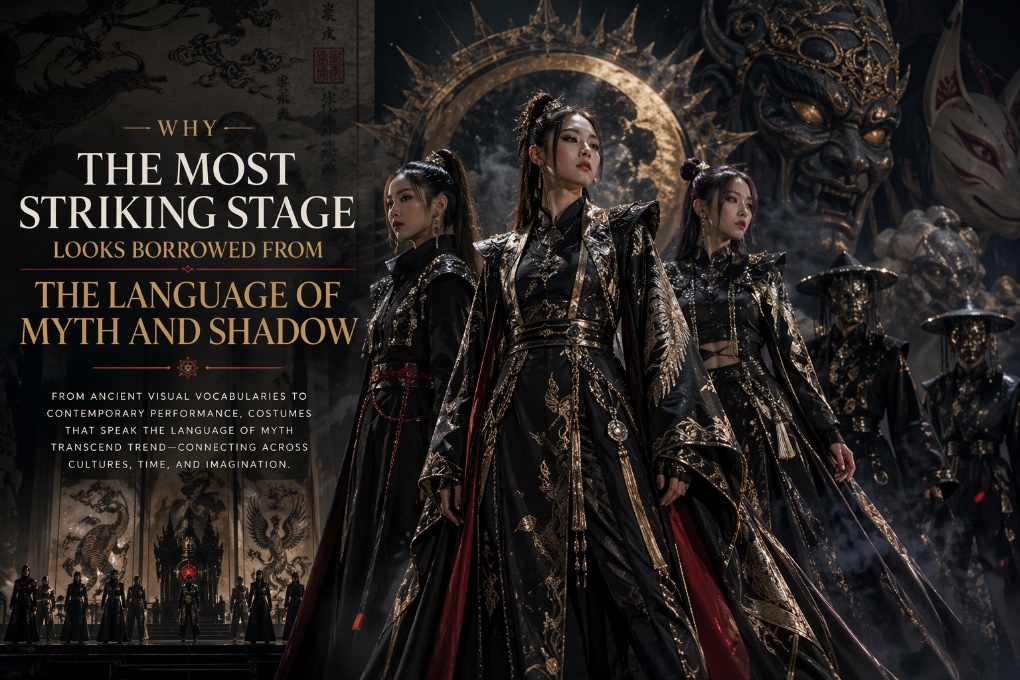
Every culture has a visual vocabulary for the supernatural. Over thousands of years of storytelling through images and objects, human beings have developed a consistent shorthand for communicating that something belongs to a world beyond the ordinary. Sharp things. Dark things. Things that do not quite obey the rules of proportion that govern everyday objects and bodies. This vocabulary is ancient, it is deeply embedded in human visual processing, and the most accomplished dark fantasy performance costume designers know exactly how to use it.
What Myth Contributes That Trend Cannot
When a costume borrows from the visual grammar of myth, it draws on something that has been tested over time and across cultures. The specific forms may be inflected by contemporary aesthetics, but the underlying principles have a durability that trend-driven design cannot match. A silhouette that echoes the proportions of traditional guardian figures from East Asian visual culture carries associations that are both immediately legible to audiences familiar with that tradition and intuitively powerful to audiences who are not.
K-Pop Demon Hunters Costumes occupy a particularly rich position in this regard, drawing on visual traditions from multiple mythological systems and synthesising them into something that feels simultaneously ancient and entirely contemporary. This synthesis is not a superficial appropriation. At its best, it is a serious engagement with the visual logic of different traditions, extracting the principles that make them powerful and integrating those principles into a new visual language.
Why This Approach Has Found Its Moment
The global reach of K-Pop performance content has created an audience for dark fantasy stage aesthetics that is larger, more diverse, and more visually sophisticated than any equivalent audience in history. This audience has been exposed to high-quality dark fantasy visual content across multiple media, and it brings genuine discernment to what it watches. It can tell the difference between a costume that is genuinely using the language of myth and shadow with intention and understanding, and one that is simply assembling dark fantasy signifiers without a coherent underlying logic.
This discernment is raising the standard of dark fantasy performance costume production across the board. Designers who understand the mythological visual traditions they draw on and can clearly articulate how their design choices connect to those traditions are producing work of quality and depth that rewards the attention of a genuinely sophisticated audience. That relationship between makers and audience, where both parties are operating at a high level, is producing some of the most visually compelling performance work of the current era.
The timing matters too. Global streaming platforms have expanded access to this work well beyond the audiences who can attend live performances, and the high-resolution formats through which most people now consume performance content reward exactly the kind of detailed, carefully considered surface work that the mythological approach demands. Every element that was placed with intention becomes visible. Every surface that was crafted with depth registers on screen. The language of myth and shadow, it turns out, was always designed to travel far and to last long. In the hands of the most accomplished performance costume designers working today, it is doing exactly that.