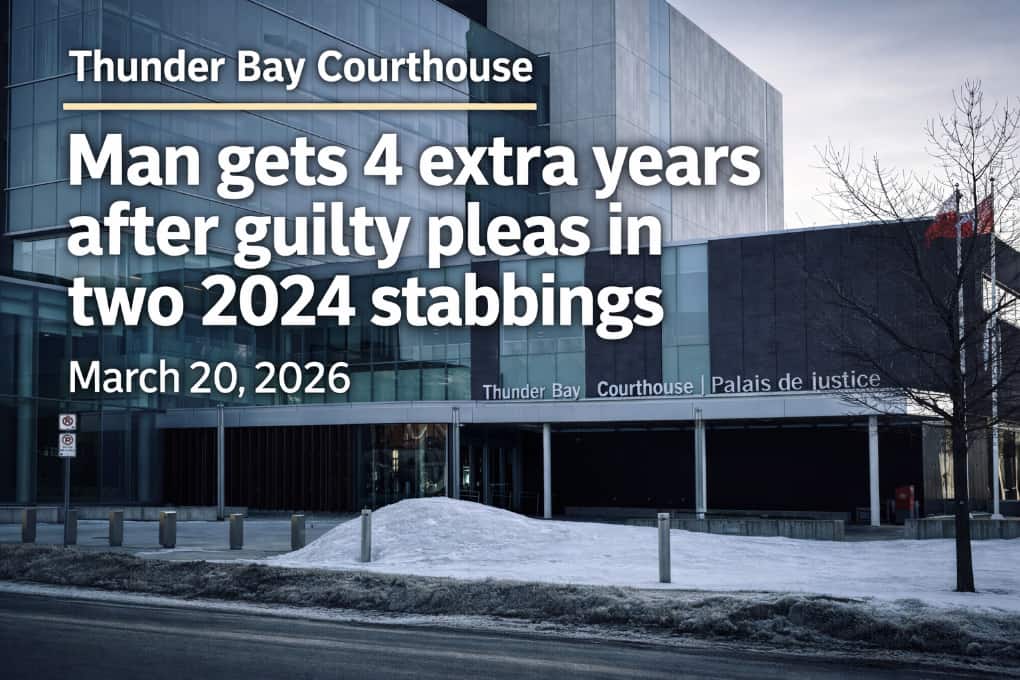
Thunder Bay judge adds four years after guilty pleas in two 2024 stabbing cases
THUNDER BAY — Jeremy Tyler Wade Mequanawap, 32, was sentenced in Thunder Bay on March 20, 2026, after pleading guilty in connection with two separate stabbing incidents that happened one week apart in March 2024.
The case is significant locally because it again highlights the intersection of serious violence, trauma and public safety pressures in Thunder Bay and Northwestern Ontario.
Joint submission accepted after court hears admitted facts
Mequanawap appeared in person before Justice Frank Valente after being transported to Thunder Bay from a federal institution in Drumheller, Alta., where he is already serving a sentence.
Court heard Crown attorney Lillian Taylor and defence lawyer Amanda Gallo made a joint submission asking that Mequanawap receive an additional four years in custody. Justice Valente accepted that submission. The judge also imposed a DNA order and a lifetime weapons prohibition.
Blucher Avenue stabbing
According to the admitted facts read in court, Thunder Bay Police Service officers were called to 227 Blucher Ave. at 3:18 a.m. on March 23, 2024, after a man was stabbed inside the residence.
The victim was asleep when the attack began. Court heard he was awakened when a television was slammed into his face. There were five men in the room at the time, and Mequanawap then pulled a knife and stabbed the victim three times — once in the left side of the chest, once in the left side of the back and once in the back of the left leg.
Police later spoke with the victim of the attack in hospital. According to the court summary, he said Mequanawap was not trying to kill him, but was “sending a message.”
Limbrick Street stabbing
The second incident happened on March 30, 2024. Police were called to 4A Limbrick Street at 10:55 p.m. after reports that a person had been stabbed several times inside the home.
Court heard the victim had been drinking in a residence with a femaie and Mequanawap before she left to get a cigarette. During that time, an argument broke out between the victim and Mequanawap, and the court heard he became jealous.
According to the admitted facts, Mequanawap pulled a pocket knife and stabbed the woman multiple times on both sides of her chest, as well as in her left shoulder and left arm. She also suffered a black eye during the attack.
Court heard the femaie victim had lost a significant amount of blood before being taken to hospital by paramedics for treatment. A neighbour heard calls for help and called 911.
Lengthy criminal record and personal history raised at sentencing
The court heard Mequanawap has a lengthy criminal record that includes violence, break-ins and breaches of court orders.
Defence submissions also described a life marked by childhood instability, homelessness, repeated family loss and mental health struggles. When given a chance to speak,
Mequanawap told the court he now understands the role intergenerational trauma played in his life and said he is trying to rebuild for the sake of his daughters.
Justice Valente pointed to what he described as a significant and unrelenting criminal record before imposing the additional four-year sentence.
Criminal Code context
The court summary provided did not specify the exact Criminal Code sections tied to the guilty pleas. In serious stabbing prosecutions, the most relevant provisions are often section 267, assault with a weapon or causing bodily harm, and section 268, aggravated assault. Section 267 carries a maximum sentence of 10 years if prosecuted by indictment, while section 268 carries a maximum of 14 years. Section 268 applies where a victim is wounded, maimed, disfigured or has their life endangered.
The DNA order imposed by the court is consistent with section 487.051 of the Criminal Code, which requires DNA orders for primary designated offences. Justice Laws materials list both section 267 and section 268 among those offences.
The lifetime weapons prohibition is consistent with section 109 of the Criminal Code, which requires courts to impose prohibition orders in certain violent and weapons-related cases. The exact scope of the ban can depend on the offence and the offender’s record.
People charged with criminal offences are presumed innocent unless proven guilty in court. In this case, Mequanawap entered guilty pleas and was sentenced by the court on March 20, 2026.
Why this matters in Thunder Bay and Northwestern Ontario
For Thunder Bay and regional readers, the case underscores how serious violence is often tied to broader issues including trauma, unstable housing, addiction and gaps in long-term support. It also reflects the reality that Thunder Bay remains the main service, court and transportation hub for many people from across Northwestern Ontario, including remote First Nations communities, placing local justice, health and social systems under continued pressure.