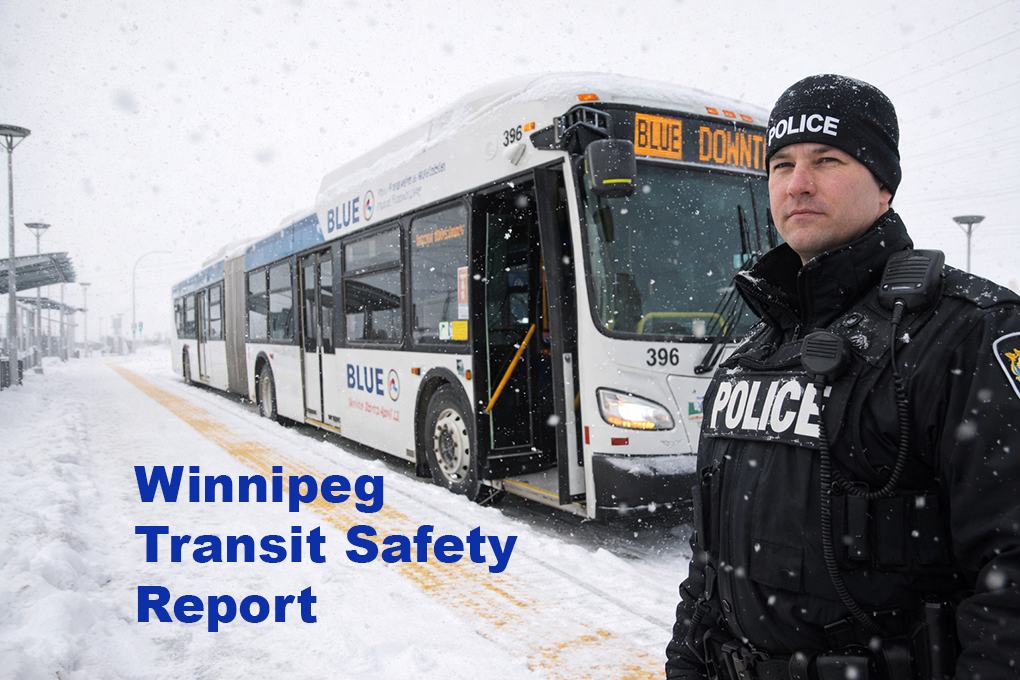
WINNIPEG – National Crime Report – Winnipeg Police Service report that a 15-week enforcement and visibility campaign on the city’s transit system led to fewer reported crimes and fewer calls for service in late 2025.
Crime and calls for service both declined during 15-week project
The Winnipeg Police Service said its Transit Violent Crime Intervention Strategy ran from Sept. 17 to Dec. 31, 2025, in partnership with Winnipeg Transit and the Community Safety Team.
The initiative focused on high-visibility policing, targeted enforcement and a proactive presence on buses, along transit corridors and at bus stops. Police said the strategy was launched in response to rising concerns about violence and disorder on and around the transit system, with the goal of improving safety for riders and operators.
Comparing the same period in 2024, police reported:
-
total crime fell 15.1 per cent
-
violent crime fell 18.2 per cent
-
property crime fell 15.2 per cent
Police also said transit-initiated calls for service dropped to 1,044 during the strategy period, down from 1,259 in the same period a year earlier — a decrease of 17.1 per cent.
Officers made 12 Criminal Code arrests and issued 98 fare evasion enforcements
During the 15-week project, assigned officers recorded 442 engagements in a range of enforcement and visibility roles.
According to Winnipeg police, those efforts resulted in:
-
12 Criminal Code arrests
-
98 fare evasion enforcements
-
143 hours riding on buses
-
101 hours on foot at bus stops and other transit locations
-
36 hours of marked cruiser patrols
Police did not provide a detailed breakdown of the arrests or the specific offences involved in the update.
Police say more work is still needed for lasting results
Despite the decline in crime and calls for service, Winnipeg police said the work is not finished.
The service said officers from divisional community support units and foot patrol units continue to maintain a visible presence on the transit system as part of their regular duties. Police said that ongoing work, alongside Winnipeg Transit, the Amalgamated Transit Union and the Community Safety Team, is intended to support longer-term safety goals.
Winnipeg police said the results reinforce the value of targeted enforcement and visible presence initiatives, but also acknowledged that a sustainable long-term approach is still required.
Why the Winnipeg results matter in Thunder Bay and Northwestern Ontario
For readers in Thunder Bay, the Winnipeg strategy is relevant because it highlights a challenge facing many mid-sized and regional cities: how to keep public transit safe while maintaining service that is accessible, reliable and welcoming.
Thunder Bay Transit operates in a different environment and on a smaller scale than Winnipeg, but the broader issues — rider safety, operator security and disorder at transit stops and hubs — are familiar across Canadian communities. Winnipeg’s results may add to ongoing conversations in Northwestern Ontario about the role of enforcement, outreach and visible public safety measures in protecting transit users.
The findings may also be of interest to other municipalities across the region, where local governments and police services continue to balance safety concerns with the need for practical, sustainable transit operations.
Winnipeg police say safety remains the priority
In its update, the Winnipeg Police Service said riders, operators and transit staff all have the right to safety, and that violent and disruptive behaviour will not be tolerated.
Police said the strategy was built around prevention and protection, with the aim of supporting a transit system that is safe, dependable and welcoming for all users.