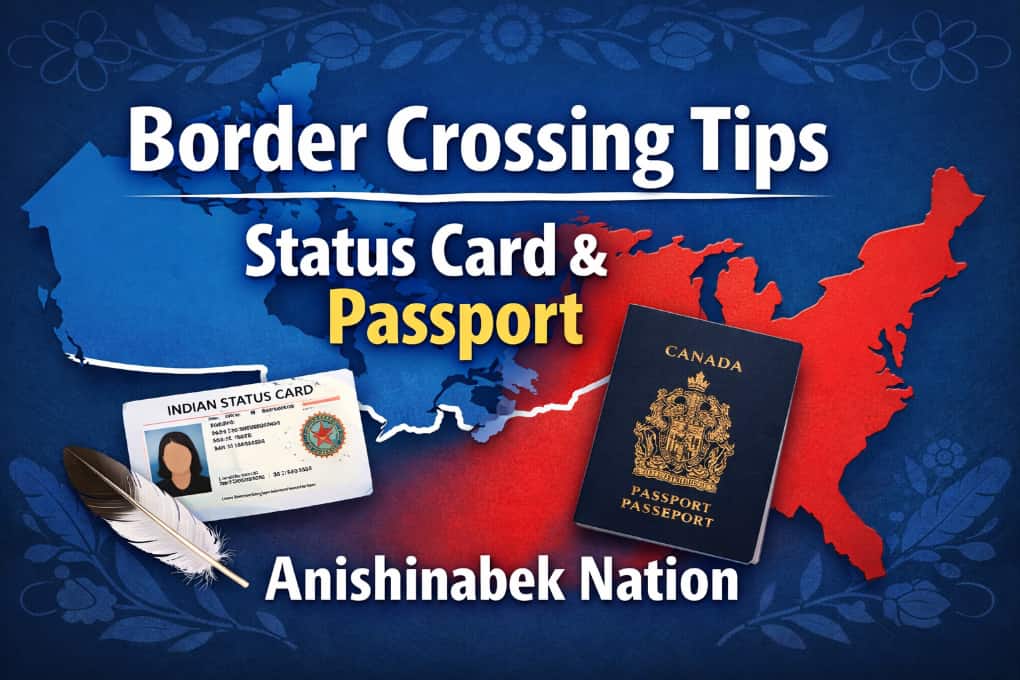
THUNDER BAY — For many Anishinabek Nation citizens in Northwestern Ontario, a trip across the Canada–United States border can be as common as a weekend shopping run, a family visit, or travel for sports, medical appointments, or work. But rules at the border don’t always match what travellers remember from years past—especially for First Nations people travelling with an Indian status card.
Here’s what registered persons under the Indian Act should know before they head south, and what to expect when returning home.
Before you travel: do the basics first
Even quick cross-border trips are smoother when you prepare the same way you would for any international travel:
-
Check Canada’s official travel advice for the United States before you leave, including entry/exit cautions and safety updates.
-
Register with the Registration of Canadians Abroad (ROCA) so the Government of Canada can contact you in an emergency abroad (or a crisis at home).
In Northwestern Ontario, that matters—weather shifts, road closures, and long distances can turn a “day trip” into an overnight fast.
Key facts about travelling with a status card
If you are registered under the Indian Act, these points are central:
-
You have the right to enter and remain in Canada.
-
Any valid version of a status card can be presented to enter Canada, but the secure status card is strongly recommended.
-
Canada’s entry rules and U.S. entry rules are not the same.
Canada-side: your right of entry is protected.
U.S.-side: admission is a U.S. decision, and documentation expectations can be different.
Entering the United States: don’t rely on your status card alone
Indigenous Services Canada (ISC) is clear: acceptance of status cards for U.S. entry is entirely at the discretion of U.S. officials, and ISC strongly recommends carrying a valid passport when travelling outside Canada—even if you’ve crossed in the past with only your secure status card.
Land or water crossings
At land/sea ports of entry, U.S. border officers commonly expect Western Hemisphere Travel Initiative (WHTI)-compliant documents. For Canadian citizens, that typically means a passport, or certain other approved options (such as Trusted Traveler Program cards).
Bottom line: if you show up with only a status card, you may be admitted—or you may face delays or refusal—because the final call is with U.S. officials.
Flying to the U.S.? A status card won’t work
ISC states plainly that status cards are not travel documents and can’t be used to cross the Canada–U.S. border by air. You’ll need a passport or another WHTI-compliant travel document for U.S. entry by air.
Coming home to Canada: what to expect at the port of entry
On return, a Canadian border services officer may ask questions to confirm identity and status—but the key protection is this:
-
Registered persons have the right to enter and remain in Canada, and a Secure Certificate of Indian Status (SCIS) or Certificate of Indian Status (CIS) can be used as proof.
If you arrive without your status card, officers can still make a decision based on your statements and any documents you do have—and if satisfied you’re registered, you must be allowed to enter.
If your card is lost or stolen
ISC also issues a Temporary Confirmation of Registration Document (TCRD)—an official letter-format document confirming registration under the Indian Act—which can help when proof of registration is urgently needed.
Need a Secure Status Card (SCIS)? Here’s what to know
ISC distinguishes between registration (Indian status) and the physical card. Status cards are government-issued ID that confirm you’re registered, and there’s no fee to apply (though you might pay for supporting documents like a birth certificate).
ISC notes that, once registered, secure status cards typically take 8–12 weeks to process for a complete application.
You can apply:
-
by mail, or
-
in person at a regional office, trusted source location, or (where available) through your First Nation office.
Planning to live or work in the U.S.? Blood-quantum questions can come up
ISC advises that registered persons entering the U.S. to live or work may be asked to provide documentation proving the percentage of Indian blood required under U.S. law. ISC says documentation may come from your First Nation or ISC.
ISC also notes:
-
A letter of ancestry from ISC can confirm registered ancestors, but it does not list blood quantum, and more documentation may be requested.
From the U.S. side, U.S. immigration policy recognizes special provisions for “American Indians born in Canada”with at least 50% American Indian blood, including entry-related protections tied to that threshold.
Because this is a highly document-sensitive process, travellers considering long-term work/residence should expect detailed questions and plan paperwork well in advance.
A Northwestern Ontario reality check: practical tips for smoother crossings
Whether you cross at Pigeon River/Grand Portage, drive down to Duluth, or connect onward through Minnesota, a few habits help reduce stress:
-
Carry your passport (and your secure status card if you have one).
-
Don’t assume “it worked last time” will work this time—U.S. acceptance of status cards is discretionary.
-
If travelling with medicines, sacred items, or traditional medicines, review destination rules—Travel.gc.ca flags this as a common source of unexpected issues.