Filed by a war correspondent from the fighting fronts and forward bases
Somewhere in the East — Monday, Feb. 15
The winter has teeth out here, and it bites metal as readily as men. The roads are a misery of churned ice and brown slush, and every gun crew learns again the old arithmetic of war: how many horses—or tractors—per piece, and how many minutes of daylight to get it moved before the enemy’s aircraft come nosing for it.
Yet the talk in the dugouts tonight is of motion, not merely endurance. Since the great news from the Volga a fortnight ago, the Red Army has kept the pressure on the German line and on German nerves, driving hard enough that even the vaunted German organization shows strain.
Operation “Star,” the Soviet push aimed through the Belgorod–Kharkov country, has been rolling since early February, and the thrust has the unmistakable sound of a door being forced—hinges protesting, wood cracking, men shouting in the smoke.
English coast and Channel skies — Monday afternoon
Across the continent’s breadth, the Americans have been prying at the enemy’s coastal strongholds by daylight.
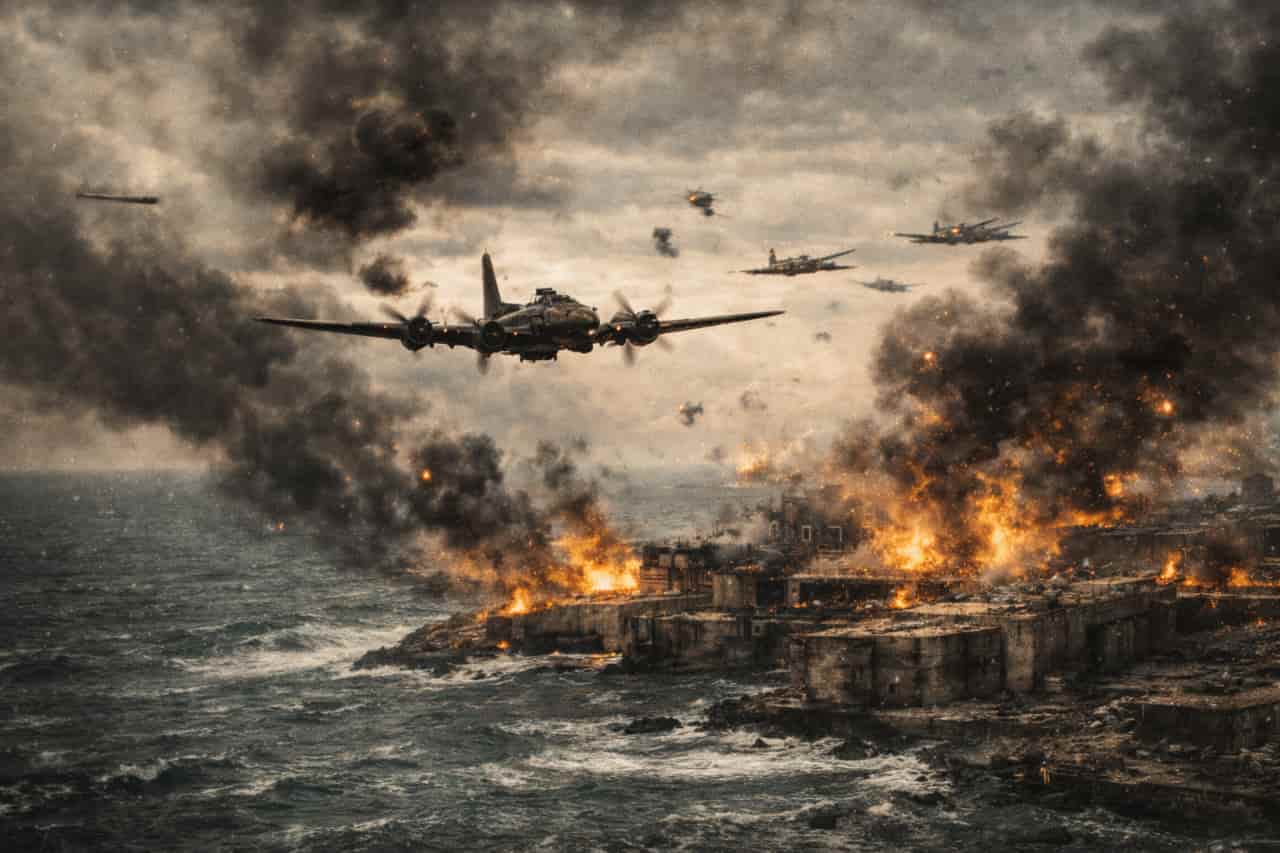
U.S. heavy bombers struck the port installations at Dunkirk in mid-afternoon—an attack aimed at the machinery of occupation and the shipping that sustains it.
The official summary tells of 23 Liberators dropping 62 tons of bombs and meeting fighter opposition over the Channel route.
Kharkov — Tuesday, Feb. 16
Kharkov has changed hands again.
This is a city whose name has become a kind of shorthand for the Eastern Front’s brutality—brick and tramlines ground into powder, factories turned to skeletons, civilians moving like shadows between cellars.
Yesterday the Germans held it; today Soviet troops have taken it back. The German withdrawal was not the tidy, deliberate kind they once managed with cold confidence. It had the look of a man stepping backward too quickly on ice—trying to keep his balance while the pursuer closes.
But even in victory there is a caution in the Soviet officers’ faces. They speak, when they speak at all, of distance—of lines that have outrun their supply, of units pushed forward on momentum and courage, with the fuel and shells panting behind. A correspondent need not be a general to see the danger: in this wide country, speed can become a trap.
Bay of Biscay — Tuesday midday
The same Tuesday brought another hammer blow from the air in occupied France. U.S. Eighth Air Force heavies went for the submarine base at St. Nazaire—those thick concrete shelters that are the wombs of the U-boat war.
The raid, timed in tight minutes, sent Fortresses and Liberators over the target and dropped 160 tons of bombs, the record noting brisk fighter attacks and losses to the bombers. Whatever the immediate damage, the intention is plain: to make the enemy’s Atlantic lairs costly to use, and dangerous even to enter.
Front-line roads — Wednesday, Feb. 17
There is a particular sound to a moving front: the constant coughing of engines, the creak of sledges, the slap of boots in thawing muck, the thin clatter of small arms somewhere ahead like a typewriter in the next room. The men are tired, but it is a traveling tiredness—the kind that comes with hope and orders and the belief that the next village might be the one where the enemy breaks.
Yet rumors run faster than trucks. German armor, it is said, is gathering like storm clouds beyond the Donets; SS formations are mentioned in low voices; and there is talk—always talk—of a counterstroke. Operation Star’s early successes are real, but so is the old German habit of striking hardest when it seems most hurt.
Berlin — Thursday, Feb. 18
Behind the front, the Reich has been putting on a show of its own.
In Berlin’s Sportpalast, Propaganda Minister Joseph Goebbels addressed a carefully chosen crowd, calling for “total war”—a demand for stricter sacrifice and fuller mobilization as the war turns against Germany. It was stagecraft with a sharp edge: banners, choreographed enthusiasm, and the unmistakable message that the regime intends to squeeze harder—on labor, on dissent, on anything that still breathes outside its grip.
Munich — Thursday, Feb. 18 (quiet news in a loud world)
Also in Germany, though without banners or brass, the Gestapo arrested the young leaders of the White Rose resistance after leaflets were scattered in the University of Munich. In a Europe of mass armies, it is easy to miss such small acts—but the totalitarian state does not miss them. It fears them precisely because they are small and contagious: a sentence read in a corridor, a thought carried home, the first crack in the wall.
Kharkov approaches — Friday, Feb. 19
The counterblow has begun.
German forces under Field Marshal von Manstein have launched their move against the overextended Soviet spearheads—an operation that, according to the record, opens the battle that will decide whether Kharkov can be held or must be fought for yet again.
The date matters: this is not weeks later, not after leisurely preparation, but now—within days of the Soviet entry—showing how swiftly a front can reverse when one side stretches too far and the other still has armored teeth.
In the forward positions, the change is felt before it is understood. The air has more of that distant, rolling thunder that is not weather. Wounded begin to come back along the road in twos and threes. Maps are unrolled more often. Men who were talking of going home after the war go back to talking of tomorrow morning.
Italy — Night of Feb. 14/15 counted into the week; aftershocks felt through Feb. 20
In Milan, far from the Russian snow but not far from the war’s reach, the city has been struck from the night sky. The account states that 142 RAF Lancasters dropped 110 tons of high explosive and 166 tons of incendiaries, damaging factories and rail installations and setting neighborhoods burning; the toll listed is 133 dead, hundreds wounded, and tens of thousands left homeless. This is the modern way of war visited on old streets: industry and homes tangled together in the firelight, and the smoke of the front drifting into the life of the city.
Sunday, Feb. 21 — The week’s end, no end in sight
By Sunday the shape of the week is clear: a Soviet surge that reclaimed ground and headlines, and then the first hard German shove back—an early sign that, even after Stalingrad, the enemy is not done fighting in the East.
If there is a single truth from the front lines this week, it is this: Europe in 1943 is a continent of hinges—cities and armies swinging on them, sometimes twice in the space of days. Kharkov’s streets, St. Nazaire’s concrete pens, Milan’s burning blocks, Berlin’s shouting hall, Munich’s leaflets—each is a different face of the same struggle, and each insists that the war is not merely being fought somewhere else. It is being fought everywhere men can march, planes can fly, and an idea can be printed and tossed into the open air.
This is a new feature on NetNewsLedger offering an insight to the past. The expression unless you learn history, you are doomed to relive it stands as a monument to humanity’s follies to not learn.