
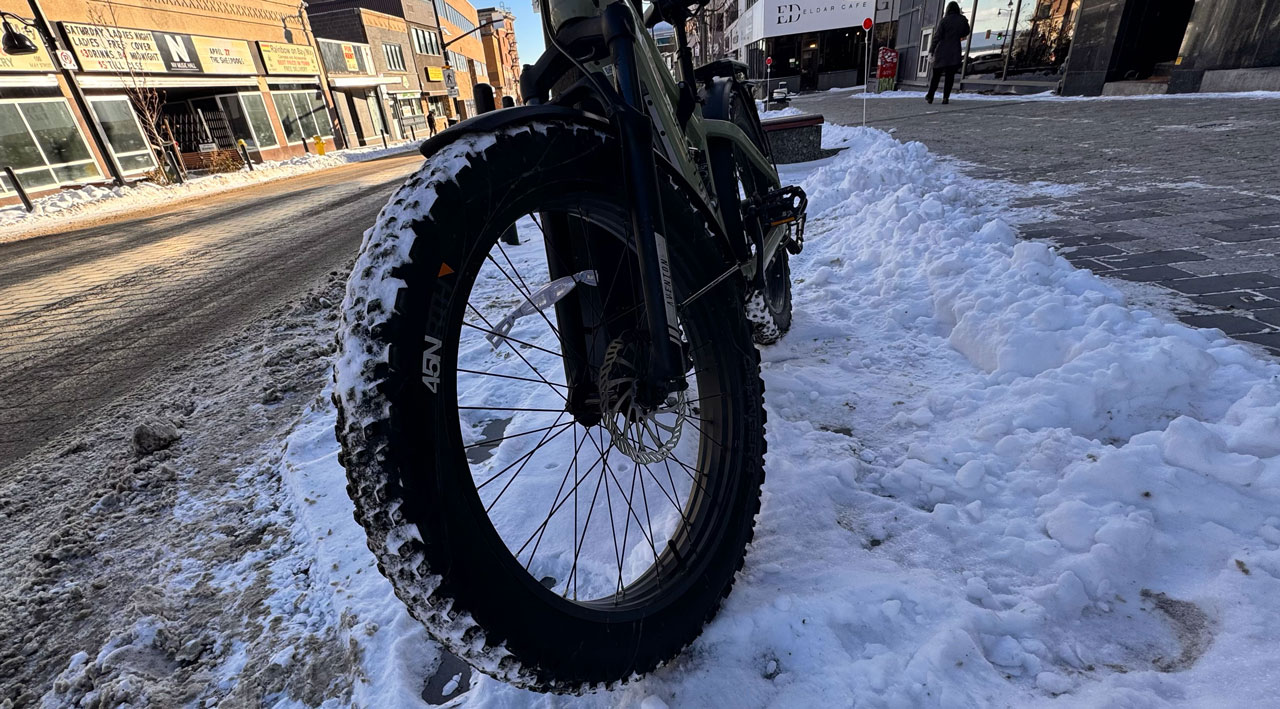
THUNDER BAY – LIVING – Canada is a winter country, and over the past decade, the idea that bikes must hibernate for five months has faded fast. More and more in our city we are seeing bikes on the roll right through the winter. That is similar in other much larger cities including Toronto, Winnipeg and Edmonton.
Across Canada, almost all major cities are building four-season cycling networks—yet the deciding factor isn’t paint or bollards.
It’s what happens after the first heavy snowfall: how quickly, how consistently, and to what standard bike routes are cleared.
For Thunder Bay and across Northwestern Ontario—where winter is long and storms can be intense—these big-city approaches offer a practical question: what policies and practices actually make winter cycling realistic for everyday commuters?
Why winter cycling is growing—and why maintenance matters most
Separated lanes and multi-use paths can be great in July and useless in January if snow is left to hard-pack into ruts, windrows block entrances, or freeze-thaw cycles turn routes into ice lanes.
Cities that take winter cycling seriously tend to do three things well:
-
Define priority routes (so crews know what gets cleared first)
-
Set clear triggers and timelines (so service is predictable)
-
Invest in the right equipment (because narrow lanes need narrow plows)
Here is how several major Canadian cities approach the problem.
Toronto: “2 cm and we roll” snow triggers, plus year-round Bike Share
Toronto’s winter cycling guidance sets a specific operational trigger: cycling infrastructure is cleared when about 2 cm of snow accumulates, and each “round” of plowing can take roughly eight hours, with multiple passes sometimes needed during longer storms.
The city’s growth in winter cycling is also tied to availability: Bike Share Toronto operates 365 days a year, and Toronto’s own reporting notes strong winter ridership growth during recent system expansion.
Takeaway: Toronto’s model is about consistency and predictability—clear triggers, repeated passes, and year-round access.
Montréal: plowed routes, protected lanes, and BIXI in winter
Montréal explicitly promotes winter cycling and notes that many bike lanes are cleared at the same time as streets, or soon after, with hundreds of kilometres of lanes and protected paths in its network.
On the bike-share front, Montréal has pushed further into four-season service: BIXI moved from a winter pilot to ongoing year-round availability, with defined winter operating dates and options for memberships/trips.
Takeaway: Montréal pairs infrastructure scale with winter operations, then reinforces it with year-round bike share.
Calgary: priority downtown cycle tracks and clear service timelines
Calgary is unusually direct about timelines. The city states that downtown cycle tracks are Priority 1 (cleared within 24 hours after snowfall ends), while marked on-street bike lanes are Priority 2 (within 48 hours) under its Winter Maintenance Policy.
Takeaway: Calgary leans into service-level clarity—riders know what should be cleared first and when.
Edmonton: protected bike lanes, multi-use trails, and pathway standards
Edmonton’s winter operations messaging includes protected bike lanes, multi-use trails, and sidewalks as part of its winter response planning.
For trails and walkways, Edmonton specifies a clearing approach that begins once about 2.5 cm accumulates, with a target of within 72 hours for many routes (with exceptions for priority corridors).
Takeaway: Edmonton highlights a network approach—roads plus active pathways—supported by published service levels.
Winnipeg: a mapped priority network for active transportation snow clearing
Winnipeg provides an active transportation priority map showing sidewalks and active transportation pathways with defined priorities (P1/P2/P3).
Takeaway: Winnipeg’s strength is transparency: if you know the route, you can see the intended priority.
Québec City: a defined winter bike network—and an ongoing budget debate
Québec City notes that winter cycling is growing and that roughly 136 km of cycling links are cleared or packed each winter, supported by an interactive map of maintained connections.
The politics of winter maintenance also show up more openly in Québec City than many places, with public debate around costs and priorities.
Takeaway: Québec City demonstrates that winter cycling networks can exist even in snow-heavy climates—but they require budget choices and clear priorities.
Vancouver: fewer snow days, but mapped priority routes that include bike lanes
Vancouver’s winter is milder, but when snow hits, the city maintains priority snow removal routes, and its open-data description explicitly includes routes used to salt/brine and clear snow from city streets and bike lanes.
Takeaway: Vancouver shows the value of pre-mapped operational routes—even if storms are less frequent.
What is the Thunder Bay Take?
Cycling is a climate tool, not just recreation
In Thunder Bay’s Net-Zero Strategy, the City frames climate action around cutting community-wide greenhouse gas emissions and reaching net-zero by 2050, following Council’s climate emergency declaration (January 2020).
Within that plan, cycling shows up as a practical way to reduce emissions because transportation was the largest source of emissions in Thunder Bay (2016 inventory)—meaning fewer car trips is one of the biggest levers available.
The Net-Zero Strategy’s big move: shift trips to walking, cycling, and transit
The Net-Zero Strategy sets an ambitious direction for local travel: 65% of trips within the city to be walking, cycling, or public transit by 2030, alongside efforts to reduce private vehicle trips over time.
To make that possible, it explicitly points to “enabling” investments that include:
-
Complete street standards (designing roads for all users)
-
Trail expansions and pedestrian-priority corridors
-
A Fort-to-Port cycling connection
-
Active transportation zones (car-lite / people-first areas)
-
Winter cleaning of active transport pathways
That last point matters in Thunder Bay: if winter routes aren’t kept usable, cycling can’t contribute meaningfully to year-round mode shift.
What Thunder Bay and Northwestern Ontario can take from the big-city playbook
Even without Toronto-scale budgets, the most transferable lessons for Northern communities are operational—not flashy:
-
Start with a “Winter Cycling Spine”: a small set of corridors linking major employment areas, schools, and transit nodes.
-
Publish a trigger and a timeline (example: “plow at X cm, cleared within Y hours”). People will only rely on the network if they can predict it.
-
Design for maintainability: protected lanes need openings that don’t become snow storage. Narrow lanes need equipment that fits.
-
Measure and report: cities that publish maps and standards make it easier to spot gaps—and justify improvements.
Winter cycling isn’t about convincing everyone to ride in February. It’s about ensuring that those who want to ride—because it’s cheaper, faster, healthier, or practical—can do so safely.
For major cities, it sure looks like the goals have been set and transparency is paramount.
It is a goal that the City of Thunder Bay should be seriously looking to follow. If the talk is all that happens, it won’t take long before people start making a lot of noise on this issue and others. During an election year, it is as good a time as any to make a difference.