When the World Arrived in Newsprint
THUNDER BAY – OPINION – There was a time when learning what was happening in the world meant reading it from the pages of the newspaper your hands.
Growing up, I was an avid newspaper reader—one of those kids who didn’t just skim headlines, but lived inside them. When we moved to Thunder Bay in the mid-1970’s, what stuck to me were words from my father’s boss. He stated, “Get the local paper to know what happening around town, but get the Financial Post and the Globe and Mail so you know what is happening in the world.
Those words stuck to me.
In my teen years, Sunday nights often meant the library at Lakehead University, sitting with stacks of newspapers from around the world.
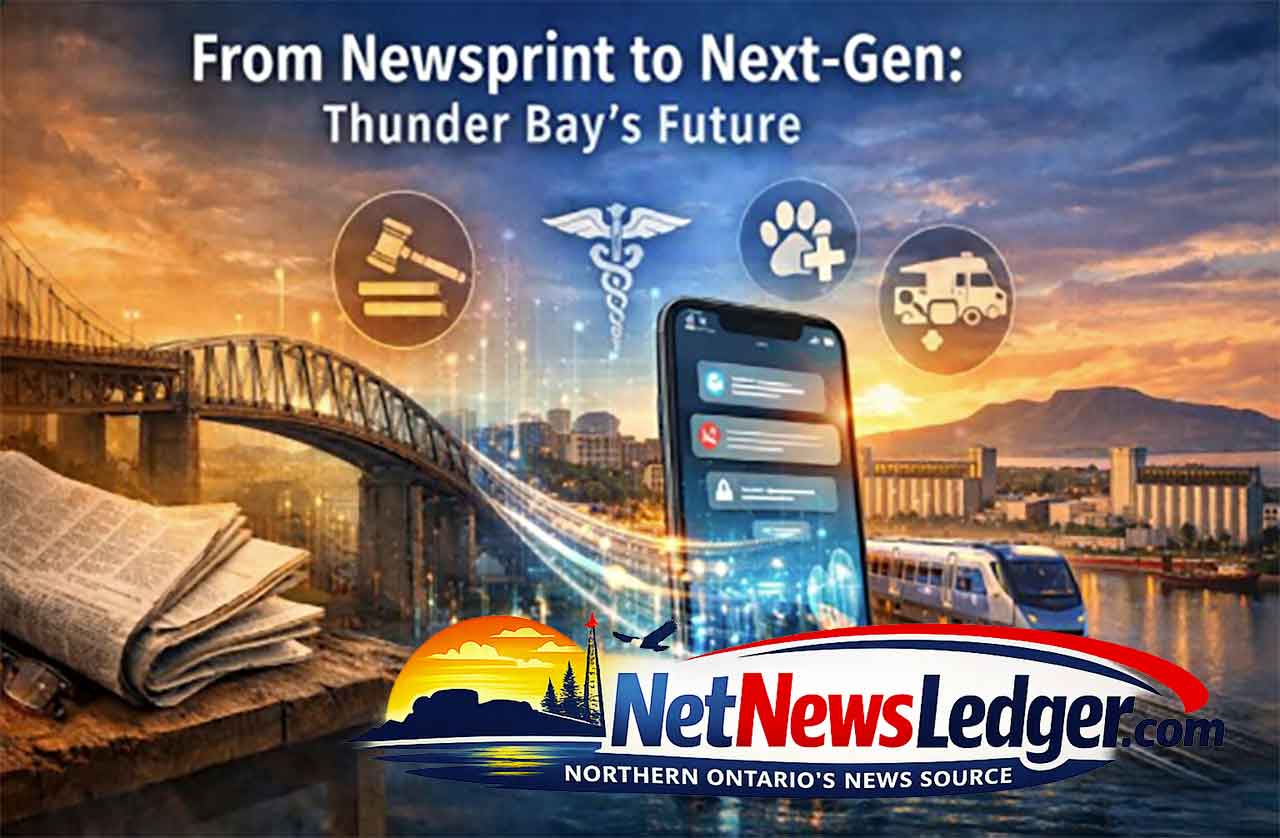
It was how I personally felt connected to everything—wars, elections, science breakthroughs, cultural shifts—delivered page by page, with the pace set by printing presses and delivery routes.
For me too, there was the ritual of heading down to Simpson Street to a now-closed magazine and newspaper shop, where one could pick up publications that made the world feel bigger. Subscriptions stacked up too—Photo Life, National Geographic, Time—and the habit became a mindset: stay curious, stay informed, stay awake to change.
And then, almost without noticing, it ended. Now it’s hard to remember the last time I held and read a physical newspaper. The news didn’t disappear. It accelerated. It first hit me when I returned to Thunder Bay in 2027, Hurricane Katrina was blasting the Gulf Coast States causing massive evacuations. It was almost a missing in action story here in the Lakehead.
That news report was the impetus for NetNewsLedger.
The Speed of the Internet—and the End of Newsprint
Today, between an iPhone, a MacBook Pro, and an Apple Watch, news arrives not daily, but constantly—notifications, live updates, and “breaking” banners that refresh by the minute.
We are living in an era where information moves at the speed of the Internet, and industries built around slower rhythms are being forced to adapt or collapse.
That’s why the announcement that Thunder Bay Pulp and Paper is ending newsprint production lands less like a surprise and more like confirmation of what the world has already been telling us. The company has pointed directly to declining demand as the key driver, with North American newsprint demand falling sharply in recent years. Unifor has urged supports and retraining for affected workers—because behind every “market shift” are families and paycheques.
This is not just about one mill. It’s about what happens to a city when the foundational industries of the 20th century shrink faster than we can replace them with 21st-century ones.
And it forces a bigger question: what does Thunder Bay choose to become next?
A City Built for Talent: Law, Medicine, and a New Veterinary Path
Here’s the part we don’t say loudly enough: Thunder Bay already has many of the building blocks of a “city of the future.”
A city with a law school isn’t just educating lawyers—it’s building capacity in governance, public policy, Indigenous law, business law, and advocacy. Lakehead University’s Bora Laskin Faculty of Law was designed to serve Northern Ontario and graduate practice-ready professionals.
A city with a medical school isn’t just training physicians—it’s building a health-sciences ecosystem that can anchor research, specialized services, and regional healthcare leadership. NOSM University’s Thunder Bay site is one of its main campuses, embedded in the community it serves.
And now, Thunder Bay is preparing for veterinary education growth through a collaborative Doctor of Veterinary Medicine pathway linked with the University of Guelph, with a Northern cohort slated to study in Thunder Bay as facilities come online.
Put those together and you get something powerful: a talent pipeline. People come here to learn, train, and build careers. That’s what future-oriented cities compete on—skilled people, research capacity, and institutions that attract investment.
The uncomfortable truth is that Thunder Bay has the ingredients. What it hasn’t consistently had is the alignment—and the civic confidence—to assemble them into a coherent economic strategy.
Our Competitive Advantages: Port, Connectivity, and a Northern Innovation Edge
Thunder Bay’s future doesn’t need to be imagined from scratch. It can be built from strengths that already exist—some of them obvious, some of them strangely overlooked.
Transportation and logistics should be one of Thunder Bay’s loudest claims. The Port of Thunder Bay sits at the head of the Great Lakes–St. Lawrence system, a multi-modal advantage that many Canadian cities simply do not have.
If Thunder Bay wants to be a northern gateway for trade, advanced manufacturing inputs, and supply-chain services, the physical geography is already on our side.
Connectivity is another underplayed asset. Tbaytel isn’t just another telecom—it’s locally rooted, and it has invested heavily in fibre and regional builds that strengthen the digital backbone needed for modern industry. In an economy where high-quality bandwidth is as essential as roads and rail, that matters.
So when we talk about emerging opportunity—technology, data, AI, remote services—Thunder Bay doesn’t have to apologize for being “remote.” With modern connectivity and a strong transportation base, we are positioned to be central: a northern hub for digital work, education, and specialized services that can reach far beyond city limits.
This is why simply hoping for the past to return is the wrong strategy. Mining announcements can be exciting, yes—but the deeper, more durable opportunity is building a diversified economy where Thunder Bay becomes a place that creates expertise, not just extracts resources.
What Holds Us Back: Racism, Trust, and a Justice System People Don’t Believe In
If Thunder Bay has the building blocks, what keeps the structure from rising?
Part of the answer is economic. Part of it is political short-termism.
But a major part is social—and it’s impossible to talk about Thunder Bay’s future honestly without facing it: racism and broken trust continue to hold this city back.
Multiple independent reviews have documented deep concerns around policing, oversight, and the relationship between institutions and Indigenous communities—problems that don’t just harm those directly targeted, but corrode trust across the entire city.
When people don’t believe systems will protect them fairly, everything becomes harder: attracting talent, building partnerships, encouraging investment, keeping young people here.
Sometimes some of the political leaders in Thunder Bay do not realize the reputation our city has in other parts of Canada. Constantly being the “Murder Capital“, having turmoil over racism, over policing issues – all impact our city.
Over the past decade we have had some of our political leaders complain that the national media is not reporting all the good in our city. The fact is in news, especially the national media, they are not interested in reporting what “We Want Reported” – Not when there are the serious issues that hammer our city.
Then there’s the justice system. Thunder Bay residents increasingly voice frustration when serious crimes and repeat offending appear to end in outcomes that feel disconnected from community safety. Even when the legal reasoning is complex, the public experience is often simple: a sense that consequences don’t match harm. That perception is corrosive. It breaks faith not only in courts, but in the entire social contract that makes cities function.
Locally we see some social media pundits who seem to believe generating hate will solve all the problems in our city. That is simply not true and those actions, and those who support that idea are simply making it worse, not better.
We see those tensions play out in public reporting and sentencing debates—including cases where courts have wrestled with how to interpret local context and vulnerability.
None of this is solved by angry slogans.
It is solved by sustained institutional work: accountability, transparency, culturally competent services, and leadership that treats trust as an economic asset—not a “social issue” to be deferred.
Because here’s the reality: no city becomes a “city of the future” while carrying a reputation that signals instability, inequity, or indifference.
A Future Strategy: Stop Chasing Yesterday, Start Building Tomorrow
If newsprint is fading because technology changed how the world consumes information, Thunder Bay must accept the same principle: the future won’t arrive by wishing.
It arrives by planning—and by choosing priorities that match reality.
1) Build a health and addictions centre of excellence.
Thunder Bay is disproportionately impacted by the toxic drug crisis, with local public health and city leaders acknowledging the scale of opioid harms. If we have the medical training capacity, we should also build treatment capacity—world-class addictions care, counselling, recovery supports, and research that makes Thunder Bay known for solutions, not just statistics.
2) Turn our institutions into an innovation engine.
Law, medicine, and veterinary education can anchor a broader ecosystem: health tech, rural and remote service models, AI-assisted diagnostics, Indigenous legal advocacy innovation, and northern workforce training. Lakehead University and Confederation College are economic engines building our future.
3) Grow logistics and multi-modal strength.
Lean into the Port, into rail and road connectivity, into becoming the place where northern supply chains are managed—not just passed through. That means getting really serious about building a totally divided Trans-Canada highway right across Ontario. While some areas are being “Twinned” that is not the real long term solution. Right now the Highway 11/17 the Trans Canada Highway in Northern Ontario is a National Disgrace. Politicians have paid lip service to this issue. Its time to make it a priority.
4) Make trust and inclusion non-negotiable.
A city that can’t protect people equitably can’t market itself as a serious destination for talent and investment. The work of repairing relationships—especially with Indigenous communities—has to be treated as core infrastructure, as essential as bridges and broadband. All too often there are press releases with big promises, that simply turn to promises broken.
5) Demand leaders who can see past today.
Thunder Bay needs decision-makers who measure success in decades, not news cycles—who understand that “remote” is a mindset, not a map coordinate.
Because with today’s technology, Thunder Bay isn’t on the edge of the world. It’s connected to it—instantly. The question is whether we’ll act like it.
James Murray