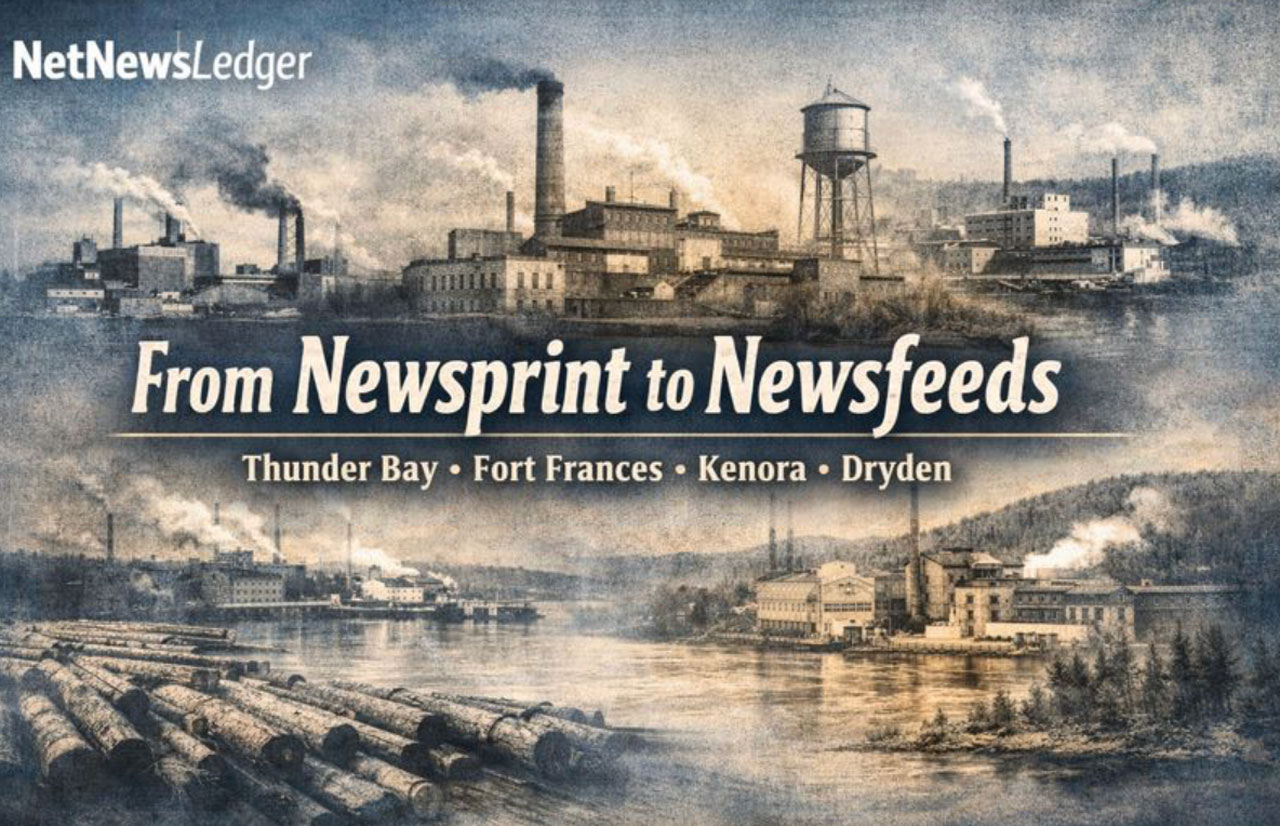
The paper that built the region also carried the region’s news
THUNDER BAY – ANALYSIS – For much of the 20th century, Northwestern Ontario didn’t just read the news on paper—it made the paper the news was printed on.
From Thunder Bay’s Lake Superior waterfront to the Rainy River at Fort Frances, to Kenora on Lake of the Woods, to Dryden on the Wabigoon system, pulp and paper helped anchor local economies, drew rail and hydro investment, and shaped everything from shift work to minor hockey sponsorships.
But the same force that rewired journalism—digital distribution—also rewired the market for newsprint, pushing mills to close, consolidate, or pivot into pulp grades feeding tissue, packaging, and other products.
That story has a new chapter this winter: Thunder Bay Pulp & Paper says it will cease newsprint operations in Q1 2026, citing steep demand declines, while continuing as a softwood kraft pulp operation.
Why paper mills landed here in the first place
Northwestern Ontario offered the three ingredients early papermakers chased:
-
Fibre supply: Boreal forest stands (notably spruce historically prized for newsprint) plus access to timber limits.
-
Water and power: Rivers for process water and—crucially—hydroelectric generation.
-
Transportation: Rail connections and ports to reach North American publishing hubs.
At the national level, newsprint wasn’t a niche product—it was a pillar export. A Rotman/University of Toronto business history case study notes that newsprint rose from about 5% of Canada’s exports in 1920 to 16% by 1939, becoming Canada’s most valuable export commodity for a long stretch thereafter.
That “golden age” left fingerprints all over Northwestern Ontario’s town maps.
Thunder Bay: a century-old landmark pivots again
Thunder Bay’s modern pulp-and-paper identity traces back to the early industrial buildout at Fort William/Port Arthur, with the Great Lakes Paper legacy dating to the 1920s and later corporate transformations that ultimately fed into today’s mill.
In August 2023, Atlas Holdings’ affiliate Thunder Bay Pulp and Paper completed its acquisition of the Thunder Bay mill operations from Resolute FP Canada, positioning the site as a multi-grade producer (pulp, paper, newsprint, directory).
Now, the market reality is forcing another reset. In a Jan. 22, 2026 release, TBPP said it will file notices to cease newsprint operations in Q1 2026, citing demand declines and rising inputs, with up to 150 directly impacted—while continuing as a single-line softwood kraft mill and generating renewable energy for the grid. The same release points to the speed of the collapse: it claims North American newsprint demand declined 40% since 2022, including 18% in 2025 alone.
For Thunder Bay, that’s the story in miniature: the mill remains an anchor—just not for the same paper grade that once fed newspapers across the continent.
Fort Frances: powered by the falls, defined by a century of paper
If any Northwestern Ontario town illustrates the “hydro + fibre + rail” formula, it’s Fort Frances.
Library and Archives Canada’s local history pages capture the civic stakes in the early 1910s: the “first sod” ceremony for the big mill is framed as a turning point, tied directly to ensuring power development benefitted the Canadian side and created a pulpwood market for settlers.
The Town of Fort Frances’ heritage tour puts the key dates in plain language:
-
Paper mill production began in 1914
-
A kraft mill was constructed in 1971
-
The mill was shut down in 2014, “a week shy of its 100th birthday”
Resolute’s 2014 statement ties the closure to “end product markets,” configuration, and costs—classic pressures in a shrinking newsprint world.
And the end of paper-making became visible infrastructure work: a 2021 industry report describes demolition requiring an overnight closure of the Fort Frances–International Falls crossing, noting the mill’s closure in 2014 and subsequent asset sale.
Kenora: Backus & Brooks, Mando, and the long afterlife of a mill site
Kenora’s paper story is inseparable from early 20th-century industrialists and the region’s power/transport buildout.
A local museum timeline notes construction of the Kenora pulp-and-paper mill began in 1920, owned by Backus and Brooks, with paper production beginning in 1924.
By the 1940s, corporate reorganization linked Kenora and Fort Frances more tightly. A Fort Frances Times archival piece describes the formation of the Ontario-Minnesota Pulp and Paper Company Limited in 1941, amalgamating multiple related entities and operating Kenora and Fort Frances as divisions.
Fast forward to the newsprint era’s unwind: a City of Kenora legal agreement states Abitibi “permanently closed” the Kenora pulp-and-paper mill on Oct. 23, 2005—a stark, official timestamp on the end of an industrial epoch.
Contemporary reporting captured the immediate hit: the Fort Frances Times reported in July 2005 that Abitibi would shut down both machines, with one slated for permanent closure and another “idled for an indefinite period,” and described the move as a major blow to Northwestern Ontario forestry employment.
Kenora’s paper-making legacy now lives on through redevelopment debates, environmental responsibilities, and waterfront planning—the “mill town” identity persisting even after the machines stopped.
Dryden: kraft pulp, a hard pivot, and a complicated legacy
Dryden’s paper history is older than many people realize—and it highlights how “paper” isn’t one market.
A Forestry Chronicle abstract hosted on ResearchGate notes the Dryden mill began production in 1913, becoming the first kraft pulp mill in Ontario and the fourth in Canada. It also documents a key structural change: after decades of operation, “the 90-year history of paper production at the Dryden site came to an end,” with the early-2000s decline in fine paper “driven by electronic substitution,” forcing adaptation.
That adaptation has continued. A 2023 industry report states First Quality closed its acquisition of Domtar’s Dryden pulp mill and that it now operates as Dryden Fibre Canada, ULC, producing Northern Bleached Softwood Kraft (NBSK) pulp for North American customers.
Dryden’s story also carries an environmental and justice dimension tied to mercury contamination in the English-Wabigoon system that affected downstream communities, including Grassy Narrows—an issue widely documented in Canadian historical and legal discourse.
Any “history of papermaking” in the region is incomplete without acknowledging how industrial benefits and harms were distributed—and why remediation, transparency, and Indigenous partnership matter in today’s forestry economy.
The newsprint market didn’t just shrink—news moved off paper
To understand why Northwestern Ontario mills closed or pivoted, you have to look at how audiences stopped relying on physical newspapers.
Thirty years ago: the mid-1990s “mass print” era
In the 1990s, the daily newspaper was still a default habit: delivery bundles, flyers, classifieds, and subscription bases that made newsprint demand relatively predictable. Local papers were community bulletin boards and ad engines.
Twenty years ago: the mid-2000s disruption starts to bite
By the mid-2000s, broadband and search rewired discovery. Newspapers launched websites, but digital advertising rates didn’t match print, and readers began sampling news free. That’s also when consolidation accelerated in both publishing and pulp-and-paper, as mills tried to ride out falling demand and higher energy costs (a theme echoed in Kenora-era reporting).
The past decade: smartphones, platforms, and “news everywhere”
In the 2010s and 2020s, phones became front pages. A Pew analysis found 86% of U.S. adults get news from digital devices at least sometimes, and when asked what platform they prefer, only 7% chose print.
Pew’s social media fact sheet shows that large shares of Americans regularly get news on platforms such as Facebook and YouTube, and it tracks year-to-year shifts in “often” and “sometimes” getting news from social media.
Meanwhile, the physical circulation base eroded. The U.S. Census Bureau summarized a steep drop in estimated weekday circulation of U.S. daily newspapers—from 55.8 million (2000) to 24.2 million (2020)—capturing the scale of the audience migration.
When news consumption changes that dramatically, mills built to supply “yesterday’s platform” either reinvent themselves—or become redevelopment sites.
What comes next for Northwestern Ontario’s fibre economy
Northwestern Ontario is still a forest region—but it’s increasingly a pulp, energy, and bioproducts region rather than a pure newsprint region.
-
Thunder Bay is explicitly positioning itself around softwood kraft pulp and power generation as newsprint exits.
-
Dryden is aligned with NBSK pulp markets that feed tissue and hygiene products—demand profiles that look very different from newspapers.
-
Fort Frances and Kenora illustrate the hard truth: when mills close, communities inherit not only job losses but also decades of infrastructure and land-use decisions that take years to unwind.
For NetNewsLedger readers, the takeaway is local and immediate: the same forces that changed how we read the newschanged what Northwestern Ontario makes. The fibre is still here. The skill is still here. The markets—and the platforms—moved.
Timeline: four towns, four turning points
Thunder Bay
-
1920s: mill era begins; newsprint becomes a defining product
-
2023: Atlas/Thunder Bay Pulp & Paper acquisition
-
2026: planned end of newsprint operations (Q1)
Fort Frances
-
1912: “first sod” era of mill-building politics and power allocation
-
1914: production begins
-
1971: kraft mill built
-
2014: permanent closure
Kenora
-
1920–1924: construction to production
-
1941: major corporate reorganization links Kenora/Fort Frances operations
-
2005: permanent closure date in municipal agreement
Dryden
-
1913: kraft pulp production begins; first in Ontario
-
2000s: electronic substitution drives fine paper decline; paper production ends
-
2023: becomes Dryden Fibre Canada under First Quality