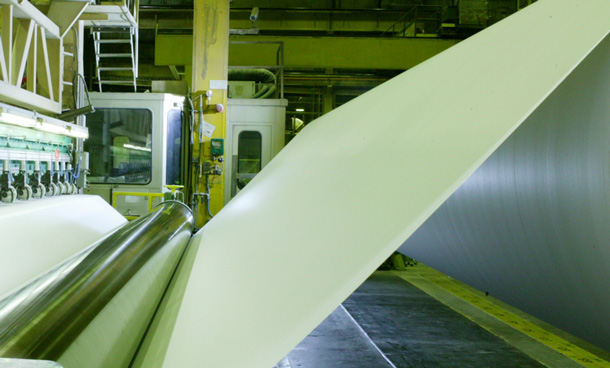
A century-old product meets a digital-era reality
THUNDER BAY – NEWS – Thunder Bay Pulp and Paper says it will file the required notices with Ontario’s Ministry of Labour and wind down its newsprint operations in the first quarter of 2026, citing what it calls an unusually steep drop in market demand and rising input costs.
Up to 150 workers are expected to be directly affected, with the company saying it is working with unions and governments on transition supports, retraining options, and other resources.
The announcement marks the latest chapter in a story that has been building for years: newsprint has shifted from a core North American paper grade into a shrinking niche, sustained increasingly by exports and specialty end-uses rather than by local daily newspapers.
Thunder Bay’s mill — acquired in 2023 by Atlas Holdings’ affiliate, Thunder Bay Pulp and Paper — has been positioned as a multi-product operation spanning pulp and paper grades.
The newsprint market, 2016–2026: ten years of contraction and “right-sizing”
Over the past decade, newsprint’s decline hasn’t been a single event — it’s been a steady erosion driven by audience migration to digital platforms, collapsing print ad volumes, and newspapers reducing print frequency.
Canada’s newspaper business indicators underline the direction of travel. Statistics Canada reports that from 2022 to 2024, print circulation sales for daily newspapers fell 11%, while digital circulation sales rose 4%—growth that hasn’t been enough to offset the print slide.
The result for mills: even when operators can improve efficiency, they can’t manufacture demand. In the background, capacity has continued to exit the system. A widely cited industry closure tally shows at least 59 North American millsrepresenting 11.6 million tons of annual capacity shut permanently between 2014 and 2022, with closures peaking during the first year of the pandemic.
While that list spans many grades, it includes multiple newsprint-related exits, illustrating how consistently “mechanical” paper capacity has been squeezed.
Demand and pricing: why “lower volume” becomes a structural problem
A core challenge for newsprint is that many costs don’t shrink neatly with demand. Paper machines and mill systems are capital-heavy; when orders drop, mills can lose economies of scale quickly.
Industry data published by Fastmarkets’ PPI Pulp & Paper Week shows North American newsprint demand continued falling in 2025, with Q1 2025 total consumption down 6.6% year-over-year to 231,000 tonnes. The same report notes overseas exports accounted for just over half of total shipments in a recent quarter—an illustration of how mills have leaned on offshore markets as local print demand fades.
Prices have also been volatile, but not in a way that rescues the business case. In early 2024, Fastmarkets reported U.S. benchmark newsprint prices down to roughly $795/tonne (US East) and $805/tonne (US West), describing a market that saw a pandemic-era run-up in 2022 followed by declines in 2023 amid oversupply.
In plain terms: when demand is shrinking, price spikes tend to be temporary, and competition for fewer tonnes often pulls prices back down.
Cost pressures: fibre, energy, freight—and the mill math gets tougher
Thunder Bay Pulp and Paper points to “significant increases” in input costs alongside demand decline. That aligns with broader sector dynamics: pulp and paper manufacturing is energy-intensive, heavily reliant on stable logistics, and exposed to swings in wood fibre and chemical costs.
Canadian energy data shows how much the sector has been forced to adapt. The Canada Energy Regulator reports that, over two decades, the industry’s energy use fell sharply as production dropped, and notes that a large share of electricity used in pulp and paper can be generated on-site by burning manufacturing by-products.
For Northwestern Ontario mills, that reality cuts both ways: cogeneration can be a strength — but when paper volume falls, the cost per tonne to run big systems can rise.
What Thunder Bay Pulp and Paper says happens next
The company says it will continue operating as a single-line Softwood Kraft mill and keep generating renewable energy for sale to the grid, while pursuing plans for future investment in its kraft pulp operations. It also says the paper machine will be safely shuttered in a condition that could allow a future conversion.
In its statement, the company describes itself as remaining the region’s “anchor mill,” and estimates the broader forestry ecosystem tied to the operation supports thousands of jobs across sawmills, harvesting, hauling, and related suppliers.
For Thunder Bay and Northwestern Ontario, the immediate business question becomes: how much local economic activity is linked specifically to newsprint, and how much can be sustained (or even grown) through kraft pulp production, energy sales, and potential reinvestment?
Why conversions matter: the industry’s most common survival strategy
Across North America, many legacy paper assets have tried to remain viable by moving away from declining grades and toward stronger ones—especially packaging and board, where e-commerce and consumer packaging demand have been structurally more resilient than print.
One visible example: Domtar has been linked to discussions around converting its Gatineau, Quebec operation from newsprint toward containerboard, reflecting the broader logic of repurposing “paper machines built for yesterday” into machines that feed today’s packaging supply chains.
Thunder Bay’s note about shuttering the machine “in a condition that could enable future conversion” is significant. Conversions are expensive and complex, but they can keep industrial sites viable when the underlying asset—power, water, rail, skilled labour, fibre access—still makes sense.
The local angle: what this means for businesses in Thunder Bay
For the region, this announcement lands in the overlap between industrial transition and community impact:
-
Workforce and households: up to 150 people directly affected means real pressure on families, mortgage payments, and local spending.
-
Contractors and service firms: mechanical maintenance, trucking, supplies, catering, safety services, and smaller vendors often feel secondary effects.
-
Indigenous partnerships and forestry planning: changes in product mix can shift fibre needs, harvest patterns, and procurement practices, affecting forest-based partners and communities.
-
Municipal and regional tax base: mills are not only employers; they are major industrial ratepayers and infrastructure anchors.
At the same time, the company’s commitment to maintain kraft operations and energy generation matters: it signals continued industrial activity, continued fibre flows, and a pathway—if investment follows—to stabilize the site in a new market reality.
Bottom line: newsprint is no longer a “cycle,” it’s a shrinking category
The defining feature of the newsprint market over the last ten years is that its decline has been structural, not cyclical. When newspapers reduce print days or stop printing entirely, that demand typically doesn’t come back.
That’s why the key business story in 2026 isn’t just one mill’s decision — it’s the broader reallocation of capital and fibre toward products with a future. Thunder Bay’s pivot to kraft pulp and energy, and its decision to preserve conversion options, fits the pattern of an industry adapting — one paper machine at a time.